Province looks to deposits on appeal, mandatory meetings and fewer reports to clear backlogs — legal experts outline how changes impact HR

British Columbia is looking to make legislative changes that will give the Employment Standards Branch (ESB) more tools to resolve straightforward complaints faster, increase early dispute resolution and make it easier to reunite workers with unpaid wages.
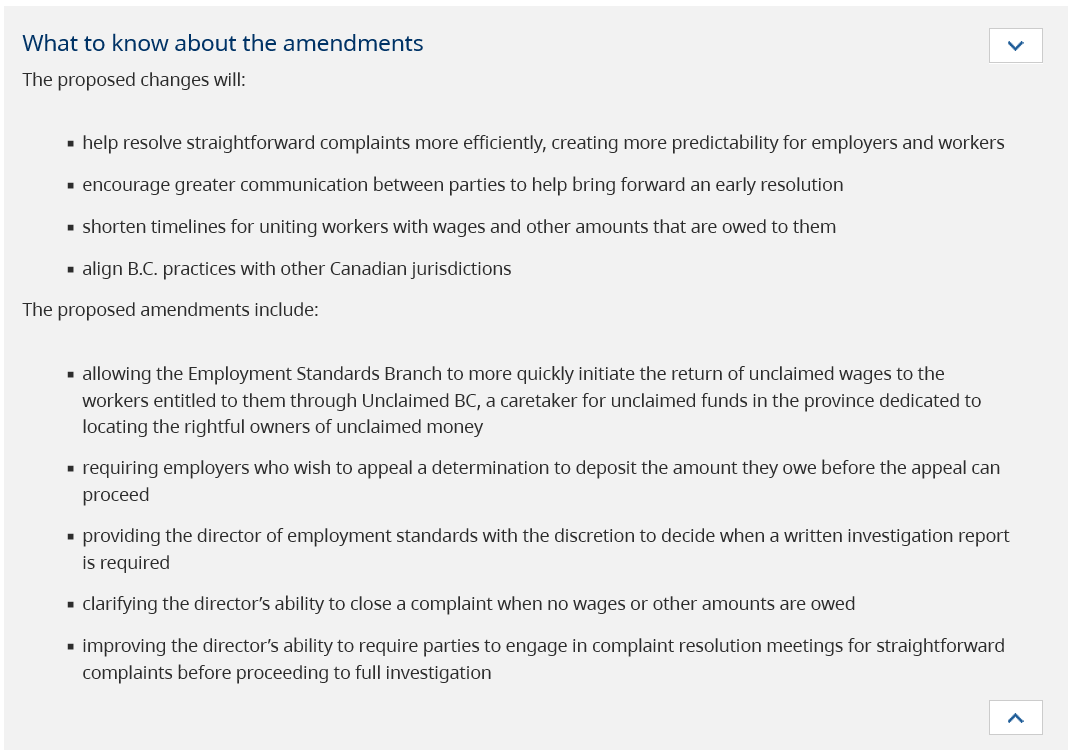
The proposed amendments to B.C.’s Employment Standards Act and Temporary Foreign Worker Protection Act include a new requirement that employers deposit amounts owing before appealing determinations, mandatory participation in early resolution meetings for certain matters, and clarity around director discretion to screen or close complaints.
The bill is an attempt to return to the efficiency that was originally expected from direct‑access administrative tribunals, according to Dana Hooker, partner at DLA Piper in Vancouver.
“We’ve really lost that efficiency. And there’s a whole host of reasons that has occurred. But I think this is an attempt to try to get back to that,” she says.
“The main goal here seems to be to give the director some discretion to move things along.”
‘Hopefully this will eliminate delays’
The overall aim is to tackle a process Hooker describes as “very protracted,” with “a significant delay before employers are notified.”
“For employees, justice delayed is justice denied,” she says. “For employers… there's this sword of Damocles hanging over your head while you're waiting to see if a complaint is actually going to come through. And then you have to wait and see what the determination will be. So, hopefully, this will eliminate some of those delays.”
Over the past couple of years, Hooker says she has seen complaints where the worker filed at least a year before the employer hears from the branch, followed by a further information‑gathering stage before a written investigation report is produced.
“It is, unfortunately, a lengthy process… I think the changes will hopefully create new efficiencies in the complaint process,” she says.
Deposit requirement on appeals
While the proposed changes in B.C. largely build on the existing framework — in making the process faster and adding more discretion for the director — the most significant change is the appeal deposit, says Sarah Hickey, associate at McCarthy Tetrault in Vancouver.
“Currently, there is no requirement to deposit the amount of the determination in order to file an appeal,” she says. “If there is a determination, it’s still able to be enforced by the director but the employer isn’t required to pay a deposit in order to file.”
Under the amendments, employers that want to appeal the determination will have to deposit the amount of money that they owe the director before the appeal can proceed, says Hickey.
The proposed legislation also says the Employment Standards Tribunal can allow a smaller amount “if it considers that to be adequate in the circumstances,” she says.
As a result, the employer would presumably need to pay the full amount or this lesser amount to the director, and the director would need to provide written confirmation of delivery, says Hickey.
“All this would need to be done within the appeal period set in the legislation, which is 30 days from the date the determination is served on the employer. So, that’s actually pretty quick.”
The same deposit rule will apply to complaints under the Temporary Foreign Worker Protection Act, she says.
If a determination orders an employer to pay unpaid wages or a penalty, says Hooker, that is going to have to be paid unless the Employment Standards Tribunal decides that a lesser amount should be paid or the determination should be suspended for some reason pending appeal.
“It just means an appeal is not effectively a stay to a determination or an order for payment. And employers have to be prepared for that,” she says.
The idea is to ensure that minimum employment standards in the province are enforced, says Hooker, “but I also think this could act as a bit of a bar to meritless appeals… It’s quite common to see appeals advanced as an attempt to relitigate, for example. And this may be a bit of a disincentive to do that.”
Mandatory early resolution meetings
Both lawyers also highlight the shift from optional to mandatory early resolution meetings in certain complaints as a positive — and hopefully less costly — change for employers.
Currently, these meetings at the ESB only occur if both the employer and employee agree to take part. If one party wants to attend and the other does not, “the early resolution meeting won’t happen and the complaint will automatically move to the investigation stage,” says Hickey, adding the Employment Standards Branch has reported that quite a few complaints do resolve at these meetings.
Under the proposed amendments, the director of employment standards could require the parties to come to an early resolution meeting, says Hickey.
“Sometimes the officer will give their very honest thoughts about the strengths or weaknesses of the case, and that can be helpful to help resolution.”
Earlier resolution of complaints
If parties refuse to participate when directed, the director could decide not to proceed with or investigate the complaint, says Hooker: “There’s now some hammers, as it were, to ensure that the parties actually come to the table… it goes toward having things resolved earlier as opposed to later where you don’t necessarily need a determination, you have the opportunity here to resolve it.”
Hooker says this new complaint‑resolution process should bring people to the table and be useful where complainants are unrepresented and need more perspective on their complaint.
“It can shave off those aspects of a complaint which either have no prospect of success or without merit or, frankly, are not within the jurisdiction of the director to decide,” she says.
For many complainants, the chance to be heard is an important feature in itself, says Hooker.
“People want to feel that their voice has been heard by somebody in a position of authority and so… we might be able to get to that [resolution] point faster than if we have to go through a fulsome investigation and submissions and determination.”
Confidential, without prejudice
A key difference from traditional mediation is how information can be used later. The new legislation gives the director the discretion to decide that everything the parties say during that process or procedure is on the record, says Hooker.
“That is a pretty significant difference to mediation, which is typically confidential and without prejudice,” she says.
“The point of that is to give parties the latitude to speak freely.
And so there may be some people may be more guarded in their participation in this process. It may become more of a mini hearing where people are more focused on the legal aspects of their complaint defence as opposed to creative solutions towards resolution.”
Written investigation reports
Another proposed change would give the director more flexibility on written investigation reports. Under the current Employment Standards Act, the director must write a report in order to make a determination, says Hickey, but the bill changes that wording to suggest reports “may” be required.
Hickey notes that reports “can be lengthy” and these changes should speed up complaint resolutions.
However, Hooker says this new discretion could also alter how employers approach complaints.
“Currently, when a written investigation report is issued, our practice is typically to use that opportunity to make our pitch, to make our submission to the director before a determination is made,” she says. If, however, no report is issued, employers will need to be prepared to have “their best foot forward” in terms of the evidence and any arguments they want to make right at the outset, she says.
“They won’t be able to use this receipt of a report necessarily as an opportunity to go, ‘OK, so where are our holes? What are the gaps we need to fill? What other evidence can we provide, and what arguments can we make?’”
Screening out complaints
The proposed amendments, Bill 10 or the Labour Statutes Amendment Act, 2026, also outline when complaints that should not be proceeding can be disposed of by the ESB at its discretion.
While Hickey says some of the reasons listed in section 76 aren’t necessarily new and are just worded differently, one clearer power is the ability to close a complaint if they’re satisfied it’s been resolved, such as when no amounts remain owing.
“My understanding is that the legislation was a little ambiguous before about whether the director could close a complaint if… all wages had been paid,” she says.
But greater clarity will help, according to Hooker, because currently an employer can receive a complaint where “a chunk of it may not even be relevant to the Employment Standards Act, but it’s up to the employer to put that forward and make that submission,” she says.
“Under the proposed legislation, we see now the director will have some discretion to make some of those calls before a complaint even gets to the door. So, we see some gatekeeping.”
For example, there are cases where an employee may not be working in British Columbia but still files a complaint, says Hooker. With greater mobility and remote work, those jurisdictional questions arise more often, she says.
The proposed legislation “gives the director the opportunity to decide if the act applies or not and if it doesn’t, the director may refuse to proceed with an investigation,” she says.
Another example is where a matter falls under a collective agreement, so the employee can proceed through the union’s grievance procedure.
Hooker also notes situations involving “multiple fora,” such as when an employee files a civil claim for wrongful dismissal, that effectively includes statutory notice, and at the same time files for statutory pay in lieu of notice under the Employment Standards Act.
“What that means is that the employer is, unfortunately, having to spend time and resources defending in the context of these multiple forums… so it can be a real drain of resources and it can be occasionally used as mischief to pressure employers,” she says.
“The proposed legislation says that if there’s a matter that is before a tribunal, arbitrator or court, if it’s already proceeding that way, the director has the discretion to not proceed.”
Source: B.C. government