
Half of lawyers surveyed say there’s been a measurable increase in NDA usage in Canada

Non-disclosure agreements are being routinely misused to silence people who experience gender-based violence in British Columbia workplaces, protecting perpetrators and employers while extending the harm to survivors, according to a new report.
Based on the Speak Out project, a multi-year community consultation initiative led by supervising lawyer Jennifer Khor and funded by Women and Gender Equality Canada, the report draws on an anonymous community survey of 339 respondents, 10 regional workshops attended by 160 people, four case studies, and a survey of 54 lawyers across Canada.
The project reached out to more than 500 organizations and individuals across B.C. between January 2025 and March 2026.
The primary recommendation of Gender-Based Violence in the Workplace and the (Mis)Use of Non-Disclosure Agreements is that the B.C. government enact legislation banning or significantly restricting the use of NDAs in situations involving gender-based violence, harassment and discrimination — a step that 34 other jurisdictions have already taken around the world.
From trade secret to silencing tool
NDAs originated as a mechanism for protecting business trade secrets during the technology boom of the 1970s and 1980s, according to the report. Originally, when used in employment settlements, they covered only the settlement amount — people who signed them were still free to share their story.
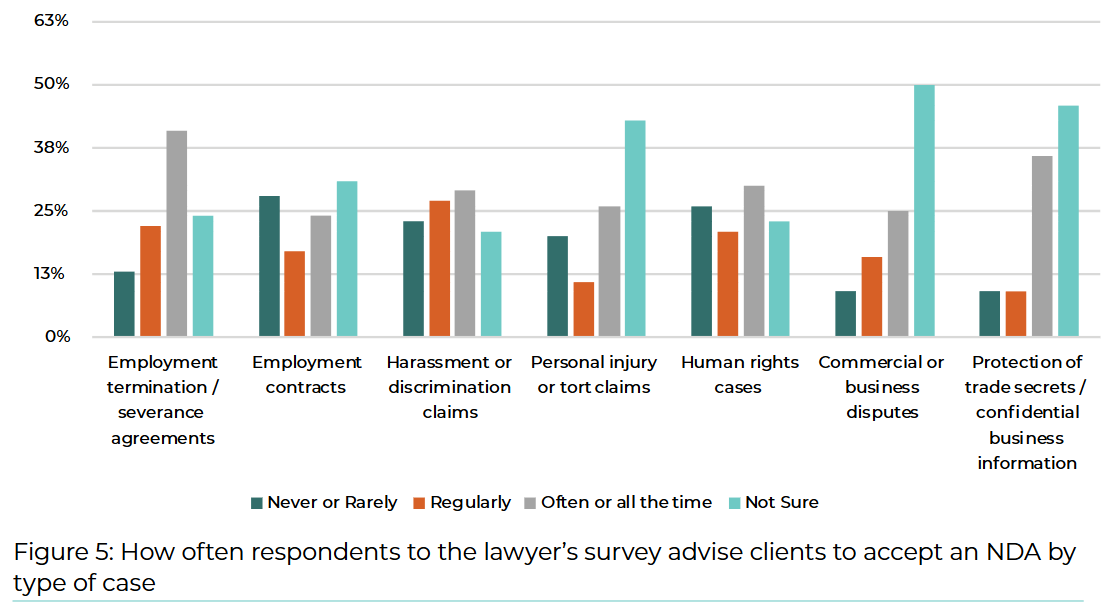
That has changed. NDAs preventing complainants from disclosing the underlying facts of their claim are now used in almost all employment-related disputes, according to the report. Of the 54 lawyers surveyed, half agreed there has been a measurable increase in NDA usage in Canada, and many employers now expect no settlement will be provided without one.
The report also notes that NDAs increasingly appear in employment contracts before any incident has occurred, binding workers to silence about events that have not yet happened.
Recently, Ontario’s Superior Court of Justice ordered that a former chief pension officer and head of HR at OPSEU Pension Trust be examined for discovery in a harassment‑linked wrongful dismissal lawsuit — despite his signing an NDA.
What NDAs do to survivors
The report documents consistent harms among those who signed NDAs in connection with workplace gender-based violence:
- depression, anxiety, and trauma from being unable to speak about what happened
- uncertainty about whether counselling or medical support was permitted
- inability to explain employment gaps to future employers
- fear of accidentally breaching the agreement.
Because most NDAs carry no time limit, the report states, "the perpetrator effectively exerts a level of control over the complainant forever, exacerbating feelings of powerlessness and helplessness."
The report also notes the power imbalance at the moment of signing. Complainants are typically in the midst of trauma, facing financial pressure, negotiating against an employer who controls the settlement funds.
Time limits are placed on offers to create urgency. Payback clauses, which require the return of settlement funds if the NDA is breached, serve as a further deterrent.
Esther Hwang and the Vancouver Symphony Orchestra
The report's most detailed case study is that of Esther Hwang, whose story became public in early 2026 after she chose to breach her NDA.
Esther is a musician who began performing with the Vancouver Symphony Orchestra as a soloist at age nine. As an adult on-call musician, she was sexually assaulted multiple times by a former teacher and mentor — a permanent VSO staff member more than 25 years her senior, says the report. She filed a complaint; the VSO denied the perpetrator held a position of power over her. A settlement was reached under which the perpetrator would be dismissed and some counselling costs covered. Her lawyer advised her that signing an NDA was a condition — without it, the offer and the dismissal would not proceed. She signed. The VSO subsequently stopped calling her to perform entirely, according to the report.
Years later, Esther heard rumours among former colleagues that she and the perpetrator had a consensual affair and that both had been fired. She asked the VSO to release her from her NDA. They refused. When she filed a police report, the VSO told her it constituted a breach of the NDA and threatened to end any retaliation investigation if she did not withdraw it, says the report. She eventually left music entirely before later returning — only after choosing to breach her NDA and speak publicly.
Her recommendation: "If someone does not want to sign an NDA, that should be ok. An institution or corporation should not use it as a tool to hide wrongdoing instead of addressing it."
The VSO said in January that it will largely abandon the use of non‑disclosure agreements (NDAs) in matters involving sexual misconduct, following public criticism over its handling of a former musician’s allegations.
What the lawyers say
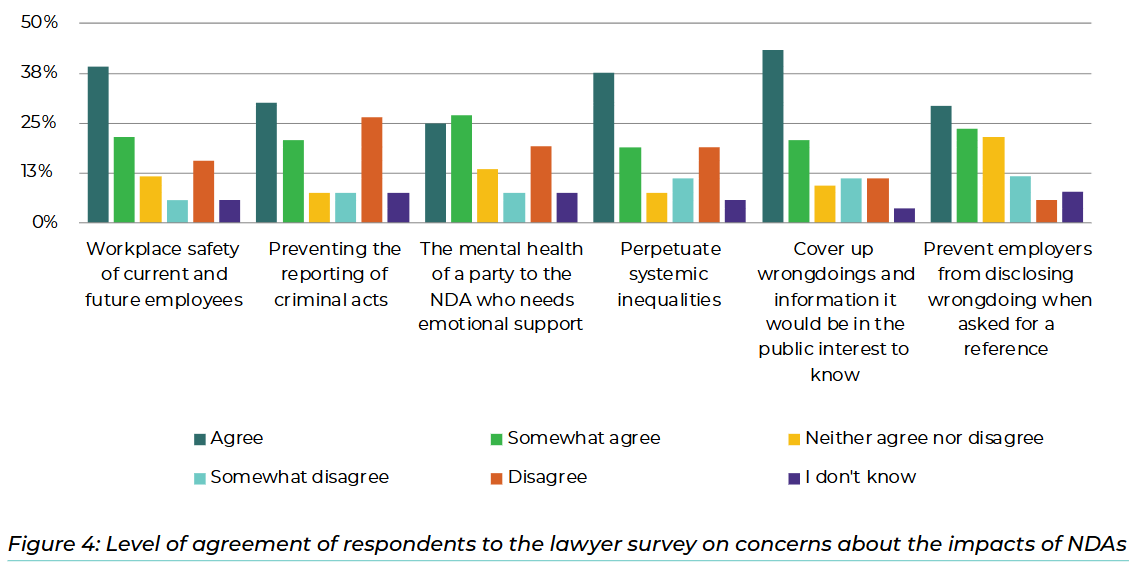
The lawyer survey findings are more divided but point in a consistent direction. Of 54 responding lawyers, 43% agreed that NDA use in GBV cases undermines the public interest in addressing gender-based violence. More than 70% agreed or somewhat agreed that misuse of NDAs could result in wrongdoings being covered up that are in the public's interest to know. Half reported having often or occasionally seen the documented negative impacts on their own clients.
Some lawyer respondents were cautious about an outright ban, noting that some survivors actively want confidentiality, and that NDAs can give complainants leverage they would not otherwise have against a well-resourced employer.
"I am concerned about the chilling effect on free speech and public accountability," wrote one respondent with more than 20 years of practice. "There is a need for clearer regulatory limits on the scope and enforceability of NDAs, especially in cases involving human rights and criminal conduct."
Notably, the report cites a 2025 study reviewing more than a quarter million case filings in Los Angeles County that found settlement rates were not negatively affected following restrictions on secret settlements — addressing a concern frequently raised against regulation.
Recommendations for NDAs
Thirty-four jurisdictions have enacted legislation restricting or banning NDAs in workplace sexual harassment, discrimination, and sexual assault cases, including the United Kingdom, Ireland, the Australian state of Victoria, 29 American states, and the United States at the federal level.
In Canada, only Prince Edward Island and Ontario — in the post-secondary context — have acted. The Uniform Law Conference of Canada's working group on NDAs is expected to bring forward draft legislation in August 2026. B.C. has nothing in place.
The report calls on the B.C. government to enact legislation ensuring NDAs:
- are invalid when signed under coercion
- cannot prevent reporting to police or regulators
- cannot block access to health and counselling services
- cannot include payback clauses or defamation threats designed to intimidate complainants.
More than 95% of community survey respondents who had experienced GBV supported these measures. At the workshops, 88% supported a complete prohibition on NDAs in GBV cases, and 100% agreed that an NDA signed under coercion should be invalid.
"Until this is done," the report concludes, "workplace GBV cannot be adequately addressed by workplace safety initiatives, current training efforts, legal remedies, or internal systems for addressing complaints."



