‘There is no grey area. Texting communications between school staff and students is no longer approved ’

Manitoba has ordered every publicly funded school and school division to stop employees from messaging students one-to-one on platforms the school cannot monitor.
The Manitoba directive, announced by Tracy Schmidt, minister of education and early childhood learning, is a ministerial directive rather than legislation.
It came after two educators recently lost their teaching certificates for sending inappropriate messages to students, and divisions must report back to the province on updated policies by the end of the year, The Canadian Press (CP) reported.
What does the Manitoba directive prohibit?
School employees may no longer contact students through personal social media accounts, private messaging apps, text messages or messaging features on social networking sites, according to the Manitoba government.
“We’re providing clarity for school administrators that there is no grey area. Texting communications between school staff and students is no longer approved in Manitoba,” Schmidt told CP.
Exceptions tied to a student’s safety, accessibility, well-being or learning needs require advance approval from administration, with parents included or informed. Existing family or personal relationships may also qualify.
“This will give a chance for kids not to have to manage this space as it relates to communication with their teachers,” Noni Classen, the commissioner, told CBC. Classen was previously director of education at C3P.
“This directive is a step forward in better safeguarding youth,” said Lianna McDonald, C3P’s executive director.
What school HR leaders need to do now
Schmidt told CBC News she acted after reviewing some of the commissioner’s cases and seeing a consistent pattern: inappropriate communication between staff and students that contributed to grooming.
Back in 2020, an Ontario teacher’s dismissal for not respecting student-teacher boundaries was upheld. And in 2016, a teacher lost his job after controversy with a former student.
Teacher misconduct data
Manitoba’s Commissioner of Teacher Professional Conduct does not break out communication-related complaints separately. It received 94 complaints and reports related to teacher misconduct between January 2025 and March 2026, 53 of them from employers, according to its 2025/26 annual report. Six matters were resolved through consent resolution agreements, and one of those involved a technology-facilitated boundary violation: contacting a student on social media. The office also saw turnover after Manitoba’s first teacher misconduct commissioner left following a remote work revelation.
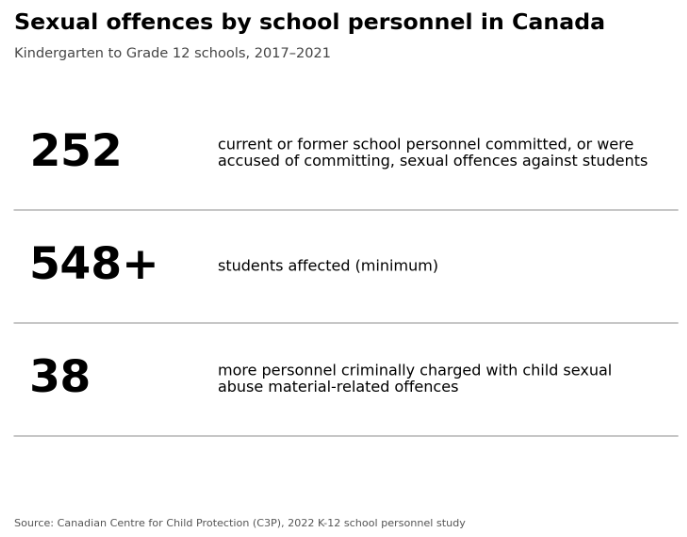
Nationally, the Canadian Centre for Child Protection (C3P) found that 252 current or former school personnel working in Canadian K-12 schools committed, or were accused of committing, offences of a sexual nature against at least 548 students from 2017 to 2021. Another 38 personnel were criminally charged with child sexual abuse material-related offences. C3P has called for all provinces to disclose educator misconduct, and Manitoba now publishes consent agreements and hearing decisions on its teacher registry