
But employers struggle without standardized processes, say experts
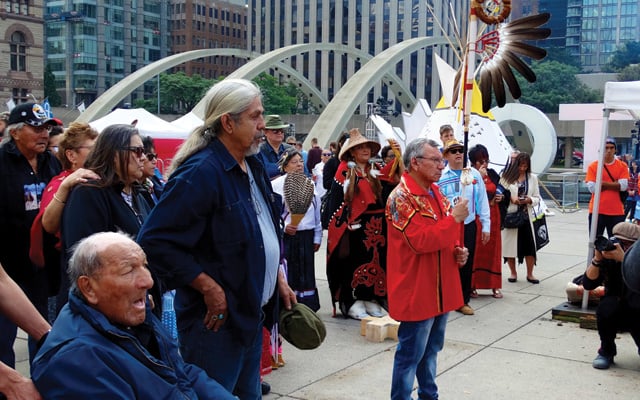
The path to reconciliation in Canada lies not in pomp and circumstance but rather in more minute, day-to-day interactions within the business community, according to a series of reports by the Canadian Chamber of Commerce.
And recognizing reconciliation as an opportunity rather than an obligation is mission-critical for success, says Susanna Cluff-Clyburne, senior director and Indigenous policy lead at the chamber in Ottawa.
“There needs to be a recognition of this as a tremendous opportunity,” she says. “We’ve got this homegrown, young, fast-growing workforce — potential workforce — in a country that has labour shortages.”
The chamber hosted three roundtable events to capture the perspectives of business, community and post-secondary educators on reconciliation. Sessions were held in Saskatoon, Sask., Thunder Bay, Ont. and Fredericton, and led to three separate reports.
Government action needed
Even as the federal government pushes a large-scale reconciliation process, it is businesses that are truly driving practical change, says Cluff-Clyburne, who has spent the last decade studying business-Indigenous relationships.
“Businesses that deal on a day-to-day basis with Indigenous communities are further ahead than government in recognizing the capacity that exists within Indigenous communities,” she says.
“Business-Indigenous relationships are much further ahead than those between Indigenous peoples and the Crown.”
At issue is a lack of practical direction coming from the federal government, says Jamie Saulnier, president of Working Warriors and Running Deer Resources in Winnipeg.
“Ottawa is pushing reconciliation to employers in Canada and saying that ‘This is part of our corporate social responsibility to do this,’” he says.
“But companies are on their own, trying to sort this out. A lot of companies struggle. Somebody has to take responsibility for this.”
At present, it is difficult to identify the group responsible for reconciliation efforts as the responsibility is continuously pushed down the chain of command, says Saulnier.
The lack of direction or mandate from the government is a main reason why the reconciliation journey isn’t farther along, he says.
The government needs to turn its future efforts to drumming up a standardized process where employers begin to engage with the First Nations, says Saulnier, who is also a member of the leadership council for Workforce Forward, an Indigenous-focused employment conference set to happen in Calgary this month.
Further focus should be given to working with Indigenous peoples to understand their available workforce and any potential barriers they are facing, such as lack of education or training opportunities, he says.
“It’s great that our country is pushing reconciliation,” says Saulnier.
“But it’s almost premature right now, because you’re not providing the tools to both employers and the nations to be able to do it.
“Because you’re not doing that, you’re getting a lot of frustration. Employers are frustrated because of various reasons and the nations are frustrated because their members aren’t getting jobs,” he says.
“It’s a very, very messy situation. And somebody has to take responsibility for this.”
If the government fails to create a standardized process, a large majority of employers will not engage in the reconciliation process unless they truly need to find employees, says Saulnier.
“The responsibility, I feel, has to fall to somebody to pave that path for us.”
A standardization of Indigenous engagement processes is also necessary to assist employers with this recruitment, says Saulnier.
“These are the conversations that I’m having from coast to coast with employers — everybody is struggling to find a workforce in Canada,” he says.
“So, now, they’re turning to the Indigenous population to see if there [are] people that can be utilized in their operations.“
The recruitment of Indigenous people in an urban setting is somewhat easy, but when you [are] trying to get out into communities, it’s a difficult and often costly process.”
Strong relationships needed
Last month, the Canadian Council for Aboriginal Business (CCAB) unveiled a Business Reconciliation in Canada Guidebook in partnership with the federal government to begin fostering respectful economic partnerships, according to JP Gladu, president and CEO of the CCAB in Toronto.
Business associations across the country understand that the importance of the Indigenous economy is “paramount,” as the growth and scale of this sector has been remarkable in recent years, he says.
The Truth and Reconciliation Commission emphasizes that the responsibility to improve relationships between non-Indigenous and Indigenous communities rests on all Canadians, says Gladu.
More specifically, call to action 92 states: “We call upon the corporate sector in Canada to adopt the United Nations Declaration on the Rights of Indigenous Peoples as a reconciliation framework and to apply its principles, norms and standards to corporate policy and core operational activities involving Indigenous peoples and their lands and resources.”
The success of the national economy will increasingly require strong relationships with Indigenous peoples, and business leaders need to take the time to understand the issues at hand, he says.
“If you don’t understand us, how are you going to work with us?” says Gladu.
“Racism is still alive and well in this country. A lot of Indigenous people don’t self-identify in the workforce, because they’re afraid of reprisal against them to advance their careers or being let go.”
“This is a fear of Indigenous people,” he says. “So, we’re still very much at the front end of trying to change up the way that we actually perceive and work with Indigenous businesses and employ Indigenous people.”
The CCAB also offers a Progressive Aboriginal Relations (PAR) certification program and has trained 250 companies on improved Indigenous relations, he says.
Varying degrees of success by sector
The success of economic reconciliation efforts varies sector by sector, according to Gladu.
“Generally speaking, if you blanket Canada as a whole, we’re at the very beginning,” he says.
“Canada’s just waking up to this idea that there’s an Indigenous population that has been mistreated for 150-plus years and [is] living in poverty… But there’s also many communities that are doing exceptionally well in developing their economy.”
Still, it is important that the country isn’t painted with one broad stroke, as many employers are successfully engaging with Indigenous communities and entrepreneurs, says Gladu.
Efforts by the federal Liberal government and late Tragically Hip frontman Gord Downie have pushed the conversation forward, as have three decades of effort from the natural resources sector, he says.
“They’ve stumbled along the way, but they are certainly more advanced in their understanding and practices than all other sectors, quite frankly.”
For full reconciliation, Indigenous people need to be given a corporate voice and achieve economic independence, says Gladu.
“There needs to be more Indigenous people represented at the corporate level.”



