HR leaders from Walmart, McCarthy Tétrault and Wajax discuss skills-based hiring, hybrid work, pay transparency and AI
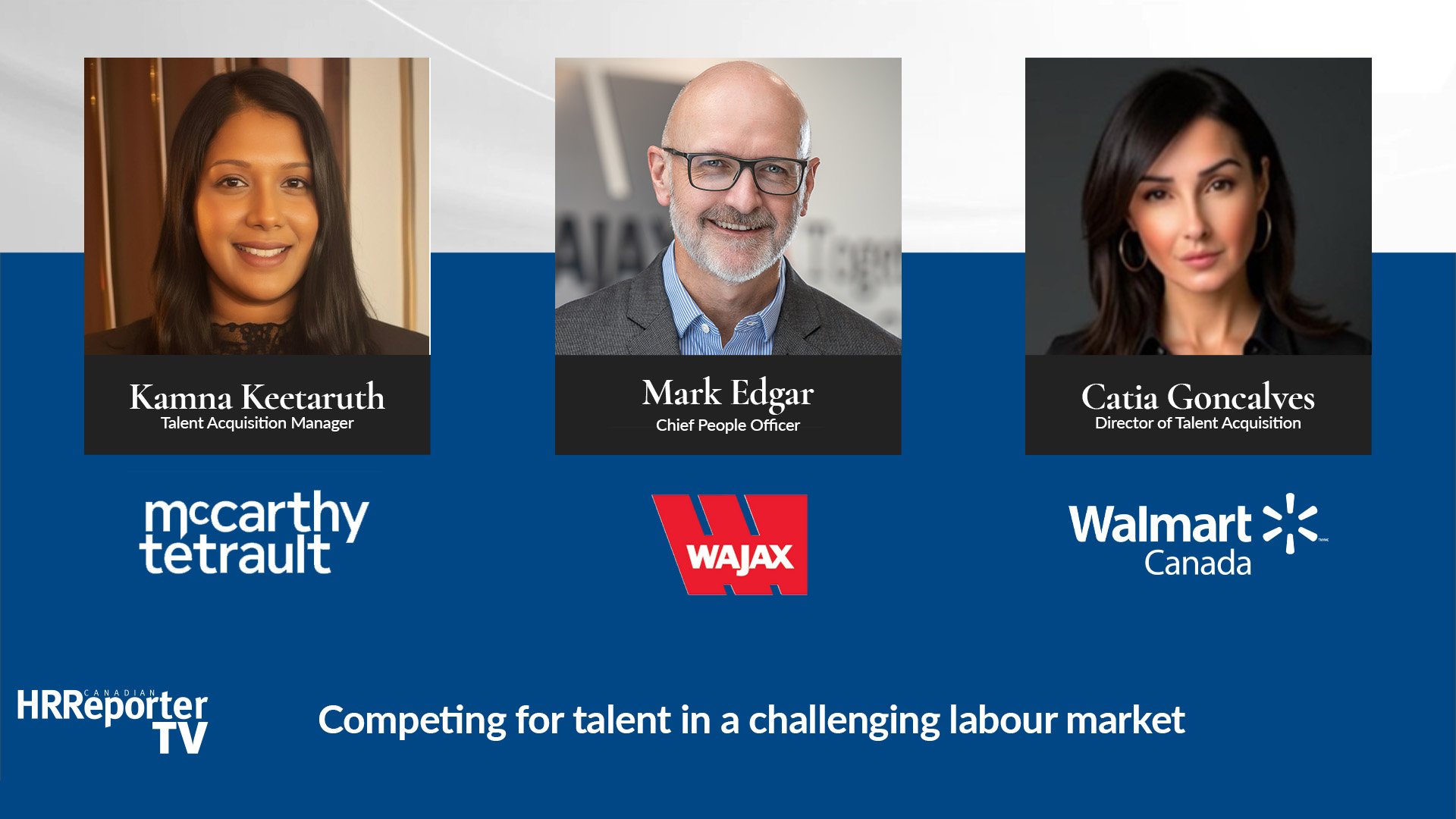
Three HR leaders from Walmart Canada, law firm McCarthy Tétrault and industrial products and services provider Wajax recently compared notes on how they are approaching recruitment in the face of talent shortages, skills gaps, evolving expectations around flexibility, rising pay transparency and the growing role of AI in hiring.
In a roundtable discussion with Canadian HR Reporter, they shared how their organizations are retooling hiring models to compete for scarce skills, balance flexibility with in‑person expectations, embrace pay transparency and define the right role for AI in hiring.
Walmart Canada, for one, has overhauled its recruitment model, according to Catia Goncalves. While the company continues to attract a high number of applications, the challenge over the past year has been quality, not quantity, in an increasingly competitive labour market, says the director of talent acquisition.
“This has been the catalyst for transformation at Walmart Canada, accelerating a shift from traditional, volume-driven hiring to a smarter, more resilient and quality-led recruitment strategy.”
The retailer has centralized hourly hiring, embedded in-line assessments and is leveraging data-driven talent intelligence “to move faster, reduce bias and improve quality of hire at scale — particularly across our stores and our supply chain,” she says.
At the same time, the company is doubling down on internal mobility and leader capability in hiring and amplifying the employer brand to “compete more effectively for scarce talent, reduce dependency on external agencies, and build a more sustainable, resilient workforce,” says Goncalves.
“We're taking the guessing work out of just reviewing all these résumés… we're able to rank individuals based on the behaviours and attributes that we're looking for in Walmart associates — but we always have the human in our process.”
Talent shortages push proactive hiring
For Wajax and McCarthy, shortages in specific skill sets are forcing deeper structural changes in recruitment, say the two HR leaders.
Wajax, which has about 3,000 employees across more than 100 sites coast to coast, is seeing acute gaps in certain technical roles, according to chief people officer Mark Edgar.
“Finding heavy-duty engineers and technicians who can repair equipment on behalf of our customers, we see some shortages in terms of people coming into that market… making it quite competitive.”
At McCarthy Tétrault, shortages are particularly pronounced in Quebec for bilingual roles and legal assistants, according to Kamna Keetaruth, manager of talent acquisition. As a result, the law firm has shifted from a reactive to proactive strategy, with layered conversations between talent acquisition, HRBPs, hiring managers and leadership to forecast needs over three, six and 12 months.
“We can't just wait for a requisition to open,” she says. “Sometimes, it's not just one requisition — we could be hiring for five open positions in the same role at the same time.”
In response, in-house recruiters are expected to “know your talent pool, know the market,” carry out advanced market research and engage with candidates early, says Keetaruth, so “we know they are ready to go once we have the go-ahead to recruit for the role.”
Skills, not titles in recruitment
Across the roundtable, the three HR leaders pointed to technology and leadership as critical capability gaps — and to skills-based decisions as the way forward.
“The biggest skills gap that we're seeing is in technology, it's actually leadership keeping pace with it,” says Goncalves. “AI is moving fast, but organizations stall when leaders don't know how to apply it, trust it or lead through it and really take the team through that change.”
Walmart is hoping to close the gap by embedding AI into how work gets done, she says, “not as a side skill, but as a core leadership capability… Our belief is simple: AI creates speed, but leadership creates impact. And you need both to really win as an organization.”
In addition, the retailer is “moving aggressively to skills-based decisions because titles and tenure don't predict future success anymore,” says Goncalves. “
Edgar agrees on the importance of thinking about the skills beyond specific roles: “I think that allows us to be much more agile and flexible in dealing with the dynamic world of work that we live in.”
Wajax is also weighing “build versus buy” alongside “build, borrow and bot” strategies — combining external hiring and upskilling in areas like change management and automation, while staying mindful of budget constraints and risk, says Edgar.
“We know it can be very costly and there's a whole level of risk associated with bringing new people into the business,” he says. “[So] where can we build some of the existing skills with our people that we have already? We try and take a holistic approach, but at the same time be quite pragmatic.”
At McCarthy Tétrault, new headcounts increasingly require advanced AI and technical skills, so the key is being able to assess those candidates' skills, says Keetaruth. The firm is responding by reframing requirements around “must-haves and nice-to-haves,” focusing on what people need in the first 30 days at the firm, and then identifying resources and tools to train new hires, she says.
Internal mobility is another pillar: “We are really investing in our internal employees — like, how can we better assess, [and] help them to actually move to the next step in their career?” says Keetaruth. “Hiring someone internally definitely — it's a different type of investment as well, instead of going to agencies… or finding external talent.”
Flexibility and location: three different models
When it comes to recruitment, where people work has become an important factor for many candidates. The three roundtable organizations have adopted distinct models — from highly flexible arrangements to strict in-office expectations.
Wajax is using flexibility as a competitive differentiator, according to Edgar.
“We've chosen to maintain a high level of flexibility with our folks who aren't having to be in a particular location at any particular time, to the extent where we'll currently using that as one of our competitive advantages because we have obviously seen the shift with many other organisations moving to a more office-based environment.”
With a “loose expectation” that people come in two days a week for his own team, he says they are focusing on planning, accountability and performance to sustain productivity while offering choice.
“For me, the key thing here is around flexibility: people feeling as though they've got the flexibility and choice about not only where they work, but how they work and, to an extent, when they work as well.”
However, with about one-third of employees in the branches every day, “it does create a bit of a sense of ‘haves’ and ‘have-nots’ in terms of flexibility, which we are very conscious of,” Edgar says.
McCarthy Tétrault operates on a hybrid model, with “strict” in-office expectations and work-from-home requests handled largely on a case-by-case basis, according to Keetaruth.
Exceptions may be considered for niche, hard-to-fill roles or “rock star” candidates, with leadership involvement, but “it's a tight process,” she says. “We keep it very much within our control, but we are also flexible in understanding why an employee wouldn't be able to meet the requirements.”
At Walmart, the operating model for support functions is five days in office, set over a year ago, says Goncalves.
“In-person presence is really critical in how we lead, collaborate, develop talent and deliver results.”
However, individual flexibility is handled “with empathy and common sense,” she says. “It is five days in office — but flexibility is not about changing the model, it's how we respond within it.”
Company leaders are “empowered” to make short-term accommodations when circumstances require it, “grounding it in trust, performance and role requirements,” says Goncalves.
Pay transparency moves upfront
Legislative changes in provinces such as Ontario, along with market pressures, around pay transparency are also changing how employers talk about compensation — and when.
At Walmart, the company standardized pay transparency across job postings nationwide without waiting for provincial laws, says Goncalves.
“We clearly post the minimum pay ranges as required and have removed subjective language like ‘Pay based on experience’ to reduce ambiguity, bias, negotiation and equity upfront,” she says.
The conversation has shifted to total rewards, highlighting base salary, incentive eligibility, benefits and retirement programs, along with defined career paths and access to education and skills-building programs, says Goncalves.
“Transparency has really changed how we negotiate,” she says. “We focus on the ‘why’ behind the offer — how pay is set, how equity is maintained, and how growth, learning, and rewards come together — rather than making ad hoc exceptions that undermine trust and consistency with candidates.”
The push for transparency has led to faster accept rates, Goncalves says, along with stronger candidate trust “and offers that stand up to scrutiny while reinforcing Walmart as a place to build a career, not just accept a role.”
Transparency about total rewards
At McCarthy Tétrault, pay transparency has been pushed to earlier in the process, with salary bands tied to roles and “maturity zones” aligned to years of experience, says Keetaruth.
“We still have room for negotiation,” she says. “We are having conversations with hiring managers at a very early stage. We go back in historical data, see how long it took us to fill the position, how much candidates are actually asking — so [it’s about] being able to provide those metrics to our hiring managers.”
For Wajax, transparency work has included internal research on how employees perceive different components of total rewards, according to Edgar.
“If you spend more time helping people understand the benefit or the element of the total rewards package, then their appreciation of them increased sevenfold,” he says. “I think just being able to talk about these things, explain the rationale, is where you want to get to. But I appreciate there can be sensitivities around that… Many organizations [do not have] leaders equipped to have those conversations. So that's where I think, as HR teams, we can really double down.”
AI in hiring: How much is too much?
All three organizations are using some form of AI in talent acquisition, but each is drawing its own line on where automation ends and human judgment begins.
At Walmart, AI has been embedded in talent processes for years, particularly in shortlisting to ensure individuals are aligned with the right attributes, values and skills, says Goncalves. The company is also looking for “simple automations” such as candidate self-scheduling to alleviate recruiter workload.
New in-line assessments have been added for hourly hiring and are being rolled out for first line and second line leadership hiring, with “really good results,” she says.
But concerns over who is actually completing assessments — including deepfake and impersonation risks — mean Walmart insists on human checkpoints.
“We can't guarantee that the candidate that we're interviewing is the one who actually did the assessment, right?” says Goncalves. “That’s why it's really critical to have the person come in-person and meet with the panel and have that conversation.”
Cautious use of AI
McCarthy Tétrault is using AI to move faster on administrative tasks but has tightened controls where candidate assessment is concerned, according to Keetaruth. While video is still used by the distributed talent acquisition team for initial contact, assessments previously done online are now done in-person, with controlled laptops and blocked access to AI tools, she says.
“Bottom line is that AI is helping us move faster, but the TA team help us hire better… they have their own judgment — they are the final decision-makers.”
Wajax, meanwhile, has deliberately held back on deploying AI in talent acquisition, focusing its efforts elsewhere, according to Edgar.
“We've reviewed — quite thoughtfully, we think — just where we think the best approaches are for AI and the best use cases,” he says. “Talent acquisition for us has always been a very kind of high-touch, very human relationship-based experience, which we feel is consistent with the culture — so we've avoided going too hard in that particular area.”
Pointing to a proliferation of platforms, tools, approaches and suppliers — along with “confusion” in talent acquisition technology — Edgar urges a cautious approach to AI.
“We've chosen to focus elsewhere at the moment but, as I say, I'm sure that will change in time.”