'We built it. We have the agency to build it differently'
Many businesses are jumping with both feet onto the AI bandwagon but there are some biases that must be accounted for before it’s fully integrated into an inclusive organization.
“Generative AI was trained on a vast amount of data; it’s really spitting back to us all of our biases and that’s why in some of the first versions, when you ask for an image of a CEO, you would get an image of a white men,” says Yara Elias, EY Canada senior manager, AI risk, financial services risk management at EY in Toronto.
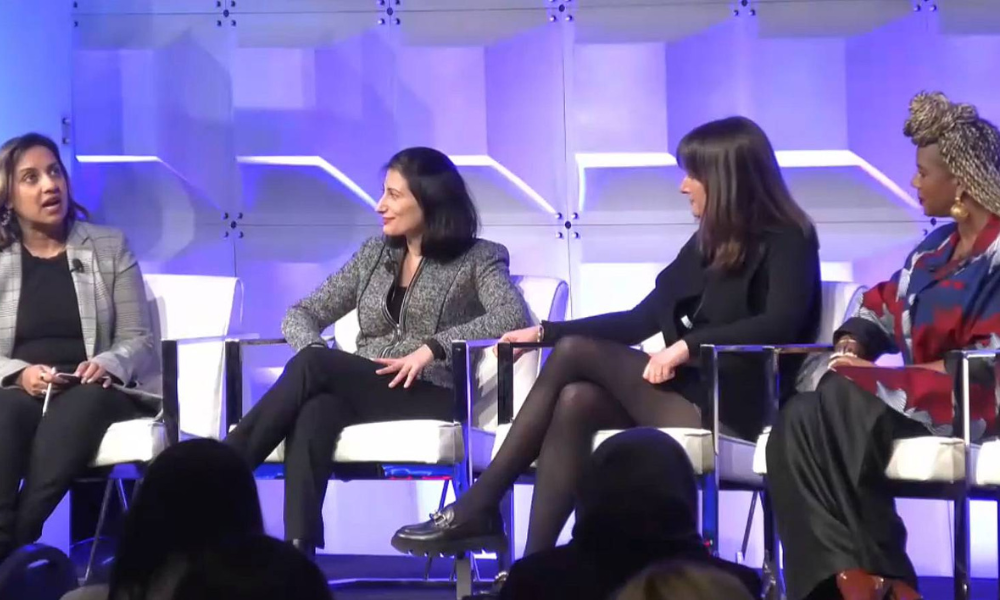
Elias was speaking as part of a panel at the recent Catalyst Honours 2023 event which ran on Nov. 15 in Toronto and online.
The theme of this year’s event was Accelerating Equity on All Fronts—So Women Thrive and it included the panel talk Advancing Representation and Inclusion Through Responsible AI.
Joining Elias on the panel was moderator Rubiena Duarte, vice-president, head of diversity and inclusion at Procore Technologies in Carpinteria, Calif., Anna Jahn, director of public policy and learning, AI for humanity at Mila Quebec Artificial Intelligence Institute in Montreal and Karlyn Percil-Mercieca, founder and CEO at KDPM Equity Institute in Toronto.
This bias represents one of the great risks inherent within AI, says Elias.
“We’ve seen some very big technology vendors that publish chatbots that became racist within 24 hours or hiring models that were sexist and so we’ve seen that in variety of mishap around bias and fairness. It’s not only a technical question, it’s also an ethical question,” she says.
“A lot of the facial recognition models initially were performing very poorly on people of colour because there were not trained and tested on that portion of the population,” says Elias.
Fake personality tests done by AI are becoming more a concern for hiring managers, according to an expert.
How to train the newest generations
The news is not all negative however, as there is some progress being made to eliminate the bias, according to Jahn.
The Mila Institute offers a training program called AI4Good Lab, which aims to make the technology more inclusive.
“It’s a seven-week program for women and gender-diverse people to have at the end of their undergrad, either in computer science or math, but actually other fields as well and we asked them to do basically a bootcamp on what is actually AI and how it really helped them, with 14-hour days. I have to admit, it’s quite grueling, and then we put them into groups and they are building a prototype within three weeks,” says Jahn.
The training initiative has produced great success, she says.
“For me the most interesting data point is that their confidence in pursuing a career in AI has gone through the roof and our data shows that about 50% of everyone who takes his program actually pursues a career in AI afterwards.”
To reach the group of workers, the organization tries to ensure that inclusivity is top of mind.
“We give coaching to all our speakers and experts on gender diversity on how to address the group so that they feel included. These are little things but what we hear is that this makes a huge difference in how they feel included in this space,” says Jahn.
The participants are also matched up with mentors and it’s hoped these types of efforts will make a real change in AI.
“These are ways of really making that community of AI a lot more inclusive and diverse and that will have an effect on ultimately how the technology is built because the one thing I always kind of try to keep reminding — including my computer scientists colleagues at Mila — is this is not a technology that fell from the sky and is this amazing thing; it looks shiny, we don’t really understand and hope it’s fair.”
“We built it. We have the agency to build it differently and so that’s something I think to really keep in mind,” she says.
The technology poses some potential dangers and might even want to control humanity, warned a former Google executive who is known as “the godfather of AI.”
AI was ‘built on the white racial frame’
In order to responsibly advance the integration of AI, some hard conversations need to be had, and some difficult truths need to be addressed, according to Percil-Mercieca.
“I think addressing the elephant in the AI room, which is AI is built on the white racial frame. We have to talk about the dominant culture and we have to talk about going beyond the AI to look at human equity because human equity we really centre the human being through going through the experience. And when we look at what we’re grappling with, reframing invites us to a deeper and also more actionable conversation.”
To that end, Percil-Mercieca’s company has compiled a database of learning from “black, Indigenous, women of colour who have done research around AI or mentoring around advancing equity around bias around cultural equity and in the database, what we’ve done is to put all their research, their articles, their voices, their perspectives and have created a curated list that we share with our audience,” says Percil-Mercieca.
If the change is successful and bias is eliminated, “I’m hoping 20 years from now, we’re still not talking about the fear and AI but we’re talking about what have we put into action in terms of what we’ve learned listening to women, listening to Black women, listening to Indigenous women,” she says.
Change is inevitable says Jahn but young, marginalized workers need to not be afraid to step into the dialogue.
“Every discipline, every background needs to be part of the conversation around AI. The days are over when only computer scientists make a decision around AI.”
“Be part of the conversation and don’t be intimidated by: ‘Oh, it’s technology and I don’t fully understand it.’ No one fully understands and you need to be part of it and you need to claim that spot and be a lot more confident about what you can contribute from your background, your experience your training, and you need to be part of it,” says Jahn.