Benefits planning about 'greatest value for greatest number of people' – but in an equitable way, says HR exec at Lindt Canada
At Lindt & Sprungli Canada, employee benefits have evolved to reflect the diversity of its workforce and the realities of today’s economy. Erin Gordon, vice-president of human resources, says the company's approach prioritizes both a strong foundation and flexibility.
"We want to make sure that we have a baseline benefit program that delivers value to the greatest number of people," said Gordon.
“We also realized, due to the demographics in our business, that it was difficult to have a one size fits all.”
As a result, the company now has a “generous” healthcare spending account (HSA), introduced after Lindt found savings through measures like mandatory generic drug coverage and good governance, she says: “Things to have in place to prevent future cost increases.”
"It wasn't about saving cost in the moment," Gordon emphasizes. Instead, it was about investing back into benefits that employees could tailor to their individual needs.
"Employees were able to still have the baseline of coverage we felt was critically important, and they had some flexibility and choice to be able to cover the things that were of greater value to them."
Financial support growing priority
Financial support has become a core focus of employee benefit plans in Canada, according to a recent survey by Mercer looking at the prevalence and evolution of non-traditional benefits.
It separated the offerings into “mainstream” — meaning benefits of 50% or more prevalence, with considerable growth since 2023 — “stable and niche” — meaning benefits with up to 50% prevalence or stable offerings since 2023 — and “truly emerging” — meaning those with less than 15% prevalence but an upward trend since 2023.
According to the report, 63% of Canadian employers now offer budgeting education, and 58% provide financial coaching. A further 44% offering savings programs other than retirement, while 34% have a share purchase or profit-sharing program.
When it comes to these programs, it’s all about the affordability component, says Fatima DiBiase, principal and consultant in Mercer’s Health & Benefits business.
“There’s a lot of Canadians that struggle from a financial perspective. So, whatever an employer can be doing in the back end to offer and support individuals in the workplace, I think, is going to resonate right now."
Focus on retirement savings at Lindt
At Lindt, it’s important to make sure there is strong foundation that provides solid benefit coverage for the workforce, says Gordon.
“We don't ask employees to contribute to the monthly premiums for benefits. We pay those costs because ... how we want to show up, as a very supportive employer, is just really part of our culture and how we want to be recognized.”
And ensuring financial security through retirement savings is non-negotiable at the company, which has about 50 retail stores in Canada with roughly 900 hourly staff and 500 employees in the salaried group.
"I'd never consider removing or reducing the pension contribution," says Gordon
“I think it's critically important that we offer that, and we do a lot of education sessions around that. The vendor that we partner with has a whole savings plan platform where you can put in your retirement saving goals, and it helps you walk through what that plan would look like.”
In HR, people often are too focused on employee wellness, including mental and physical, says Gordon.
“And that is exceedingly important but can take up perhaps more focus [than necessary] and we tend to forget about the financial security. And if I think of Maslow's Hierarchy of Heeds, safety and security is [near the] bottom. And so, at the end of the day, we can't make these choices for our employees, but we can create the conditions to help support them in planning for their retirement.”
Virtual care popular among benefits
Access to virtual care has also become a baseline expectation, according to Mercer, with virtual therapy offered by 84% of Canadian employers, telemedicine offered by 69% and substance use virtual therapy seeing strong growth, now offered by 38%.
Lindt made a major investment in virtual healthcare recently, recognizing that many new Canadians were struggling to find primary care doctors, says Gordon.
“It was really important to me and to the executive team that employees have access to a doctor if they needed … and not spend hours in a walk-in clinic.”
As for the quality of the service, that is something that will be evaluated by HR further into 2025 after people have had a chance to use the service, she says.
“Right now, we just have the lift of people who are excited that we have something that we didn't have. The next thing we need to assess is the quality of the service to make sure that it meets the high standards that we have.”
DiBiase says that virtual care provides a clear return by reducing absenteeism.
"It's probably about a half-day spent [accessing in-person care and] when we get a virtual appointment, that changes to maybe a half-an-hour. So, I mean, the ROI can be really clear in terms of the reduction in lost time.”
These benefits not only meet a need but are “impactful” for employee attraction and retention, she says.
"They do feel increasingly like table stakes when you're upwards of 70% prevalence.”
Inclusivity drives new benefits
Inclusivity-related benefits are another area of rapid growth. Mercer’s data shows that offerings around fertility medication (66% prevalence) and gender affirmation (39% growth) have expanded significantly.
"We saw definitely some gains around fertility coverage,” says DiBiase, which includes medication and treatment if not offered already.
Gordon emphasizes the importance of ensuring that any additions to the benefits plan serve a demonstrable need.
"It just is really important for me to make sure [we offer the] greatest value to the greatest number of people, but also that we do it in an equitable way," she says, sharing how Lindt has expanded parental leave policies to cover a broader range of family structures.
Data-driven decisions
At Lindt Canada, inclusivity is approached thoughtfully and driven by data, according to Gordon.
"If we hear that there's a gap, then that's something that we want to explore…. I like to have data to be able to provide rationale for why we might make a change.”
For instance, two benefits that are seeing greater coverage by companies are fertility benefits and smoking cessation.
“I have a female-dominated workforce significantly in my business. And so my question to the insurance company is… ‘What data can you give me to say that this is a need in my business?’ Because if it's a need, then I'm happy to include it in the benefit plan.”
And it’s the same idea with the smoking cessation — offered by 63% of Canadian employers, according to Mercer: In looking at the healthcare spending account, says Gordon, it’s about asking: Are people making use of this benefit?
“Because then I at least have some data to say, ‘Oh, my goodness, there's a need in our business.’ And then how do we make sure that we come up with a solution to address that? So, we don't target a population, but... when we see that there are gaps, we then look for solutions to fill that.”
Emerging benefits in Canada
Mercer's research also highlights several emerging benefit areas gaining traction:
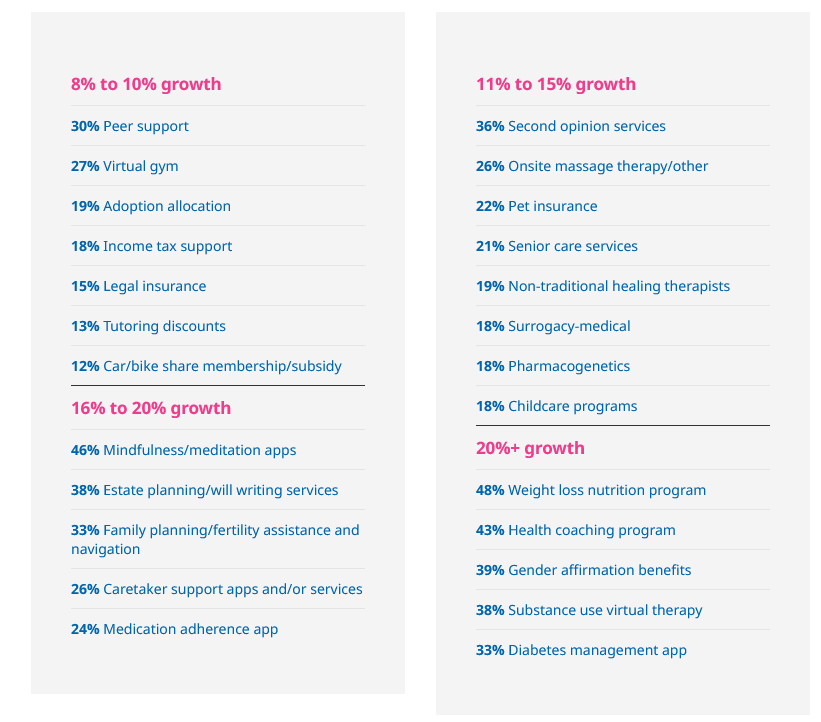
- Weight loss nutrition programs (48% prevalence)
- Estate planning and will writing services (38%)
- Second opinion services (36%)
- Caretaker support apps (26%)
- Virtual gyms and fitness subsidies (27%)
- Smudging ceremony (10%)
- Robo advice (8%)
- Nutrigenomics (6%)
These new offerings align with a growing recognition of employees' full spectrum of needs — physical, mental, financial, and social.
When it comes to the weight-loss programs, part of that speaks to the issue of obesity, says DiBiase.
“Quite frankly, if it is being viewed as a chronic condition, and it is, then it should be supported much like any other chronic condition as part of a group health program… [such as] smoking or diabetes or mental health support.”
For second opinion services, employees who may not be comfortable with the diagnosis or treatment path from their doctor might be interested in validating that feedback by seeking out a second opinion, she says.
“There are vendors out there that offer, basically, access to a network of specialists… to better understand the diagnosis or the treatment or other alternatives.”
The idea of offering a smudging ceremony is about acknowledging the diversity in the workplace and understanding individuals’ cultural backgrounds, says DiBiase: “A smudging ceremony is very spiritual and sacred and cultural from an Indigenous perspective.”
As for robo advice, that can involve an app or website, allowing individuals to understand and monitor how they spend their dollars, she says, “and help them make informed decisions on their savings and financial planning overall.”
Another emerging benefit in Canada is nutrigenomics, which is related to a person’s DNA, says DiBiase.
“Based on your genetic makeup, it itemizes for an individual an optimal diet for them in order to reduce their chances of getting certain diseases or other health risks.”
Mercer listed several benefits seeing higher growth (by prevalence):
Targeted investments in uncertain economy
Overall, Gordon and her team at Lindt rely on a mix of vendor data, internal surveys, market studies, and direct employee conversations to assess the impact of their benefits package.
"We piece all of those pieces of data together — it’s not perfect but I think it helps give us a pretty solid snapshot," she says.
And one important consideration involves educating long-tenured employees, says Gordon.
“For people that have worked for Lindt for, say, 10 or 12 or 15 years, they have been insulated from some of the changes that other companies have made trying to be fiscally responsible with their benefits spend. We made choices elsewhere so we didn't have to make those changes.
“I think for that population, we've had to work a little bit harder to explain to them that the landscape outside of Lindt has changed, and that we are really, really competitive — because they just don't have that frame of reference.”
For Canadian employers, it’s about finding a balance — especially in an uncertain economy, says DiBiase.
"Employers are really needing to take a much more targeted approach," she says. "There’s still interest out there in ensuring that they're competitive but they also need to pick their spots because they can't do everything for everyone at this stage of the game.”