
Combining new innovations like flexibility, VLPAs, newer investments 'can improve retirement outcomes,' says expert

Workplace defined contribution (DC) retirement plans that build in more flexibility, broader investment options and new decumulation products could allow some Canadians to retire more than three years earlier than under traditional arrangements, according to a recent report..
The findings come as Canadian employees rank their “ability to retire” as their second‑highest concern, behind only covering monthly expenses, underscoring the pressure on employers to modernise workplace savings programs, Bernadette Chik, Mercer Canada’s DC contribution leader, tells Canadian HR Reporter,
“What’s clear is that Canadians don’t feel ready to retire,” she said, linking the trend to rising living costs and declining overall financial well‑being.
Only 33% of non-retired Canadians have a retirement plan and savings, and just 11% know how much annual income they will need in retirement, according to a previous report.
DC innovation boosts retirement readiness
Mercer recently released its Retirement Readiness Barometer, which measures the age at which different worker personas can comfortably retire, assuming participation in an employer‑sponsored capital accumulation plan and public benefits such as CPP/QPP and OAS. Retirement readiness is defined as a 75% likelihood of not running out of money before death, if an appropriate level of income is maintained throughout retirement.
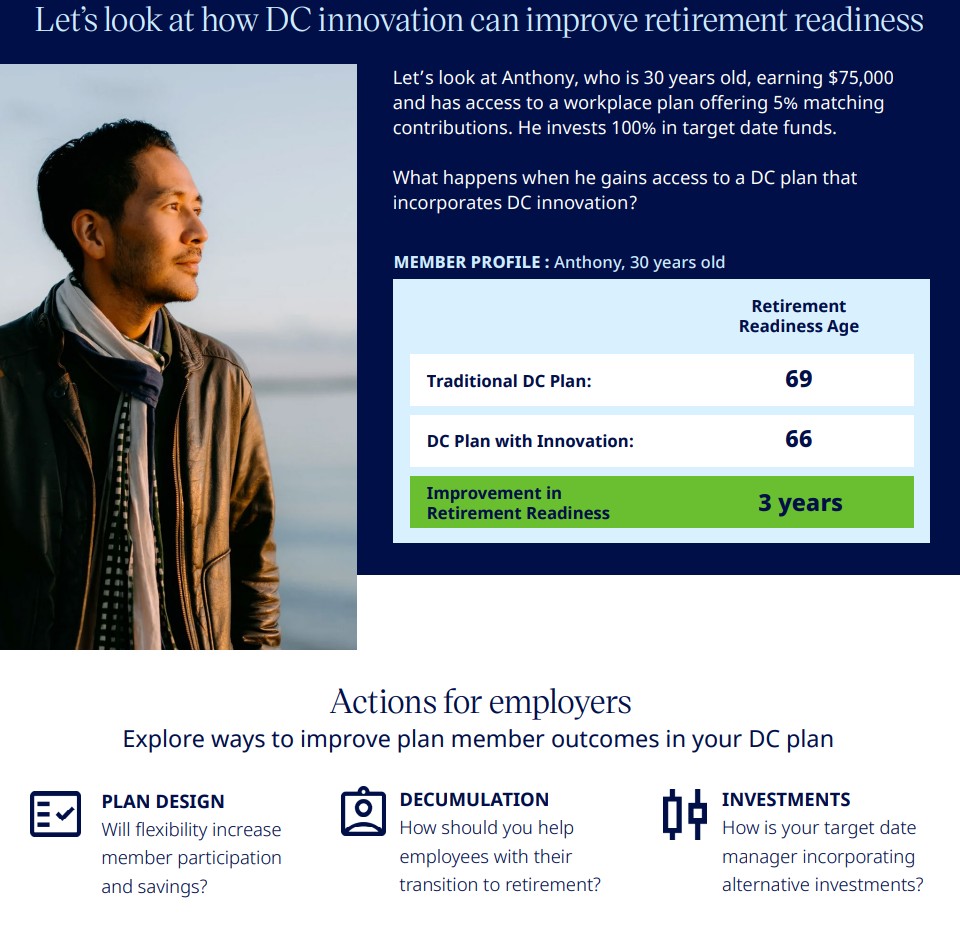 In one example, “Anthony”, a 30‑year‑old earning $75,000 with access to a 5% employer match and invested entirely in target date funds, sees a marked improvement in outcomes when moved from a conventional DC design to an “innovative” workplace plan. Under a traditional DC structure, Anthony’s projected retirement‑ready age is 69. With an innovative DC design, that age falls to 66.
Chik said Mercer’s modelling shows that “when we combine some of these new innovations like flexibility, like access to this variable payment lifetime annuity, like investment innovations, these combined can improve retirement outcomes by allowing some Canadians to retire even three years earlier.”
British Columbia is updating its pension standards legislation this year, with a series of amendments to the Pension Benefits Standards Act (PBSA) coming into force in two stages — some on April 30, 2026, and others on Oct. 30, 2026.
Flexible plan design and broader investments
A key differentiator in Mercer’s analysis is flexible plan design that allows members to save for multiple financial goals while still building long‑term retirement capital. In the innovative scenario, Anthony contributes to the plan from the start of his career, with a structure that permits access to funds for short‑term needs in the early years, then shifts to longer‑term saving as his financial position improves.
Chik said that, historically, many DC arrangements were “structured strictly to save for retirement and this money was locked in and employees were not able to access their money until retirement.” Now, more employers are adding vehicles such as Tax‑Free Savings Accounts (TFSAs) and non‑registered accounts within the overall program, enabling members to direct contributions to the type of account that best suits their financial situation and, in some cases, to access savings before retirement.
On the investment side, Mercer’s innovative design assumes a higher allocation to alternative assets within target date funds, rising from 5% in the traditional model to 15%. The firm argues that broadened exposure to alternatives can enhance long‑term risk‑adjusted returns, improving retirement outcomes without requiring higher contribution rates.
New decumulation options: VPLAs enter the frame
The third pillar of Mercer’s innovation framework focuses on decumulation — how savings are converted into income in retirement. In the traditional scenario, the member moves into a standard drawdown vehicle at retirement. In the innovative model, they are instead given the option to convert a portion of their DC balance into a Variable Payment Lifetime Annuity (VPLA) or similar pooled income product, providing more stable lifetime income.
As regulation evolves, these products are beginning to emerge in Canada. Chik noted that Quebec has already passed legislation allowing for variable payment lifetime pensions, also referred to as variable payment lifetime annuities, signalling a new phase of retirement income innovation. Employers are now “starting to ask questions in terms of: do these play a role in our program structure, will they improve retirement readiness for our employees?” she said.
While such tools are still in their early days, Mercer’s work suggests that combining flexible plan design, enhanced investment strategies and access to VPLAs can materially improve retirement readiness for some workers — including enabling earlier, more confident retirement.
Decision to retire
Chik said “the decision to retire rests on a number of factors” — from health to unexpected expenses and longevity risk — and “there are so many factors that make the decision complex” that employees can become overwhelmed and anxious.
That anxiety is already affecting how long people stay in the labour force and how they show up at work. Chik warned that when employees are uncertain about their retirement outlook, “sorting through the complexity of the decision in itself can be overwhelming and can cause worry,” which has implications for succession planning, engagement and productivity.
She added that many employees still do not fully understand the DC benefits available to them, which can blunt the impact of even well‑designed plans. Leading employers, she said, are responding by investing in communication and education and by “making available to their members access to things like financial planners and financial advice that are credentialled and independent.”
While more Canadians are saving for retirement and joining workplace pension plans, many remain confused, anxious and underprepared for life after work, according to two previous reports. Human behaviour and framing are critical in retirement benefits utilisation, according to a separate report.



