Report shows pay ranges have widened in Ontario since legislation took effect

More than half of Canadian job postings now include wage or salary information — 57 per cent as of June 2026, up from roughly one in five postings six years ago.
The latest gains have been concentrated almost entirely in Ontario, where new requirements under the province's overhauled Employment Standards Act took effect Jan. 1, 2026. Employers with at least 25 employees are now required to include expected pay details in all public job postings.
Just before the Ontario law took effect, 49 per cent of postings in the province included explicit pay information. By June 2026 that figure had climbed to 71 per cent — a 45-per-cent jump — according to Indeed's Pay Transparency Tracker.
British Columbia introduced similar pay disclosure requirements in November 2023, and saw a comparable spike in salary transparency at the time of implementation. But spillovers from either provincial law to the rest of the country have been limited.
Outside of B.C. and Ontario, only 41 per cent of Canadian job postings included pay information as of June 2026 — a figure that has remained roughly flat for three years.
Occupations with biggest transparency
The increases were broad-based across sectors, with a median gain of 31 percentage points from June 2025 to June 2026. Occupations that had the lowest pay disclosure rates prior to the legislation saw some of the largest jumps: transparency in mechanical engineering postings rose 43 percentage points, and civil engineering rose 46 points.
Human resources went from 30% to 70%, according to Indeed.
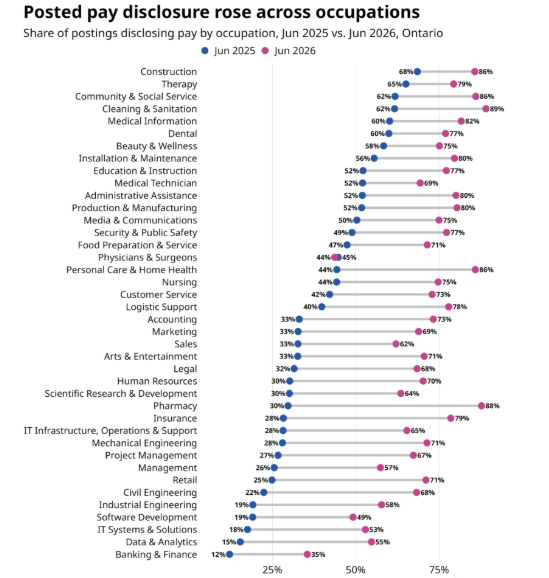
Higher-paying roles saw more modest gains. Ontario's legislation exempts employers from disclosing compensation that exceeds $200,000 annually. Pay transparency among postings for physicians and surgeons actually fell by one percentage point. Therapists, dentists, and roles in banking and finance also saw among the smallest increases.
Wider ranges, less precision
More pay disclosure has not necessarily meant more precise numbers. Of postings in Ontario that include pay information, only 16 per cent quote an exact figure — the same share seen across Canada as a whole. The majority offer a salary range instead.
Those ranges have widened since the legislation took effect. The median posted salary range in Ontario was roughly 16 per cent wide in the first half of 2025 — the equivalent of a posting that says a role pays between $100,000 and $116,000.
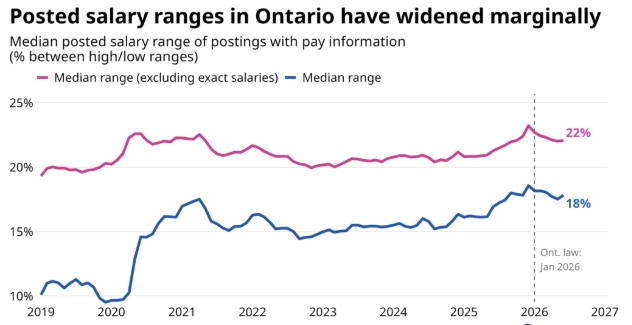
In the first half of 2026, that spread had grown to 18 per cent, or the equivalent of a $100,000 to $118,000 band. Indeed's analysis suggests that employers who had been reluctant to share pay information prior to the policy have tended to be somewhat less precise when they do disclose.
Canada moves up global rankings
The gains have moved Canada ahead of the United States in international comparisons. As of June 2026, 49 per cent of U.S. job postings included pay information — below Canada's 57 per cent national average.
Canada now trails only Japan, where 97 per cent of postings include pay detail, and the United Kingdom at 58 per cent, among the 11 advanced economies regularly tracked by Indeed's Hiring Lab.