More than 7 in 10 hiring managers say they're likely to hire contract talent

Contract workers are no longer a stopgap for Canadian employers, according to a new survey.
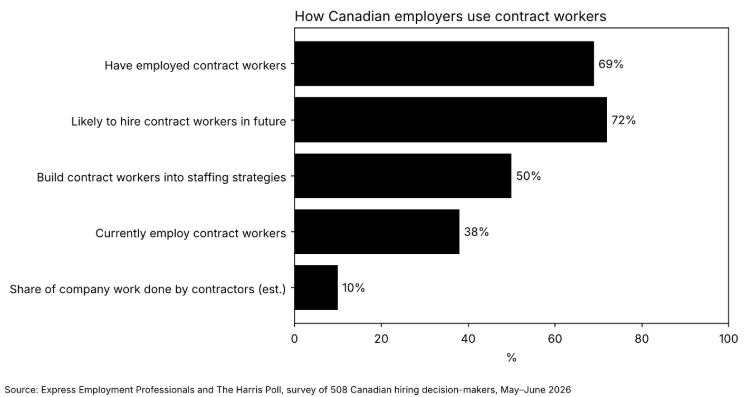
Half of Canadian companies (50 per cent) build contract workers into their staffing strategies, and 72 per cent of hiring managers say they are likely to hire contract talent, according to a survey released by Express Employment Professionals.
The shift comes as the job market weakens. Canada’s unemployment rate rose to 6.7 per cent in October 2026, its second straight monthly increase, according to Statistics Canada’s Labour Force Survey.
It also arrives as the rules change. New equal-pay provisions for temporary and agency workers under the Canada Labour Code took effect on Oct. 20, 2026.
Contract staffing widespread
Contract staffing is widespread. Some 69 per cent of hiring managers say their organization has employed contract workers, and 38 per cent currently do, the Express survey found. Hiring managers estimate contractors handle about 10 per cent of the work at Canadian companies.
Express expects reliance to deepen.
“The way businesses plan for talent is evolving, and contract staffing is becoming an increasingly important part of that strategy,” says Bob Funk Jr., CEO, president and chairman of Express Employment International in Oklahoma City.
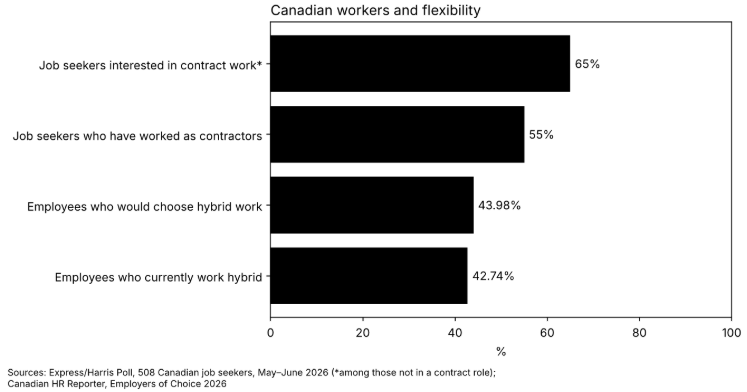
Workers appear receptive. More than half of Canadian job seekers (55 per cent) have worked as contractors, and 65 per cent of those not in a contract role show some interest in one, according to the surveys of 508 hiring decision-makers and 508 job seekers in May and June 2026.
Why contract workers may cost more
For federally regulated employers, however, the economics have shifted. Since Oct. 20, 2026, the Canada Labour Code has barred different wage rates based on employment status where employees do substantially the same work, and a parallel regime now covers federally regulated temporary help agencies.
Employees can request a wage review, and employers have 90 days to respond, Canadian HR Reporter reported in its coverage of the new rules.
Catherine Connelly, a professor at McMaster University’s DeGroote School of Business, anticipated the effect before the rules took hold. “A company could still go to an agency to find specialized workers or short-term workers. But it won’t be cheaper anymore,” she told CHRR in March 2026.
The practical reach of the rules may be limited, Hicks Morley noted, because most temporary help agencies likely fall under provincial jurisdiction.