Many employers don’t set aside money for market corrections, promotions or catch-ups -- and that's a problem

With the Democrats expected to take control of the House of Representatives and the Senate in the U.S. midterm elections, Canadian employers are likely looking forward to some much-needed stability.
But with salary budgets stuck around three per cent for a third straight year, compensation experts speaking to Canadian HR Reporter say the real 2027 decisions are where to target the money, how to manage pay structures and how to explain it all to employees.
"From a Canadian perspective, I think [there’s] a little bit of a sigh of relief with maybe some optimism, but I don't think that's going to substantially change people's plans for 2027," says Darcy Clark, senior principal of compensation, talent and culture at Normandin Beaudry in Toronto, of the election results.
"It's… fairly baked already in terms of what budgets are looking like and what the plan is."
Nancy D'Onofrio, vice-president of strategic accounts and social selling at Randstad Canada, is also hopeful: "I think it's going to alleviate some of the stresses that we're feeling in the economy, because of a lot of the tariffs, a lot of the unknowns."
Cal Jungwirth, director of permanent placement services at Robert Half in Edmonton, says the vote may influence recruitment.
"Obviously, organizations love stability for planning purposes," he says. "If organizations feel a little bit better about the future, they may then move ahead with some of their hiring plans."
A plateau at three per cent
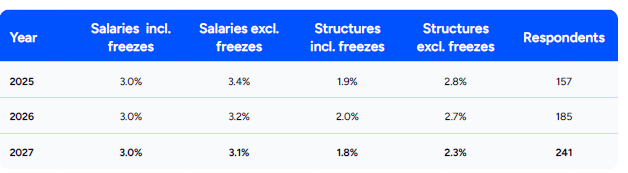
The major surveys on salaries for 2027 show consistency. Normandin Beaudry's early data points to average increases of 3.1 per cent, matching 2026. Randstad Canada says employers are budgeting 3.1 to 3.3 per cent, with Alberta and British Columbia leading at 3.4 per cent. HUB International's survey of 241 organizations puts the 2027 figure at 3.0 per cent including freezes and 3.1 per cent excluding them.
The challenge is that 2027 doesn't call for more money than 2026, according to Claudio Gardonio, vice-president of total rewards at HUB International, during a recent webinar. "You just have to decide, ‘Where do I put that?’"
For Clark, three per cent is simply the market returning to form after several unusually hot years: "Even at 3.1%, that's normal — it used to be 2.5 per cent.”
The challenge is that it doesn't feel that way to many employees, he says: "We're somewhat back to normal, which after four years, normal seems not normal anymore."
Avoiding 'peanut butter approach'
HR experts routinely advise employers to differentiate with pay — rewarding high performers, critical talent and skills gaps.
While that sounds great on paper, in practice, it is easy to slip into spreading the money evenly, says Clark: "We call it the peanut butter approach where everyone gets the 3.1% or whatever that number for your budget's going to be."
Gardonio says the three per cent is what HR should be giving, on average, while some people should get five per cent and others one per cent: "That's how you manage your budget; that's how we recognize people."
That also makes a sound performance management system essential, he says, particularly for small and mid-sized employers trying to explain to employees who gets more and who gets less.
Randstad's guide found only four per cent of Canadian companies plan flat, across-the-board raises. D'Onofrio says employers are conserving their salary payouts and investing strategically in roles such as AI and technology, the skilled trades and revenue-generating positions like tech sales.
"They're being selective where they put their funds into the talent, the level of talent, and the skill set,” she says.
Variable pay is part of that picture. Clark says employers are using spot awards (more often at junior levels), tweaks to annual bonus plans, deferrals and equity, phantom or cash long-term plans to create "hooks" for high performers — partly because these don't add to fixed costs.
"Markets can change so that if you have these variable pay programs, there's an exit strategy as well for companies, just to mitigate cost risk," he says.
Watch the pay structure
For Gardonio, the bigger story isn't salary increases at all — it's what is happening to pay structures. Excluding freezes, HUB found salary structures are projected to move 2.3 per cent in 2027, down from 2.7 per cent in 2026 and 2.8 per cent in 2025. Including freezes, the figure is just 1.8 per cent.
“It's not what pay will be next year, but rather what's going to be the movement, the evolution of your pay structure,” he said.
As to whether freezing the structure is a smart short-term move or the start of a longer-term problem, Gardonio said it depends on where employees sit in their ranges. "If they're all after the midpoint, they're getting very up their scale, there's not much movement in there," he said. "By freezing again, you're going to face a wall."
In the short term, an employer can freeze the structure and still grant increases, Gardonio said. But by the second year, employees moving up a frozen range start running out of room — and are left with limited options: accept the status quo, push for a promotion or development opportunity, or leave, he said: “That's reality by freezing your salary structure."
Money beyond merit budget
Beyond the headline number, Normandin Beaudry found more than half of participating organizations plan to allocate an average additional discretionary budget of 0.9 per cent in 2027, down slightly from 1.1 per cent in 2026.
Clark describes that extra money as "playroom" — funding for promotions, targeted spending on high performers and adjustments for people who are low in their range or out of step with peers in the same role. That extra budget can give employers some leeway, he says, "but it's still tight, don't get me wrong."
Many employers have no such cushion. Gardonio said he’s “in a state of shock” that 73 per cent of HUB's participants have no separate budget for market corrections, promotions or one-off catch-ups, while another 11 per cent don't know whether they do.
Only 16 per cent set money aside, typically around one per cent.
Mercer found half of Canadian organizations have provided or plan to provide off-cycle salary adjustments in 2026, with a similar pattern expected in 2027. But governance is uneven: among those offering off-cycle increases, only 30 per cent track and report on them regularly.
Compression and new hires
Tight budgets make pay compression harder to manage, particularly when new hires come in at higher rates than long-serving employees.
"Buying talent externally is more expensive than keeping talent," says Clark. "There's the cost of acquiring new people, and there's the backend cost in terms of internal relativity."
Randstad says employers are allocating 2.0 to 2.6 per cent of payroll to structural pay-band adjustments, partly to ease compression between long-serving employees and new hires.
That pressure extends to existing staff. “If they’re hiring externally, they need to ensure that their internal already existing talent is being competitively paid,” says D’Onofrio.
“We’re seeing a lot of organizations doing exercises and making sure that there is equity across the board because they’re going to lose tenured employees if they’re not competitive.”
Those reviews come down to a few core questions, she says: “What are they benchmarking? What do our total rewards packages look like? How are we incentivizing our talent to stay?”
“We’re seeing a lot more organizations focus on that moving into 2027.”
Jungwirth says employers should assume pay information will circulate.
"You almost have to expect that that will get out to your team," he says. "If you do bring in higher-priced talent, you either need to, number one, consider that across the board internally for that specific role, or [two] be able to justify the differentiating factor that that person brings, i.e…. a new skill that the existing team doesn't have, and that's why they command a higher salary."
Pay transparency trends
Jungwirth sees an upside to greater pay transparency: "There's no more hide-and-seek in terms of compensation,” he says.
If a competitor's posted bands for similar roles are higher, an employer now knows it has a problem. "It was too late until somebody got poached for a higher salary. Now, at least you should have a little bit of warning on that, and it gives you time to react in order to retain your top people."
The data suggests employers are responding. Robert Half found 70 per cent of companies are taking pay transparency steps beyond legal requirements, and 96 per cent of hiring managers already include or plan to include salary ranges in job descriptions.
Gardonio, however, said HUB's survey found many organizations have yet to make concrete changes, and only four per cent believe transparency is putting pressure on their budget. He pointed to Ontario, British Columbia and Prince Edward Island as provinces requiring pay information in job postings, and expects others to follow.
"I'm telling you, it's coming. You may as well prepare yourself."
D'Onofrio also says younger workers in particular are open about what they earn, and mandatory salary ranges in job postings add to the pressure.
"Your competitors are going to see if you're underpaying your talent, and then it's like, ‘OK, let's go ahead and hunt them because we know we can offer them this,’" she says.
COLAs and the case for total compensation
With affordability still top of mind, cost-of-living adjustments are popular with workers. Robert Half found COLAs were the widest gap between what workers value and what employers offer: 50 per cent of workers value them, but only 18 per cent of employers provide them.
Clark says standalone COLAs carry real risk because inflation is hard to predict. An employer might budget for one, apply it partway through the year, and find it has undershot or overshot. Guaranteed cost-of-living increases are more common in the public and quasi-public sectors, he says.
"Private sector would kind of bundle that in with a merit so that 3.1% would have maybe 1.5% or 2% of that is considered the cost of living, and then the balance is actually true merit,” he says.
Jungwirth says internal pay grids are a big part of the hesitancy. "They want fairness across the board. But that's tough to adhere to."
Instead, he recommends building flexibility into the broader package. "And the phrase that I always use is total compensation, so it's not just base pay." That includes variable pay, RRSP matching, health spending accounts, vacation and remote work options.
"Hey, if I don't have to come into work maybe one day a week, I save on gas, I save on parking, I save on going out for lunch," he says. "People get tunnel vision sometimes around that specific number, but if you could kind of do the math on the total compensation of the package, that's where you can maybe move the needle."
HUB's data backs that up. While base pay remains the dominant retention factor, Gardonio said flexibility, organizational culture and career development together accounted for 58 per cent of retention mentions in the survey.
graph
D'Onofrio also stresses work-life flexibility, citing Randstad research that shows a large share of employees would stay at or move to an organization for flexibility alone.
Explaining the 'why'
With budgets flat and employees still feeling the cost of living, how pay decisions are communicated may matter as much as the decisions themselves.
Coming off three or four hot years, employee expectations haven't adjusted, says Clark. "We can't expect people to fully understand the why — like why it’s now 3.1%, not the 5% that we got three years ago."
Explaining how budgets are set and allocated "is absolutely paramount," he says. "It's even more important than the actual number." That applies even to a salary freeze. "You can't just say we're freezing salaries and full stop."
D'Onofrio says it comes down to leadership and psychological safety. "Those leaders need to have those open and transparent conversations as opposed to avoiding the topic," she says.
When money is constrained, managers can talk about development, stretch projects and a path to the next role, she says, so employees are ready when opportunities open up: "People want a plan.”
In the end, says Clark, the goal for 2027 is to make a limited budget count: "Spend your money, your compensation dollars most strategically, crystal balling as best we can on that."