Mental health therapy claims triple since 2019 as more workers use benefits

Mental health care and earlier-onset chronic disease are pushing paramedical and drug claims well past pre-pandemic levels, according to a new report.
The growth is not coming from a few heavy users. It reflects a broader share of the workforce using coverage, according to Sun Life Assurance Company of Canada.
The insurer analyzed 2019 to 2025 claims from more than 20,000 employer groups covering several million members under age 65.
Mental health practitioner claims lead surge
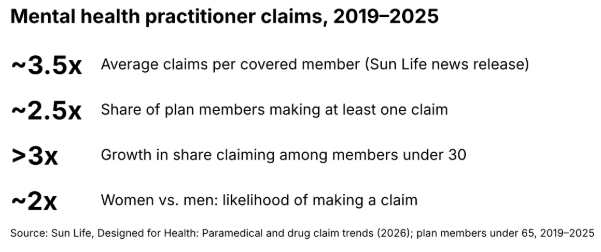
The steepest climb is in mental health practitioner claims. The average number per covered member rose nearly 3.5 times since 2019, while the share of members making at least one such claim grew approximately 2.5 times, said Designed for Health: Paramedical and drug claim trends.
Younger workers are driving much of it. “The increase among employees under 30 is particularly striking, with mental health practitioner claims more than tripling since 2019,” said Erin Crump, vice-president, market development, Sun Life Health, in a news release.
Women remain roughly twice as likely to claim, though growth among men under 30 recently edged ahead. Sun Life attributes the overall rise to higher distress, virtual care, reduced stigma and gaps in primary care – themes echoed in research on why mental health benefits are far more popular with younger workers.
Chronic disease drug claims climb
The same generational pattern appears on the drug side. Claims grew in nearly every major category except narcotic analgesics, which Sun Life tied to more cautious opioid prescribing documented in a 2025 Canadian Medical Association Journal (CMAJ) study on prescription opioid trends.
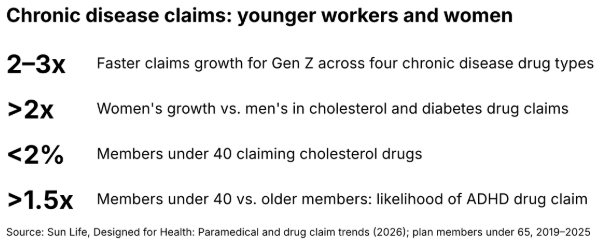
High blood pressure and diabetes drugs remain the most claimed, but cholesterol drugs posted the largest growth in members claiming, steepest among younger groups, though fewer than 2% of members under 40 claim them.
Across asthma and chronic obstructive pulmonary disease (COPD), diabetes, high blood pressure and high cholesterol drugs, claims growth has run two to three times higher for Generation Z (Gen Z) employees than other age groups. Women are also closing treatment gaps, with their growth in cholesterol and diabetes claims more than double that of men.
Weight loss, ADHD and menopause
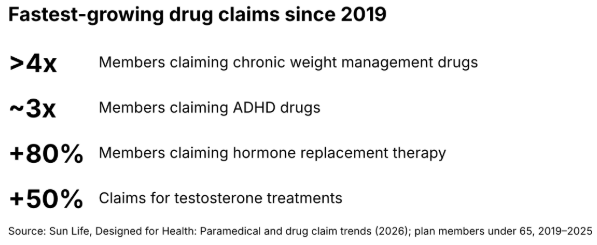
Three newer categories are also accelerating. The share of members claiming chronic weight management drugs reached more than four times its 2019 level by 2025, with growth speeding up after glucagon-like peptide-1 (GLP-1) drug Wegovy launched in Canada.
Sun Life expects generic GLP-1 versions to push claims higher, a timeline Health Canada brought closer by approving the first generic semaglutide in April 2026. Employers are already weighing data on how many Canadian employers are offering GLP-1 coverage for weight loss.
Attention deficit/hyperactivity disorder (ADHD) drug claims nearly tripled since 2019, while hormone replacement therapy (HRT) claims rose more than 80%, led by women aged 40 to 49.
These trends land on stretched budgets. Aon’s 2026 Global Medical Trend Rates report projects Canadian group health costs will rise 8.3% in 2026, up from 7.4% in 2025.