Symcor, IKEA, L'Oreal roll out initiatives to raise awareness, reduce stigma and improve wellbeing

“This isn't about women walking around with a big ‘M’ on their shirt and talking about menopause.”
So says Janet Ko, president and co-founder of the Menopause Foundation of Canada, in discussing the growing focus on workplace supports for menopause.
Encouragingly, more employers in Canada are stepping up, she says.
“This is a very exciting point … where employers, because they've now started to see the data, they're looking at their own workforce, they're recognizing that this is a very critical demographic. They're starting to consider all of their talent management practices through the lens of a midlife woman,” says Ko.
“It's not a heavy lift to make a big difference… if you're an organization who cares about high performance, about supporting people at all stages of life, this is not only the right thing to do, but it has a significant impact on the bottom line."
Costs to ignoring health challenges
Menopause is a stage of life that every woman goes through, and it impacts each one differently, says Ana Brtan, CHRO at Symcor, which has boosted resources around menopause.
“I don't think people are aware of that, of how many women actually back out and get out of the workforce because they're going through this on the back end of their life and… they’re unable to participate the way they probably would have if they had an awareness and support through the organization and the network around them.”
Menopause is a significant issue in today’s workforce, affecting employees during meetings, presentations and critical career milestones. Despite its impact, many women continue to suffer in silence due to stigma, lack of awareness and limited access to resources.
“We’ve never had so many women in midlife in the workforce in Canada in our history,” says Ko. “One-quarter of the workforce are female and over the age of 40. And the average age to reach menopause is between the ages of 45 and 55, which is the fastest-growing cohort of working women in Canada.”
Rather than seeing this as a failure, she frames it as an exciting opportunity for employers to support high performance and talent retention.
Ko stresses that the most powerful thing an organization can do is to “crack open the conversation and to recognize that you have a high percentage of people in your workforce who are experiencing this or who will be experiencing this. They're very interested in learning and they're very grateful when the organization diminishes the stigma associated with this stage of life and recognizes that there are many, many opportunities to provide support within the existing talent management framework.”
Menopause: getting past stigma
While menopause was rarely discussed in previous generations, the issue is now being brought to the forefront, says Brtan.
But women’s health requires a different approach, she says: “Women are not just smaller-framed men… there is something completely different about our DNA, our biology that needs to be looked at in a very different way than we might have traditionally many, many moons ago. And I think it’s starting to finally come up and be recognized.”
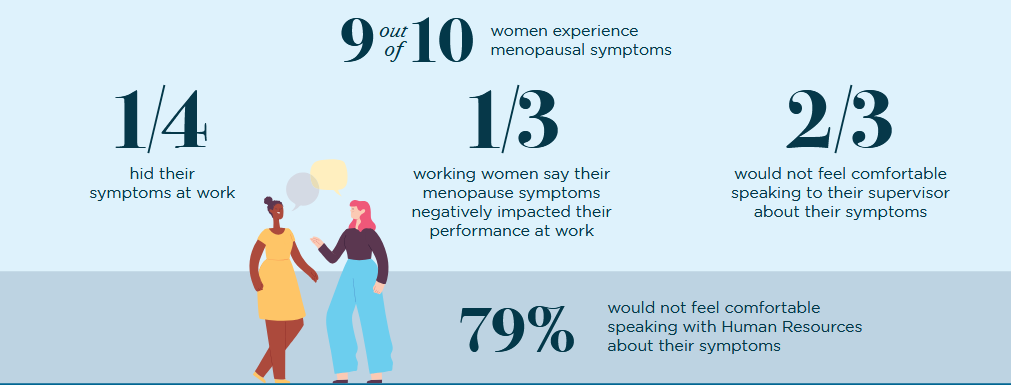
Source: Menopause Foundation of Canada
A huge area of focus when it comes to menopause support is culture and communication, according to Ko.
“Our research showed that 70% of women would not feel comfortable having a conversation with HR or with their manager. Many women fear repercussions or that it will somehow limit their career progression. So breaking the taboo of menopause at work is a very important step.”
That can mean education and awareness sessions, employee resource groups discussing women’s health and panel discussions, she says, “so people recognize this is a natural stage of life. Many of your colleagues will be going through it and they should not have to hide or be embarrassed about a symptom that may be appearing at work.”
Rachel Wong, vice-president of total rewards and HR technology at Symcor, highlights the importance of workplace culture in addressing menopause.
“It's not just women's health alone, it's the culture of talking about all well-being-related topics,” she says.
Raising awareness at work
Symcor’s recent initiatives include a two-month campaign on women’s health, partnering with Dialogue, that included interactive sessions for employees on “demystifying menopause,” says Wong.
“So, not just on the biology front, on the stages, the symptoms but also solutions, supports … how we can foster the empathy and awareness that we can have in the workplace.”
That included Symcor’s former CEO, Chameli Naraine, giving a talk about her menopause journey, along with Janet Ko relating her personal experience.
Incentives such as themed prizes, including neck fans and self-care kits, were used to draw attention to the campaign and encourage participation from Symcor employees.
The campaign also included strategies on how managers can strike up conversations about menopause and offer supports or resources, says Wong, such as turning down the thermostat or offering flexible work arrangements.
And going into Mental Health Month in October, the company will be covering mental health issues in menopause also, she says.
Workplace culture and communication
Leadership and workplace culture are key drivers of change, says Ko, who points to organizations such as L’Oreal Canada, which is hosting a menopause champions session over a couple of weeks.
Or MPAC, where the CEO, Nicole McNeill, has talked about her own menopause experience.
“She had some challenges getting support. She recognized that many people in her workplace were also going through this. And she held an education and awareness session where she told her own story,” says Ko.
“And she committed to her organization that they were not only going to break the stigma, but that they were going to look at their policies, their benefits, and they were going to take action based on input from their employees.”
Employer guides on menopause
Recently, Alberta Blue Cross introduced a workplace guide to help employers and employees address this challenge, offering evidence on the impact of menopause, insights into the economic and equity costs of inaction, and practical strategies for employers.
The best place to start is by reviewing your group benefits plan to see what support is already available, says the guide. Many plans cover treatments and services that help employees manage menopause symptoms, such as menopause hormone therapy (MHT), non-hormonal prescription therapies, medications for hot flashes and vaginal dryness. Cognitive behavioural Therapy (CBT), physiotherapy, nutritionists and dietitians, and health spending accounts (HSAs).
Similarly, the Menopause Foundation of Canada provides a Menopause Inclusive Workplace Playbook! filled with resources on how employers can support women, including accommodations such as flexible work hours, working from home, additional breaks, adjustments to workloads and more comfortable work uniforms.
Ko also advises employers to review their benefits plans to ensure they cover evidence-based treatments such as hormone therapy, cognitive behavioural therapy, and pelvic floor physiotherapy.
“Often organizations are providing these kinds of benefits, but they haven't packaged them up in a way to showcase to their employees that they do have a number of offerings that can be very beneficial to the person in midlife.”
IKEA Canada: guides and toolkits
Also offering resources around menopause is IKEA Canada. The company has taken steps to support women because when people feel valued, safe and empowered — physically and mentally — they can reach their full potential at work, says Tanja Fratangeli, a senior leader at IKEA.
But “simply sending messages or emails isn’t enough to create real change,” she says, so it’s about building a supportive environment where people have access to resources and feel comfortable discussing their issues.
To that end, IKEA Canada has partnered with the Menopause Foundation of Canada and recently hosted a panel on International Women’s Day, which attracted 300 attendees.
“My hope was to show that it’s okay to talk about menopause, helping to break the stigma and encourage more women to share their experiences and seek the support they need,” says Fratangeli.
The company also introduced an IKEA Canada guideline to support co-workers experiencing menopause-related symptoms, along with manager guides, workshops and a dedicated co-worker resource toolkit “with practical advice on recognizing symptoms, offering support, and fostering open conversations,” she says, to “normalize discussions about menopause.”
And the initiatives are meant to be inclusive by helping everyone at the company, says Fratangeli, “whether you’re experiencing menopause, supporting a colleague or leading a team.”
Being inclusive with targeted wellness
The same is true at Symcor, according to Brtan and Wong, as men also attended and engaged in the sessions on menopause.
“They too are impacted one way or another — be it their mom, sister, partner whatever… and it was great to see their presence so that's always a sign to me that it's something that's broader than just this one little group, it's quite a balanced approach and a balanced attendance that we saw,” says Brtan.
Men’s involvement is essential in creating a supportive workplace, says Ko: “They are managers, supervisors, colleagues, leaders. They have other women in their life that may be going through this or will be going through this. So, including men in the conversation is essential from a workplace perspective.”