With companies such as Toyota Canada trying out the new tech, what’s the impact on workers? Researchers call for transparency, consultation

With Toyota Canada announcing a pilot project, what’s the impact on workers? Researchers call for clarity, communication
Humanoid and general-purpose robots are beginning to leave research labs and enter everyday workplaces, from auto plants to retail stores to warehouses, taking on physically demanding and repetitive tasks.
Major tech companies such as NVIDIA, Tesla and Amazon have announced significant funding for humanoid robots, while in Canada, early adopters such as Toyota and Canadian Tire are positioning the technology as a way to ease strain and redeploy staff to more meaningful work.
But what will be the impact on the rest of the workforce? Two researchers who spoke with Canadian HR Reporter highlighted the need for clear communication, employee consultation and proper metrics to ease the integration.
“The more important question is how does it actually impact the quality of the work that we do and the tasks that we do? And what does this mean more generally for things like our job satisfaction, autonomy, meaning at work? Do we see any day-to-day changes in what workers actually do once the technology is implemented and does this depend on how the technology is implemented?” says Milena Nikolova, professor of the economics of well-being at the University of Groningen.
“So, whether it's implemented more democratically in consultation with the workers or whether it's top-down decisions from management.”
Employers should pay attention to what workers are reporting, be it anonymously, such as concerns about safety or surveillance, says Julie Carpenter, a research fellow at Ethics + Emerging Sciences Group at California Polytechnic State University.
“Now is really the time, again, to engage the HR people… to make them really proactive throughout this process, to be on the ground and get feedback and signals… on how their labour is changing and addressing that so the company grows together.”
Robots tested at Toyota, Canadian Tire
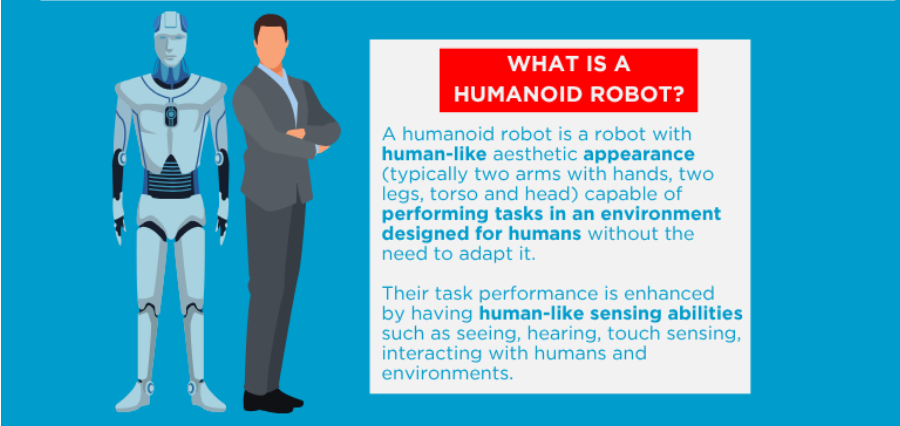
What’s behind the rise of the robot? Significant technological breakthroughs have been made in recent years, including advances in AI, machine learning and improved core components, which have enhanced the capabilities of humanoids, according to the International Federation of Robotics.
“In particular, generative AI has led to new methods by which humanoids acquire their capabilities. They can learn from demonstration and even figure out tasks independently. This could also transform the way traditional robots are programmed and pave the way for new application scenarios of smart manufacturing.”
Toyota Motor Manufacturing Canada is launching a pilot with three humanoid robots focused on internal logistics rather than direct assembly. The goal is to help reduce strain on employees “and free them to do more value-added work in the production facility,” said a spokesperson.
The robots will take on “extremely repetitive and physically taxing internal logistics tasks” that aren’t directly related to assembling a vehicle, such as picking up totes full of parts and moving them from one rack to another, he said.
“We have been adding automation to our plants for 40 years, including more than 500 automated delivery robots we already have assisting with internal logistics, and this has only resulted in increased employment as we continue to be Canada’s largest automotive manufacturer.”
Source: International Federation of Robotics
Back in 2024, a week‑long pilot at a Mark’s store in Langley, B.C. saw a “general-purpose robot” working in a store environment. The deployment by Canadian Tire saw 110 retail-related tasks completed correctly, including front and back-of-store activities such as picking and packing merchandise, cleaning, tagging, labelling and folding, according to Sanctuary AI which created the robot.
“We worked on analyzing how their work was done and what work people like and don’t like doing, in both their retail and distribution center environments,” said Geordie Rose, former CEO of Sanctuary AI.
The pilot enabled Canadian Tire to “further explore cutting-edge innovations and accelerate operational efficiency,” said the company’s VP of data, analytics and AI at the time. “We were able to focus human resources on higher-value and more meaningful work, like customer service and engagement.”
Benefits: less physical strain, ‘higher-value’ tasks
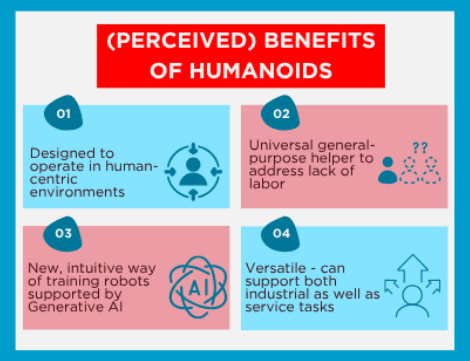
Research on industrial robots suggests one clear upside: reduced physical load — and the same is expected with humanoid robots, says Nikolova.
“What we know from the industrial robots is that they take over physical tasks. This means that the work of humans becomes less physically intense. So, that leads to improvements in workers' physical health,” she says. “With industrial robots, we know that they lead to fewer workplace injuries. And that's across many different countries, contexts... I suspect that something similar will happen with humanoids. I think that safety in general will improve.”
Source: International Federation of Robotics
Nikolova also points to the potential for more meaningful work, drawing on earlier waves of technology such as Excel spreadsheets or ATMs.
“It adds value, so it doesn't replace what you do, it just enhances what you do and you can do it better,” she says. “This could happen with humanoid robots as well [if they] take over the tasks that are dull, dangerous and dirty, and people shift to tasks requiring emotion.”
In principle, it’s possible that workers will experience higher job satisfaction and more meaning if they switch to tasks that are of higher value, says Nikolova, “or if the humanoid robots create new tasks that are high value.”
Cautions: job insecurity, shrinking social connections
However, with industrial robots, there is less need for communication because as work becomes more automated, it becomes very standardized, says Nikolova, “so work becomes less social in that sense [and] also less meaningful for people.”
While none of this is deterministic for humanoid robots, it's likely to happen if they are deployed in the same way as industrial robots, she says — without consultation with the workers on the design and in decision making without management, so “having a bottom-up perspective.”
Even if employers focus humanoids on unwanted tasks, how workers perceive the technology matters. In the study “When Your Co-Worker Is a Robot: Intergroup Performance Status and Its Consequences for Workplace Attitudes,” researchers Zhao, Zhang and Leonardelli found that “perceiving robots as outperforming humans in the workplace can be particularly damaging to employees’ workplace attitudes (e.g., organizational commitment and job satisfaction) because they create intergroup comparisons of performance status.”
This can lead to a “greater realistic threat to job security, which further lower workplace attitudes,” they say.
Cautions: lagging policies, consent
Carpenter warns that robots can also “shift power, not just absorb tasks,” which is somewhat of a governance issue.
“When a robot becomes part of a workflow, decision-making doesn't disappear — it becomes embedded in the larger cultural system and the human colleagues will know that what gets tracked flagged, escalated, optimized, etc., is now perhaps designed upstream out of their direct control — and it may shape their job,” she says.
In a stratified corporate hierarchy where independent contributors might be working with robots every day, and the C-suite is not, those are two very different conditions that HR and leaders should be aware, says Carpenter.
“Can they opt out of working with the robot ?” she says, stressing the need for clear policies.
The first robot in the workplace might be novel, says Carpenter, but after the third or fourth, “it becomes part of the infrastructure and policies often lag behind that.”
These humanoid robots may come to cross paths with human workers, so people will have to transition into this new workplace, highlighting the need for clarity and transparency from HR — especially if the robots are conducting some form of surveillance and performance monitoring.
“They need to be aware of the consent levels,” she says.
A further consideration? Humans can reach a point where they anthropomorphize robots — as seen in Carpenter’s research involving robots in the military. And as these machines gain greater language capabilities, coworkers may form stronger attachments.
If that robot breaks down or is replaced, it can actually lead to feelings of grief or loss, she says: “That can be distracting. It can be destructive. It’s not great for mental health.”
Takeaway: Garner worker input on humanoid robots
A recent report from the research organization Fraunhofer‑Gesellschaft found that one in three end users see a lack of acceptance among employees as one of the biggest obstacles to the use of humanoid robots.
Further, 57 percent say that acceptance problems among employees would have an influence on the decision to purchase a humanoid robot.
Researchers and practitioners say that how organizations roll out humanoid robots will be crucial to their acceptance. Nikolova points to evidence from Europe that shows companies with good worker representation, through work councils, end up adopting more robots.
“Workers are involved from the beginning, in the design of the robots, in how they're deployed. So, they have ownership over the process. And you have, generally, good communication between management and the workers,” she says. “That is hugely important in the short run especially but also in the long run.”
This is also linked to the bargaining power of workers and the benefits sharing the technology data — not just in terms of monetary benefits but also efficiency and productivity gains, says Molokova: “It’s hugely important.”
Having people comfortable with the physical presence of the robots is also a consideration. Carpenter highlights the importance of aesthetics, with some Japanese companies designing humanoids that are intentionally non-threatening — unlike American ones that may be more intimidating.
“Changing the colour can make a big difference. Sometimes adding a face mask or placing it differently, or the height, those things make a difference… the way it talks, how it approaches people,” she says, which can have an impact on employee engagement, trust in management, and a sense of belonging in integrating the robots into the workplace.
Takeaway: Communicate goals clearly
To combat potential resistance or hiccups, Carpenter argues that clear, honest communication is essential.
“The employer has to make it clear that the goal is efficiency. We all understand that… but that doesn't mean elimination of the human jobs; it means a reorganization of the labour around it,” she says.
“Automation always reorganizes the labour around it. So, robots rarely replace the entire job. More often, they change the infrastructure and some workers become supervisors of systems instead of other people, others become responsible for taking care of maybe AI or robot systems where in the past they didn't necessarily oversee people.”
Carpenter stresses the need for clear policies on data collection and performance monitoring, and defining escalation paths. For example, if a robot is making errors.
It’s about “oversight, transparency, and accountability,” she says, adding that workers should feel “empowered that there's some sort of path for feedback, either direct to their manager when things are changing with robots being introduced or through an anonymous path… to HR and management about how things are working.”
Takeaway: Measure impact on turnover, engagement
Beyond measuring productivity and efficiency with the implementation of robots, both experts say HR should monitor employee turnover, engagement, trust and social dynamics.
“Several companies have reduced their staff only to find out that AI cannot do what they envisioned it would and then rehiring these people or finding new ones if they leave voluntarily is very costly,” says Nikolova.
Similarly, employers should look at metrics such as early retirement, as newer tech such as robots and AI can affect people’s decisions to leave work early, leading to labour shortages, she says.
“If technology is adopted in this antagonistic way or in ways that diminishes people's sense of purpose at work, their relationships with their colleagues, their commitment to the organization etc., if that's what happens, then it's just a long-term problem for society.”
Carpenter argues that people are using quantitative measures to try to make sense of the impact of the robots — when they don't even know what questions to ask yet.
“There will be some pain and friction as people adjust and all of these workflows change. But you need to address them,” she says.
“As long as you're going to have people and humans working with the robots, you need to pay attention to the human part.”