Says Quebec validly used notwithstanding clause to shield Bill 21 from most Charter challenges
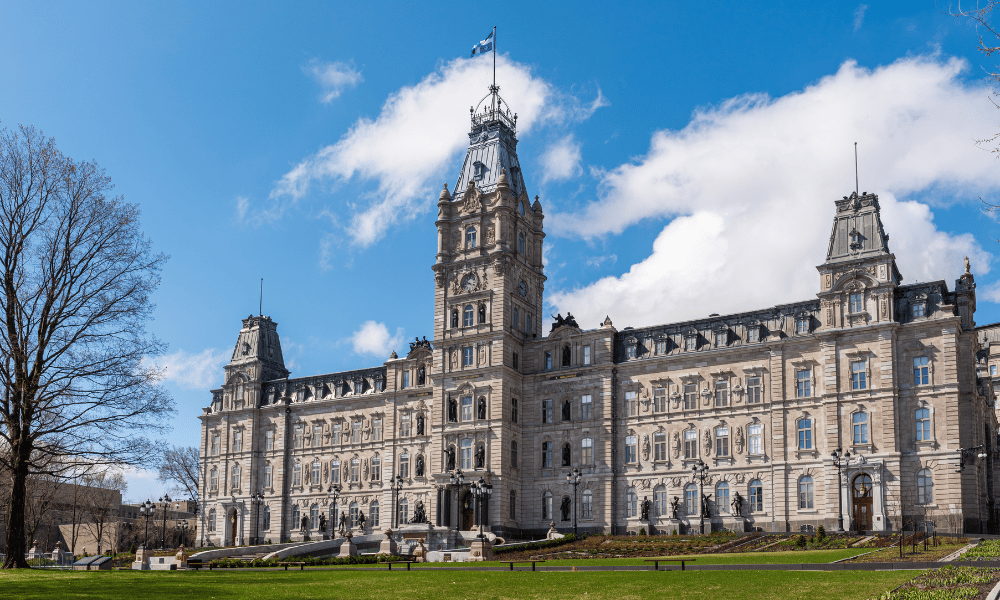
The Supreme Court of Canada has upheld Quebec's Bill 21, the province's secularism law that bars certain public servants from wearing religious symbols on the job.
However, the court struck down one part of the law, and the justices were sharply divided on the role courts should play when governments invoke the notwithstanding clause.
The court dismissed the appeals and Quebec's cross-appeal on Friday in English Montreal School Board v. Quebec (Attorney General), 2026 SCC 41. It found the Act respecting the laicity of the State to be "valid and operative," apart from section 8. That section is now of no force or effect, but only as it applies to members of the National Assembly.
The ruling produced four sets of reasons from seven judges. Chief Justice Richard Wagner wrote the lead reasons, joined by justices Suzanne Côté and Malcolm Rowe. Justice Nicholas Kasirer wrote separately. Justice Sheilah Martin also wrote her own reasons, while justices Andromache Karakatsanis and Michelle O'Bonsawin wrote jointly. Four of the seven judges dissented in part.
'Quebec's legitimate and historical commitment'
Bill 21 was passed by the National Assembly on June 16, 2019. It prohibits people in certain positions of authority from wearing religious symbols while exercising their functions, including judges, police officers, prosecutors, lawyers acting for the state, and school principals, vice-principals and teachers.
It also requires some people to have their faces uncovered to provide or receive certain public services. According to CTV News, the law passed 73-35 under the previous Coalition Avenir Québec government, with Parti Québécois support.
The law invokes both section 33 of the Canadian Charter of Rights and Freedoms, known as the notwithstanding clause, and the equivalent override provision in Quebec's own Charter of human rights and freedoms. Those declarations shield it from challenges based on freedom of religion, freedom of expression and equality rights.
In his reasons, Wagner traced the law's roots through Quebec's history, from the Quiet Revolution to the 2008 Bouchard-Taylor Commission. "In short, Bill 21 is rooted in Quebec's legitimate and historical commitment to ensuring the laicity of the state in a free and democratic society," he wrote.
He also acknowledged the law's human cost. "Bill 21's stigmatizing and deleterious effects on the persons so affected, most of whom are Muslim women, whether French-speaking or English-speaking, must not be underestimated," Wagner wrote.
Notwithstanding clause sets 'requirements of form only'
The heart of the case was the notwithstanding clause. The court had considered it directly only once before, in its 1988 decision in Ford v. Quebec.
Wagner's reasons reaffirmed Ford. He held that section 33 imposes only formal requirements: an express declaration that names the Charter provisions being overridden and that expires after five years unless renewed. He rejected arguments that a government must show a pressing and substantial objective, or wait for a court ruling, before using the clause.
He described section 33 as "the cornerstone of the Canadian model" of rights protection, rather than an anomaly. Without it, he wrote, the Charter would likely never have been adopted. He also said the clause holds particular importance in Quebec, which never consented to the 1982 Constitution.
Wagner further concluded that once the clause is validly invoked, courts cannot issue a declaration that the law violates the overridden rights. "The Court should not arrogate to itself, under the guise of constitutional interpretation or theoretical reasoning, a power that the Constitution purposely does not confer on it," he wrote.
That position did not command a majority of the court, however.
Four judges say courts can still speak
Kasirer, Martin, Karakatsanis and O'Bonsawin each wrote that superior courts retain the power to declare that a law shielded by the notwithstanding clause infringes Charter rights, even though such a declaration would not strike the law down. In their view, such declarations inform voters, who decide every five years whether to renew the override.
Kasirer and the joint reasons of Karakatsanis and O'Bonsawin went further and would have issued that declaration in this case. They found that sections 6 and 8 of Bill 21 unjustifiably infringe freedom of religion, freedom of expression and equality rights. They also concluded that the law remains valid because of section 33.
"Sections 6 and 8 of the Act put devout Quebecers in a terrible dilemma: betray their religious convictions or be excluded from avenues of public service and employment," Karakatsanis and O'Bonsawin wrote.
Martin agreed that courts retain the power to issue declarations. She said one was unnecessary in this case because she would have struck the provisions down on other grounds.
These judges noted that Quebec's attorney general chose not to try to justify the law's limits on rights under section 1 of the Charter, despite an invitation from the court to make written submissions on the question.
Limits on the notwithstanding clause
Kasirer, Karakatsanis and O'Bonsawin also wrote that section 33 has substantive limits. In their view, it cannot be used to amend the Constitution, to permanently extinguish a Charter right, or, in the words of the joint reasons, to authorize laws "incompatible with the fundamental character of Canada's free and democratic society."
The joint reasons opened by quoting the court's recent Democracy Watch decision: "An unlimited power is, definitionally, not a legal power."
All three concluded, however, that Bill 21 stays within those limits. Its effects are confined to certain state functions and would end if the override declaration is not renewed. Martin said it was unnecessary to decide whether such limits exist.
Gender equality argument rejected 4-3
The English Montreal School Board argued that section 28 of the Charter, which guarantees rights and freedoms "equally to male and female persons," cannot be overridden by the notwithstanding clause. The board said section 28 invalidates a law that falls hardest on Muslim women.
A four-judge majority disagreed. Wagner, Côté, Rowe and Kasirer held that section 28 does not create a stand-alone right that could be used to strike down a law. Wagner wrote that the board's reading would create a hierarchy of rights favouring women over other marginalized groups.
Martin, Karakatsanis and O'Bonsawin dissented. They would have declared sections 6 and 8 of no force or effect for violating section 28. Martin described the provision as both an interpretive guide and a substantive guarantee that the notwithstanding clause cannot reach. Karakatsanis and O'Bonsawin called section 28 "the Charter's other notwithstanding clause."
The dissenters pointed to the trial judge's finding about the Centre de services scolaire de Montréal: every job application file closed there because of Bill 21 belonged to a Muslim woman who wore a hijab.
School boards lose minority language challenge
The court also rejected, by a 4-2 margin, the argument that Bill 21 infringes the minority language education rights in section 23 of the Charter. Martin did not decide the issue. The trial judge had exempted English-language schools from the religious symbols ban, but the Quebec Court of Appeal overturned that exemption in 2024.
Wagner accepted that Bill 21 limits the ability of English-language school boards to hire, retain and promote people who wear religious symbols. But he found no evidence that it impairs the minority's ability to preserve and transmit its language and culture, which is what section 23 protects. Making any value a school board holds into a protected cultural interest, he wrote, "would be to transform s. 23 into a right to complete institutional autonomy."
Karakatsanis and O'Bonsawin dissented on this point. They accepted the trial judge's finding that religious diversity is a legitimate cultural concern of Quebec's English-speaking minority. They would have declared key provisions of the law of no force or effect for English-language school boards.
Face-covering rule for MNAs falls
The judges agreed on one point. Section 8 of Bill 21 requires members of the National Assembly to exercise their functions with their faces uncovered, and that requirement violates section 3 of the Charter. Section 3 guarantees every citizen the right to vote and to be qualified for membership in a legislature, and the notwithstanding clause cannot override it.
The requirement, Wagner wrote, prevents elected members whose religious beliefs require a face covering "from exercising their right to sit in the National Assembly and to participate in the legislative process." Because Quebec offered no justification, that application of section 8 is of no force or effect.
The court found that section 3 does not extend to the roles of justice minister or president or vice-president of the National Assembly. The religious symbols ban for those positions therefore stands.
Other challenges rejected
The court also rejected arguments that Bill 21 falls outside provincial jurisdiction, conflicts with pre-Confederation statutes protecting religious freedom, or violates Canada's constitutional architecture. It also dismissed a challenge to the Quebec education ministry's 2018–19 count of school staff who wear religious symbols.
The appeals were heard over four days in March 2026. The court noted that nearly 150 lawyers appeared for the parties and dozens of interveners, including the federal government and five other provinces. No costs were awarded.