Half of workers hurt by AI cite stress as training and role-level guidance lag

AI adoption is outpacing Canadian employers' efforts to prepare people for it, leaving HR to absorb the stress, according to a new report.
The survey found 63 per cent of Canadian workers have used AI in their jobs, but just 21 per cent use it regularly against a global rate of 34 per cent.
"When AI tools are introduced without adapting workflow, providing clear guidelines, or offering proper training, employees experience stress and disorientation rather than empowerment," says Teresa Palandra, CEO of Marsh Canada, in Toronto which did the report.
The pressure is growing. Statistics Canada reported that 19.2 per cent of businesses used AI to produce goods or deliver services in the year to the second quarter of 2026, up from 12.2 per cent.
Why AI adoption is raising stress levels
Faster uptake is not making workdays easier. One in five Canadian workers say AI has hurt their job, Marsh found, and half of them name stress as the main effect, versus 35 per cent globally.
Workload is part of the problem. Another 38 per cent say AI has added to their workload, largely from checking its output.
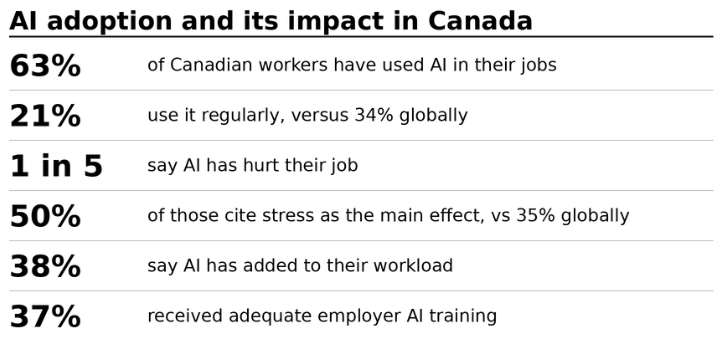
Preparation appears to be the missing piece. The 2026 TD AI Insights Report, conducted by Ipsos among 2,501 Canadian adults, found only 37 per cent had received adequate employer AI training.
Training gap runs uphill
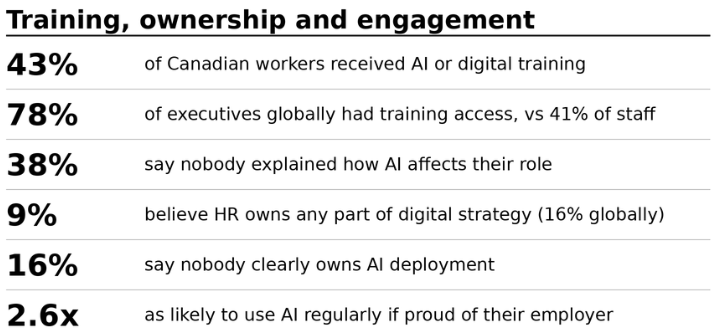
Where training exists, it is unevenly shared. Marsh found it reached just 43 per cent of Canadian workers, mostly through short online courses. Across all 10 countries surveyed, 78 per cent of executives had access, versus 41 per cent of professional staff.
Communication lags too: 38 per cent of Canadians say nobody had explained how AI would affect their role, echoing earlier reporting that AI use is up, but worker training is falling behind across employers.
Spending priorities help explain why. In a 2026 Capital One Canada survey of 1,004 professionals, 51 per cent said their employer focused mostly on new tools, versus 11 per cent on employee development.
"While the adoption of new technology is critical, it's important that employers remain focused on the people side of the equation," said Susan Zettergren, chief people officer at Toronto-based Capital One Canada.
Who owns AI adoption in the workplace?
Those gaps raise a question of accountability. Only nine per cent of Canadian workers believe HR owns any part of digital strategy, found Marsh, versus 16 per cent globally, while 16 per cent said nobody clearly owns AI deployment.
That vacuum carries privacy risk. Even with Canadians more likely than global peers to stick with approved tools, concerns persist over why employees keep turning to shadow AI tools. Canada's privacy regulators have said organizations using generative AI must comply with existing privacy law.
Engagement may be HR's strongest lever: Marsh found employees proud of their employer were 2.6 times as likely to use AI regularly. Marsh urges HR to vet tools, set clear norms and extend training equitably. Rebuilding trust is key, as Canada ranks near the bottom globally for AI trust.