Experts explain legalities, best practices to deal with discriminatory comments, other forms of 'passive' pushback to DEI

If there’s one thing that Canadian experts can agree on, it’s that a rise in discriminatory jokes and other passive forms of opposition to DEI (diversity, equity and inclusion) in some workplaces is “not surprising.”
For Jordan Cantor, employment lawyer at Whitten & Lublin in Toronto, it’s been a long time coming, as employees need only look south of the border to feel empowered to speak their mind: “We're not American, but it has global, cultural impacts in that people think it's okay to say whatever they want, because the leader of the free world says whatever he wants.”
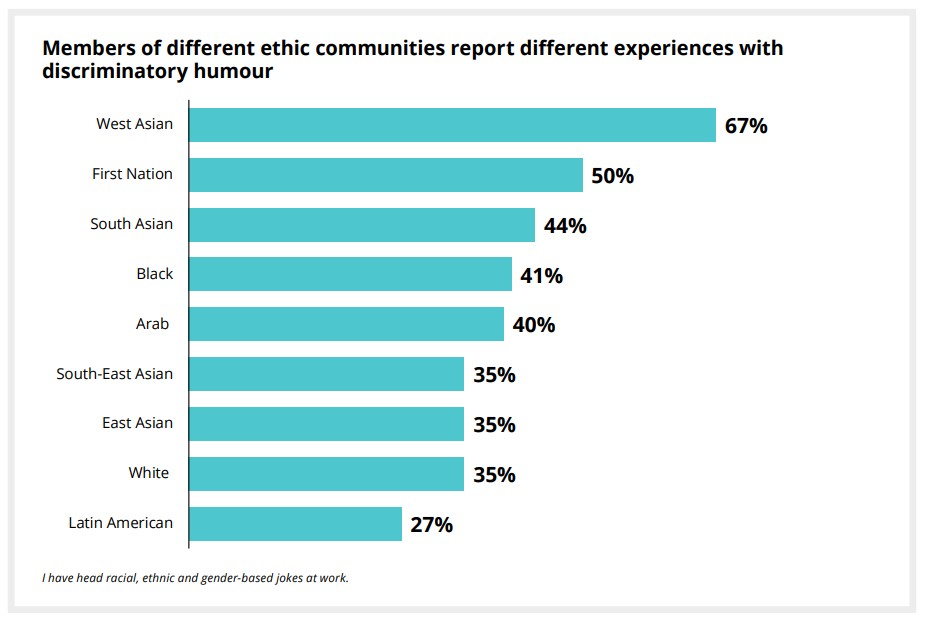
A report, EDI in Canadian Marketing: Positive Progress and Persistent Challenges, based on responses from nearly 500 Canadian marketing professionals, found that 39% of respondents heard racial, ethnic, or gender-based jokes at work this year – an eight-point increase over 2024.
And 64% of Canadian professionals from marginalized communities have witnessed pushback against EDI initiatives, compared to 42% of their non-marginalized peers.
Legal issues with discriminatory comments
From a legal standpoint, Cantor lays clear the consequences of employers ignoring signs of passive DEI pushback, opening the door for toxic workplace or constructive dismissal claims, for example.
“You can't chain someone to their desk and force them to watch training. Our society doesn't necessarily operate like that,” he says.
“But if you're an organization and you care about maintaining a healthy, diverse workplace where people feel respected, and you have people who aren't actively participating in that, you have a problem on your hands.”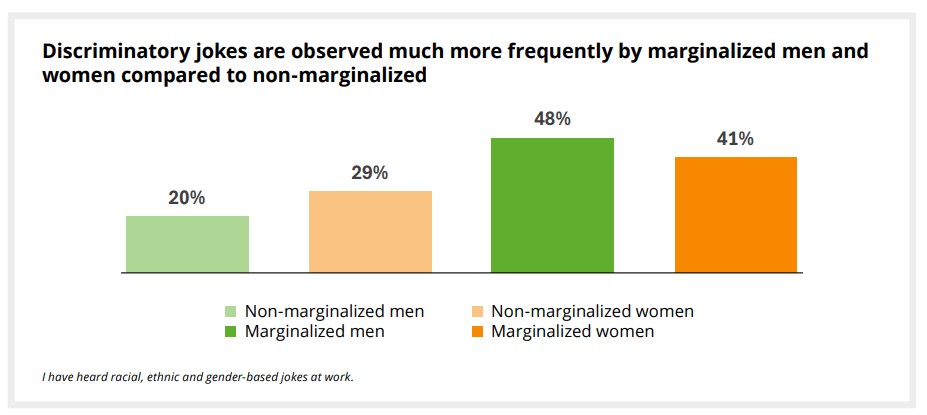
From a legal perspective, Cantor stresses the need for consistency and objectivity and avoiding biased or discriminatory enforcement of policies; he warns that selective enforcement can itself be a violation.
“If an organization is only enforcing these policies against certain individuals, that, in itself could be a contravention of the Human Rights Code,” he says.
“Regardless of who makes the comment, regardless if it's a straight, cisgender, white, heterosexual, male versus anyone else, organizations need to be consistent in ensuring that no matter who says these sorts of comments, they take a proactive approach, and they take a disciplinary approach.”
Cantor also highlights the risks of failing to address discriminatory behaviour while it’s at the “passive” or subtle stage, explaining that ultimately, the company can be liable for its employees’ actions.
“If you're an organization, and you allow sexism, homophobia, other things like that, to run rampant, you run the risk of employees resigning and claiming constructive dismissal, and that they felt that the workplace was toxic, and that there were micro and macro aggressions in the workplace,” he says.
“If someone is claiming a human rights claim that they suffered discrimination, the company is vicariously liable for its employees. If you want to reduce your risk of constructive dismissal claims or of human rights claims, you really should get your organization in line.”
Reporting discriminatory jokes
Alyson Byrne, associate professor in organizational behaviour and human resource management at Memorial University in Newfoundland, points out that social norms around humour make it especially difficult for employees to challenge or report inappropriate jokes.
“It doesn't surprise me entirely that it's rising in workplaces,” she says.
“We often laugh at jokes because there's social norms around jokes. We believe it's acceptable to laugh at a joke even before we've processed whether the joke was funny or whether the social intent behind the joke was acceptable or something that we would align with.”

Reporting discriminatory jokes is challenging for employees, especially when policies around humour are vague or nonexistent, Byrne says.
“Trying to bring it up to HR may seem more challenging, because there's in all likelihood very limited policies around humour at work, where there might be more overt policies around outright discrimination,” she says.
“And then the manager's role, about taking it seriously, is also very difficult.”
Because of this difficulty in pinpointing discriminatory humour, Cantor emphasizes the importance of organizational commitment to get ahead of the problem – not just a reliance on policies.
“Organizations should have policies and procedures in place to deal with both overt and covert aspects of discrimination, but it really requires organizational buy-in,” he says.
“Because you can have all the policies in the world, but it's about, do organizations actually care about these things?”
Passive pushback to DEI
The EDI report found that most common forms of pushback against DEI initiatives are a reluctance to allocate resources and ‘passive resistance’, such as ignoring policies or not participating in DEI training.
It can also go beyond purely passive to undermining behaviour, Byrne says, “where people are not only just not showing up for training, but they're disparaging it through gossip, through means of undermining the efforts of HR or managers who are trying to be more inclusive.”
The causes of passive pushback are complex and not limited to any one group; as Byrne explains, this speaks to a larger inclination by people to want to fit in.
“People want to be part of an ‘in’ group. So if they see others engaging in these types of discriminatory jokes, they are also, in all likelihood, willing to take part in those types of jokes as well.”
Mandatory DEI training may also be part of the problem; Byrne notes that it is human nature to push back against mandatory requirements, especially when there is a perceived judgement attached.
“There's pretty good data that suggests that this mandatory EDI training hasn't been working for a while,” she says.
“This isn't new. People don't respond well to feeling controlled, and mandatory EDI training, unfortunately, tends to have this implicit message underneath it that says, ‘If you don't show up, unless you are forced to come here, you are going to engage in these negative behaviours.'”
'Virtue signaling' and DEI initiatives
Byrne stresses the importance of adopting evidence-based DEI approaches as opposed to trendy social media campaigns or the like.
“For example, there's some research that suggests when we're looking for internal promotions, rather than asking employees to apply if they want to be considered for the job, actually ask them to opt out if they don't want to be considered for the job.”
Research-based and proven strategies can be more impactful than statements, she says: “Employees are smart and they can read through the virtue signaling pretty quickly.”
The key for HR is to look for behavioural outcomes, Byrne says, through formal measuring and documentation.
“First off, it needs to be measured. And if you're not measuring the effectiveness of your training or your DEI efforts, that's a problem, because you need to have accountability associated with these types of practices,” she says.0
“If you're seeing minimal changes, or, in fact, if you're seeing regression, then I think it's fair to assume that there's probably these types of passive undermining behaviours going on behind the scenes.”