'Maybe there's ways they can do things that nobody else can do,' says researcher, as neurodivergent workers feel they must work harder than neurotypical peers to be seen as competent
A recent survey of almost 1,000 diagnosed neurodivergent adults in the U.S. sheds light on the challenges those workers experience during every stage of the work cycle.
The survey, conducted by resumé builder Zety, found that almost all (94%) of neurodivergent job hunters don’t feel they can reveal their neurodivergence during hiring. Almost as many (93%) believe traditional application and interview methods create unfair barriers that keep them from being hired.
Ryan Collis, autism researcher and PhD student in education at York University, stressed that the situation is the same for neurodivergent employees in Canada.
“There's a lot of difference when it comes to things like race or gender. But I think because there's been so little research and so little effort in the area of neurodivergence and disability support in general, I don't think they're any further ahead or behind us … I think it is very reflective.”
Collis’s own autism research backs up the findings; an article published this year in the Canadian Journal of Higher Education, “Disability, Post-secondary Access, Graduation, and Income Earnings”, revealed that post-secondary credentials do not equal higher earnings for disabled employees; in fact, there is an inverse effect at play.
“Among college graduates, disabled workers earned approximately $5,400 less than their non-disabled counterparts,” the report states. However, “the greatest gap in earnings was observed among graduates with a university degree; university graduates with disabilities earned just over $9,000 less than their non-disabled counterparts ($41,175 versus $50,270).”
Employer awareness of neurodivergent employee stereotypes
The Zety report found that 93 per cent of neurodivergent employees believe they have been passed over for jobs due to bias, and 51 per cent have been subjected to jokes or insensitive comments at work. Plus, almost half (46%) reported "masking" (hiding their natural behaviours to fit in) on a daily basis, resulting in an emotional and physical toll.
Collis warns that when employers lack awareness or personal experience with neurodiversity, stereotypes and misinformation can fill the gap.
“If the employer doesn't actually know anybody … then the more likely they are to rely on the stereotypes. And the stereotypes are generally not positive,” he says.
This is something that neurotypical employees are acutely aware of, he adds, which may lead to them hiding their disability.
“If you don't know what your employer knows, then the odds are relatively good they're going to know the bad stuff, the fake stuff, the stuff that we're seeing more coming out of the States now, especially with RFK and his interesting beliefs on neurodiversity and autism,” he says.
“If you don't know how they're going to react, that's a very large gamble, because that could permanently affect the way they treat you. There's a lot of fear around ‘How will they take this? How will how will they treat me differently, if they know this?’”
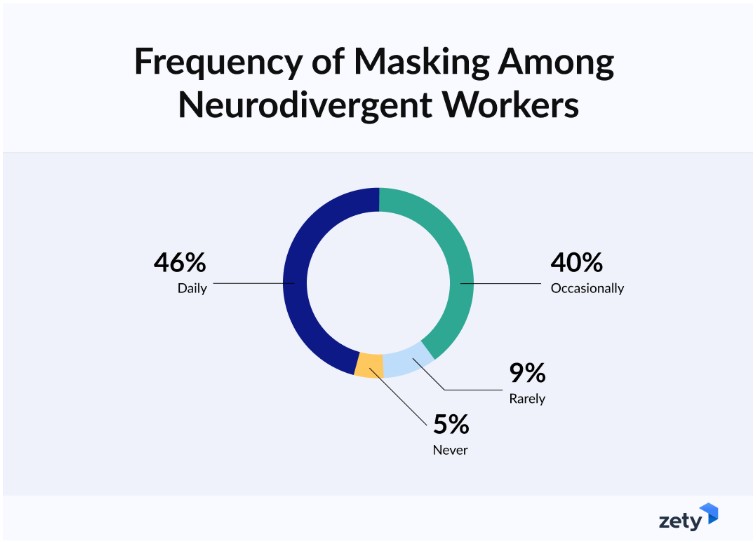
Source: Zety "Neurodivergence in the Workplace Report"
Social isolation of neurodivergent employees
The Zety survey also revealed that 24 percent of neurodivergent employees experienced social isolation or lack of manager support. Collis says that exclusion is often unintentional but still detrimental to the careers of these employees.
He explains that this exclusion can be chalked up to simple miscommunication, and is also easily solved by a rule of explicit communication around meeting and social invites.
“A lot of it is just the phrasing and just the fact that it may not be clear to the person that they're being included,” he says.
“I think that is a major aspect of things, especially things like social stuff at work, just because it's not necessarily something anyone really considered, that, ‘Did you explicitly invite Bob? Because if you don't explicitly invite Bob, Bob is not going to realize you're actually asking him to come. Because Bob doesn't realize we like having Bob around. Bob thinks Bob is a burden on the rest of us, and Bob can't imagine we actually want Bob to hang out with us.’”
For HR, Collis says, this means visible, ongoing education and leadership on neurodiversity and communication is critical to breaking down stigma and encouraging disclosure.
Flexibility in schedules and work styles
The Zety research highlights that 93 per cent of neurodivergent employees have experienced burnout due to a lack of support for their needs, and 88 per cent feel they must work harder than neurotypical peers just to be seen as competent.
For Collis, this means that employers and HR must go beyond messaging about support and demonstrate support through flexibility and a willingness to adapt to different work styles.
A big barrier for neurodivergent employees is rigid work schedules and routines, he explains.
“Part of demonstrating this willingness to support those people, is willingness to allow them to determine how their day is going to be focused,” Collis says.
“Their hours may be different. They may not be functional in the morning or the afternoon. If there are ‘ADHDers’, they may take medication the morning that may wear off by 3:30, and so they may not be able to actually get any high-focus work done in the last half of the day, so they may have to reschedule or reorganize their day.”
Fear of retaliation after disclosure
However, he reminds employers that this process requires a certain base level of trust on the part of the employee that there won’t be retaliation if they disclose their disability and its challenges.
“If the employee doesn't trust you enough to share those needs with you, you can't accommodate them. If you can't accommodate them, you're not getting the best work out of your employees, and both of you are losing at the end of the day,” he says.
“Being able to support those people means they get they do better work. You get better results. Everybody wins.”
Hiring practices and neurodivergent employees
The Zety report found that 93 per cent of neurodivergent employees believe traditional hiring practices like timed tests and unstructured interviews create unfair barriers. Collis agrees, noting that hiring is often based on interpersonal expectations that disadvantage neurodivergent candidates.
“Hiring is a big one, because most hiring is based on interpersonal relationships, whether it's interviews or timed tests or a sample question or whatnot,” he says, explaining that neurodivergent individuals struggle with direct questions.
But it goes far beyond just answering questions, he stresses.
“You also have the fact that certain expectations exist. So an employee who's not looking you in the eye, if your assumption is, if they don't meet the eye, they are not honest … then you already have a conflict between the two personalities, or the two world views, or however you want to consider it,” he explains.
“Since the employers in that situation are the ones with all the power, they're the ones who have to do more of the accommodating.”
Job interview pitfalls for neurodivergent employees
Collis points out that job interviews often penalize neurodivergent candidates for behaviours that are unrelated to job performance, such as fidgeting while concentrating, closing eyes to listen if there is a lot of sensory information in the environment, and not making eye contact.
“All of those things look bad to an employer who doesn't expect those things,” he says.
“So we find that the neuro-normative view of what an employee in an interview looks like, is very detrimental to non-neuro-normative interviewees. If you're sitting there and you're fidgeting, but that's how as an ADHD person you focus, you need to do that, because if you don't [focus], you’re deemed to be bad. But if you [fidget], you're perceived to be bad. Therefore, you lose no matter what.”
He also adds that self-promotion, usually an important aspect of job interviews, can be especially challenging for neurodivergent individuals, due to their generally more direct communication style.
“The type of flourishes that tend to impress people aren't factual flourishes, necessarily,” he says.
“And therefore they may not come as naturally to neurodivergent job seekers as they might to someone who is more willing to … puff themselves up.”
Understanding atypical work of neurodivergent workers
The Zety report highlights that 53 per cent of neurodivergent employees have been left out of meetings or projects, and 32 per cent have been denied promotions or growth opportunities.
Collis explains that these factors, plus a myriad other interpersonal and social differences, can lead to more job and career changes – traditionally a red flag for many hiring managers – due to burnout and a sense of “giving up” on the part of the employee.
The challenge for employers and HR, he says, is to find the balance between challenging neurodivergent employees and not burning them out – boredom is a productivity killer for many neurodivergent employees, but as the Zety report reveals, many of them (88%) also tend to overwork themselves in an effort to measure up to their neurotypical counterparts.
“You've got boredom on one end, you've got burnout the other,” Collis says.
“You need to try and stay in the sweet spot. If you end up in boredom, getting work done is nearly impossible. If you end up in burnout, you can't work now or for some amount of time in the future, till you can recover from the burnout.”
Burnout and employee turnover
This burnout leads to many neurodivergent employees quitting; however, Collis offers a way for recruiting managers to look beyond a spotty-appearing work history to what might actually be going on, which is a potentially high performer looking for their niche.
The key is looking for candidates who are working in varying positions or areas of the same field, he says. This indicates a commitment to an area of expertise, but that the person has not yet found the right place where they can thrive.
“If you know the person is doing different jobs because they're trying to find that thing that works for them, that thing that actually excites them, that interests them, that that should be visible from that pattern of different jobs,” he explains.
“If you can see that they're trying different things, they're trying to find that niche where they can stay between those two ends, then maybe your job is the right one for them.”
Leveraging diverse skill sets and mastery
The Zety research and the “Embedded Barriers” study both highlight the value of neurodivergent employees’ unique skills. Collis adds that neurodivergent employees often bring a wide range of expertise that stem from diverse work experience and interests – as well as the ability to adapt and even master new tasks and responsibilities.
“Mastering skills itself can be a fun thing, can be a thing that's challenging, can be a thing that keeps them interested and focused,” he says.
“And then once they've mastered two different things, they’re now experts in two different areas in your industry. Maybe there's ways they can do things that nobody else can do.”
This makes them additionally valuable as cross-trained experts, he says, adding that burning out or bored neurodivergent employees are well positioned to potentially be trained or transitioned into multi-skilled roles.
“They're very good at what they do, but clearly they're reaching that point where, this is going to be another one of those gaps the resumé, where they hit the point where it's like, ‘This isn't worth it anymore,’” Collis says.
“That's where [it’s about] looking at what other skill sets can the company use? Neurodivergent people tend to have incredibly complicated, complex, messed-up, weird sets of skills … we tend to be very interdisciplinary, cross-disciplinary, transdisciplinary, and so that itself is a useful skill. If the person has already mastered the skill to the point where it’s starting to get boring to them, well, what else can you give them to do where they can use that skill and help with something else?”