3 Canadian HR leaders talk about the tools they’re using – with impressive results
Moving your employees internally can have a lot of benefits: employee retention, talent development and overall organizational success.
But these days, people aren’t staying in the same job for the same length of time, and the shelf life of skills is much shorter than it used to be with emerging technologies, according to Annabell Tamburro, vice president of human and corporate capital at Canso Investment Counsel.
“What you have left is a conundrum, where you have companies with too many workers with skill sets that are obsolete, while having a number of hot new roles to fill with skill sets that are new and emerging. The secret then is bridging the gap between these employees with obsolete skill sets in training them, reskilling them to new roles where they’re going to add value to the organization.”
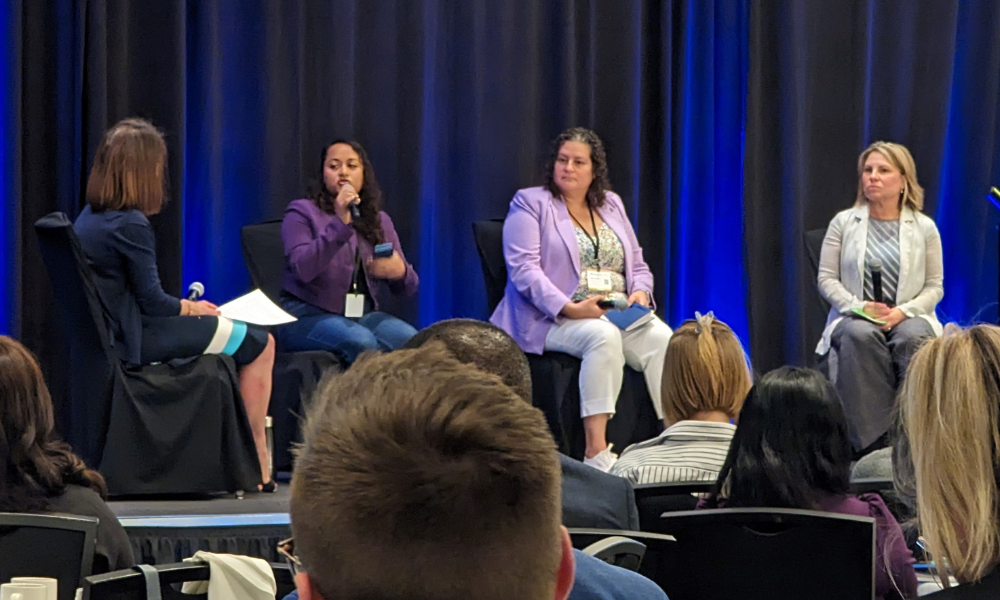
On that note, three HR leaders — Surma Guha, chief people officer at Pizza Hut Canada; Miriam Ibrahim, director of strategic talent management at Centennial College; and Shawna McNamee, VP of people and culture at Book4Time — recently spoke on a panel at HRD’s HR Tech Summit Canada, moderated by Tamburro.
They provided plenty of insights about their experiences using technology to improve internal mobility and career development for staff.
Mini gig economy expands internal mobility
At Centennial College, the organization is committed to internal talent, says Ibrahim.
But it’s not always easy when there’s a new need or a new gap and a “desperate” search to find “somebody who is capable to hit the ground running,” she says.
There’s also the challenge of internal competition.
“Sometimes you get the previous manager that says, ‘Why are you taking my best talent?’ Like this person is holding up the team,” says Ibrahim.
So in terms of thinking strategically about internal mobility and investing in your people, technology can be a big help.
That can include a good LMS (learning management system), learning experience platform (LXP) or just-in-time training tools. But when she was at TD, Ibrahim recalls a platform that created a mini gig economy within the organization.
“That technology enabled that visibility into ‘Here's the skills that I have, here's the thing that I want to learn, and here's how much time I have that I can commit to — so I can give you one day a week or half a day, a week, one day a month.’
“And then people who needed projects could put in and say, ‘OK, I need three people who can develop in this particular programming language, which is new, and it's going to be a 30-hour project; I'll take the five hours that you have or the 15 hours that you have and the 10 hours that somebody else has, and we're going to put those together and you get the stretch of learning and growth and development, and I get the work that I need to get done done, and some visibility into some talent that's available in the organization, which is sometimes hard to do, and the opportunity for that to progress and grow.”
Company boosts engagement, retention with focus on internal talent
McNamee joined Book4Time in January 2022 and at the time, turnover was 54 per cent — meaning at a company with fewer than 100 employees, they were losing five people a month.
“It’s a disruptor, and not of the good kind,” she says.
People didn’t have a lot of pride in their employer, and it was hard for them to understand this might be a place where they could build their career, and learn and develop, says McNamee.
So the HR leader did her research, looking at the HRIS system, talking to employees about their future plans, and talking to leaders.
“With that gap analysis, it became pretty clear to me that we were running on the hamster wheel of trying to keep up the pace of replacing hires, not just finding good hires or great hires, although they were wonderful people, they just weren't the right hires for the organization. And that's a double-edged sword for both the company and for the person that took a chance on you as an organization,” she says.
So the company needed to pause and take a breath, and re-evaluate how it was bringing people onboard. That meant using a technology called The Predictive Index, which is based on an individual’s preferences of behaviour styles and cognitive styles, says McNamee.
In building a job profile, it looks at years of experience in technology or project management, but it is also about understanding the context: Is this person a driver or are they a collaborator? Are they individually motivated and good working alone? Do they need to be precise or can they be flexible and agile?
“[It’s about] all of the things that really make someone successful in a role,” she says. “We all have our career derivatives… there are some nuances or contextual differences about an organization or what's required of you in that role, that would make one role a better fit over another. And that's what we're looking for with this technology.”
Applicants are given the assessment, which takes roughly 12 minutes to complete, and then the hiring manager or talent acquisition manager can use this data to really dig in during the interviews, says McNamee. For example, they can ask a candidate about their decision-making process.
“That will give you so much more information about the person you're bringing in to know whether or not they will be successful long term,” she says.
Of course, using the new tech required some behaviour changes from managers, so it was about them understanding how it would make their lives easier, she says.
“You say, ‘OK, you've done the assessment, you did a bit of different interviewing style… when an opportunity comes up, we know this person will be a really great fit for X.’”
In 2021, MacNamee says the company had three people who could move internally at Book4Time. By 2022, that number had climbed to 11 — and so far in 2023, they’ve already had 12.
“I'm sure that we're going to be able to double the internal movement just by being able to build this pipeline and being able to better assess transferable skills, the skills that are interpersonal, that really help someone to be successful in a new department, and new team working relationships, etc.”
Plus, turnover has gone down from 54 per cent to six per cent, she says.
“Now I'm not going to say it's all because of this one piece of technology — because there are a lot of levers you need to pull and to be able to utilize to make significant change like this — but it certainly is something that I leaned into very hard. And it was one of the first tools that I really put a business case together for to say, ‘We need to invest in this as it will drive our business in a positive way.’”
Boost for sales with ‘transparent’ technology, high-potential talent
When Guha worked at Thomson Reuters, there was a particular challenge with the sales team, in that they needed talent to work on building client databases — basically, pre-sales work.
But the small sales team was busy in the field talking to clients, so contractors were hired for the pre-sales work.
When the company looked at high-potential talent in its operation centres, one of the asks was exposure to the commercial side of the business, she says.
“So we were like, ‘We have this great piece of work that contract talent is doing, it's expensive, it takes time to train them: How can we give this opportunity to our internal talent within our operation centres, give them access to short-term assignments, projects, where they're still doing their primary role, but they have an opportunity to try a different skill set and show that they have an interest?’”
To that end, technology was “powerful” in creasing the transparency needed — and surpassing potential bias from managers.
“We just took the data to the employees directly. We had a tool where employees across the organization could see a short-term project or cycle that they will be a part of, we did some sort of deferred estimation, and then we just let the employees sell themselves,” says Guha.
“It resulted in great savings for our sales business. And it gave our operations centre talent an opportunity to spread their wings.”
Technology and career development
Of course, career development has changed in the last decade, she says.
“Employee loyalty is up for grabs. And we cannot retain our people unless we’re continuously growing and investing in them.
That means moving away from linear career development to non-linear development — instead of a career ladder, it’s a career lattice, she says.
“We've had a lot of our younger employees talk about learning experiences, like the YouTube learning or the Netflix of learning, where you have a bit of a direction in terms of what would be a good learning experience for you. But really, it’s self-serve, self-based — there are recommendations, machine-learning algorithms that will tell you what are the right training courses based on your learning style. And that's something that you're trying to do is to really have that self-paced approach to learning.”
Years ago, it was easy to tell what the career path of somebody would look like because it was a straight line, says Ibrahim.
“That's not the truth today. And so I think if we think about careers more as particular jobs being a cluster or grouping of skills or competencies… it gives them a chance to build those skill sets, showcase them, and then everybody build their individualized career lattice.”
Even open-sourced AI can help. For example, McNamee recently asked ChatGPT about how a product manager could grow to be a director, or a customer success specialist become a developer.
“It will give you both the linear path as well as the ‘OK, here's some project-based or competency-based shifts that you could make to move your career in a different direction if it's not linear.’”
However, this is not a hands-off tool, she says, as it needs to incorporate the consultant or business partner to fully understand it. For example, ChatGPT may suggest a move five levels out, but at a flat organization, that might not be possible.
“But it's a really good starting point for someone to be interested and learn about different ways other than just someone telling them what they need to do.”