'You have to be investing in training of your whole team all the time, so that you can adapt': experts explain how to avoid negative effects of accidental managers

“A problem with high performers is that they don't often know why other people can't do what they do.”
So says Richard Field, professor of strategy and management at the Alberta School of Business, in talking about “accidental managers.”
“It's like, ‘It's so easy, just do this,’ Field goes on, comparing the act of promoting high performers to a sports team making a star player the coach.
“You know that happens sometimes, and it's often difficult for them because they just can't understand why other players can't do what they could do.”
As recent research has been showing, accidental managers – or individuals who find themselves in leadership roles without prior experience or education in leadership – can have real impacts on organizational productivity, employee morale and retention.
In 2023, the UK-based Chartered Management Institute (CMI) reported that 82% of new managers fit this profile, entering their first role without any formal management or leadership training.
This is largely due to organizations not planning appropriately for change, says Field: “Some of them just hire individuals as required and hope that they can do the job.”
How ‘star players’ become accidental managers
A preference for experience over management training can be seen when managers retire or otherwise move on, Field explains; many employers will look to their present workforce for promotion into the empty space, often tapping the highest performers, the “stars,” as a seemingly natural choice.
“You think you're being rational,” says Field, “and you look at your team … [and] pick the best performer, the person who's doing best on the team, the star of the team. And that's probably the wrong choice for a couple of reasons.”
 Source: CMI Good Management Report
Contingency planning essential for effective manager training
If organizations engage in contingency and legacy planning before leaders leave, the effects of accidental managers can be mitigated, Field says. However, this doesn’t often happen as many organizations are more focused on current problems.
But it’s a strategy that can’t be avoided, he says, if long-term, effective management is a goal.
“They're trying to get through today and so they don't plan for the future. They don't think about contingencies,” he says.
“But that's the answer. You have to plan ahead. You have to be investing in training of your whole team, all the time, so that you can adapt when things happen.”
Why hire new grads or others with little experience?
Even with the risks associated with hiring inexperienced individuals into management positions, they still bring value to their teams, says Rafael Robert, CHRO of Elior North America – particularly, levels of comfort with technology that more mature managers might not possess.
“In this new landscape where technology has [come to the] forefront, the new graduates bring unique skillsets learned within their studies, which helps us explore and implement new systems and processes,” he says.
“They are passionate, eager, driven, and open to learning … graduates bring a fresh new set of ideas and a creative mindset that helps our organization grow.”
Chartered Managers Canada reported that AI and automation will continue to be a growing concern for human resources and management professionals in coming years – according to Gallup research, in the months between June 2023 and January 2024, the number of HR professionals planning and implementing genAI strategies in their workplaces doubled.
So, while new-career managers might lack the years of experience many hiring professionals seek in potential leaders, Robert points out that the hands-on tech experience new grads bring can potentially balance out that deficiency, “which helps us explore and implement new systems and processes.”
No way around formal training for effective management
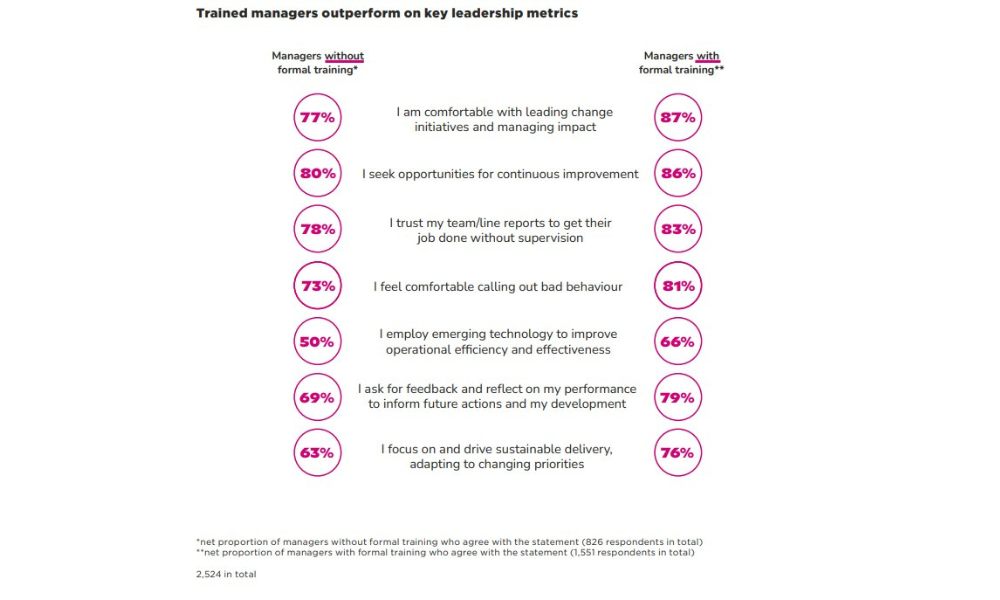
Trained managers are more comfortable in their roles and with managing change, the UK survey revealed, and are also more likely to use emerging technology to increase efficiency. They also lead to more loyal employees, with high levels of job satisfaction (74%) and motivation (77%) reported from workers who have “good” managers.
Rather than seeing new graduates as risky hires, Robert sees them as opportunities; by encouraging the “fire in the belly” mentality of these individuals, he says, they can be powerful levers for organizational growth.
“Our graduates our very career driven, and it’s up to us to provide them the continuous learning and mentoring as they enter the workforce,” he says.
“We look to partner more with universities and colleges … this is an integral strategic path to our succession plans as we look to grow our business.”
For Field, there is no way around formal training and education if an organization wants to ensure its managers are skilled and prepared for leadership. He points to McDonald’s “Hamburger University” in Chicago as a prime example of strong internal management training and a model HR leaders can look to.
Whole team training for management success
Another strong strategy for succession planning is training whole teams for transition success, Field says. This means all members of a team are prepared collaboratively for contingencies.
“You're not focused on the individual who is the next person who's going to be the leader,” he says. “You're focused on the idea of ‘This work is something that we all do together, and we all need to learn how to work together.’”
Through training entire teams – including managers and team members – on communication, decision making and teamwork, Field says, resiliency and cohesiveness can be increased.
“You're philosophically a little bit different,” he says.
“We become an effective team. And then if someone leaves — and it could be a person, a star, a regular player, it could be the coach, the manager of the team — we have this joint set of skills that we've developed that make us more resilient, and we can then shuffle roles and responsibilities and adapt.”