
Both employees and employers have concerns about going back to work
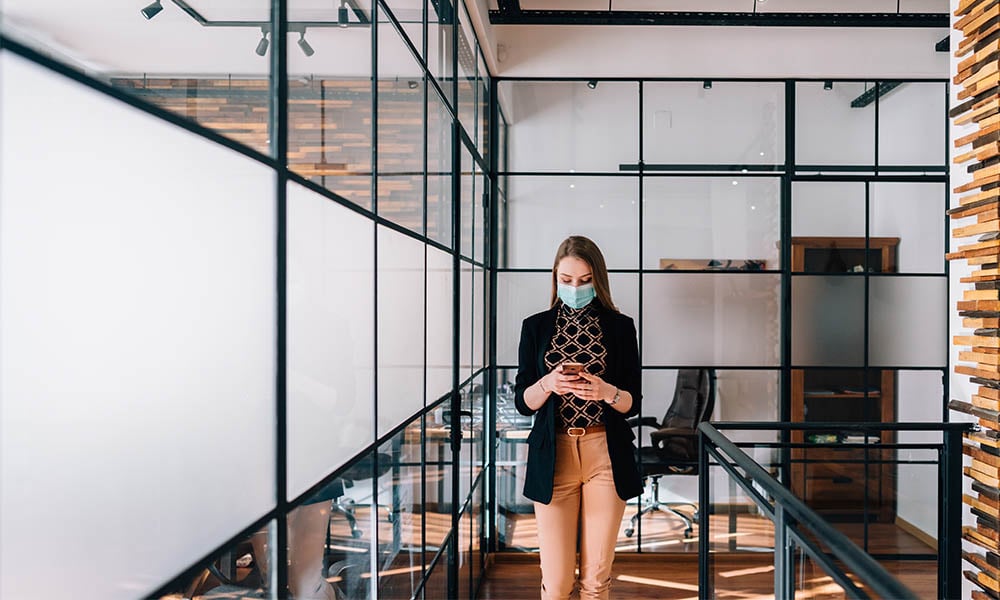
Workers are nervous. As much as they’re keen to escape the lockdowns of recent months and get back to old routines, they’re in no rush to return to their workplace if they don’t feel safe.
Employers are nervous, too, with many unsure how to maintain social distancing policies and follow the rules.
But with staggered work schedules, a changed office layout, new types of barriers and fewer in-person meetings, a “new normal” should be achievable, say experts.
Multi-pronged approach
Most companies are being very methodical as they look at this, says Cathy Hofknecht, managing partner at neuconcepts in Durham, N.C.
“They recognize the risk of not taking appropriate measures — imagine you have a large office and one person gets infected and now suddenly you have an outbreak in your office... That's why they're taking it slow.”
Organizations are going to come up with unique solutions that work for them, says Victoria Arrandale, assistant professor of occupational and environment health at the Dalla Lana School of Public Health at the University of Toronto.
“[It’s about] respecting the physical distance, maintaining good hygiene and having as few people as possible on site and supporting people who either need to stay home or are sick and have to stay home — for me, those are the guiding pillars that they need to be thinking about.”
With so much still unknown about the virus, it’s going to take a multi-pronged approach or a combination of efforts to try and reduce any transmission in the workplace, she says.
“We are learning and we are making the best decisions that we can with limited information.”
Employers want to make sure that their people feel safe, healthy and valued, says Annie Bergeron, principal and design director at Gensler in Toronto.
“They're preparing very carefully, very meticulously to mitigate risk for their employees. And they're also preparing all the communications around that, making sure that they hit the right tone and so on. Because no one can guarantee anyone's safety, but I think employers are demonstrating to their employees that they care and that they are doing everything possible to mitigate risk and to empower their people… with policies, with procedures,” she says.
Scheduling changes
Once people do start returning to the workplace, density is taking a hiatus, says Bergeron. That means having only a certain percentage of the workforce come back to ensure social distancing.
“This doesn't require sweeping architectural changes… that's more of a scheduling challenge.”
An employer could have some staff come to work Tuesdays and Thursdays, or Mondays and Wednesdays, and everybody working from home Fridays, says Doug Stewart, Cushman & Wakefield’s head of digital buildings practice in Charlotte, N.C.
“There's also some thoughts around ‘Hey, how do we start to monitor occupancy and utilization of space?’ So, [it’s about] reservation systems and if a group has to be in there during the day in a certain time, then they can be in there. And even though they're not face-to-face collaborating, they're within the same general area and able to have the interaction and conversations.”
Another best practice is for employers to keep good records on who exactly is at the worksite each day, says Arrandale.
“This will support the contact tracing that the.... public health system is trying to undertake… because, if a case arises, that's the type of information that can be very useful in contact tracing.”
Social distancing
Along with providing enhanced cleaning and hand sanitizer stations, employers can have workers travel in one direction so they don’t cross paths and limit meeting rooms to a small number of people — or close them altogether.
It’s likely that common areas with a lot of interaction, such as kitchens, will be closed in the short term while washrooms will have limited occupancy, says Arrandale.
“Those shared spaces where the high-touch surfaces exist are going to be challenging… So, instead of having everyone eating at one time, you have a rotational schedule, but there is going to be then a need for cleaning. So, it might be easier to ask people to stay at their desk for those breaks, acknowledging that that there may be other consequences to that, and people may not be happy or comfortable with that.”
For all of these, it’s helpful to have diagrams in the form of posters or signage, says Bergeron.
“This new behaviour is not business as usual, so it's not necessarily natural — people might forget. So, [it’s about] reinforcing the messaging that we are giving, perhaps virtually through revamped etiquette guides and… temporary visual cues.”
Floor graphics can also reinforce the six-foot radius recommended for distancing, says Hofknecht.
“There's the whole idea of how do you get people to understand what the social distancing protocols are in your office and how do you reinforce those habits so that people consistently follow them? Social distancing is not a natural state for most of us; it's a new skill. And, so, how does that translate when we get back to the workspace?”
One way to reinforce social distancing is wearable technology that can buzz or beep when a person comes too close. While this could make sense if people are not comfortable speaking up when a co-worker invades their space, there are questions around how effective it is, says Arrandale.
“I think there's more information needed before people jump in the deep end on that.”
It all depends on the appetite of the company and employees, and there are different granularities possible with occupancy and analytics, says Stewart.
“There’s a lot of great technology out there that says, ‘Hey, we can we can tell you when somebody comes within six feet of somebody’ but the answer is going to be ‘OK, then what happens?’” he says. “We might know somebody, for lack of a better term, is a ‘habitual offender’ and maybe there's some corrective action [needed], but you're not going see that until there's some analytics done.”
Barriers and face coverings
When it comes to actual workstations, employers can try a “checkerboard” approach to separate people and look at expanding individual work areas.
Despite the big push in recent years for open offices, that concept is not going to be popular going forward, says Hofknecht. Instead, protective barriers can be attached to workstations, such as clear or frosted Plexiglass.
“That helps create that extra distance that you have between people and creates that extra barrier.”
While we don’t have good evidence as to how effective those barriers are, they still have value in a quantitative sense, says Arrandale.
“They're fairly easy to manufacture and install. It also gives a physical reminder to people to keep their physical distance... So, they very well may be effective in reducing this droplet spread.”
As for face coverings, this is advisable if workers cannot maintain a six-foot distance from each other, she says.
“The suggestion is that they will reduce transmission so they'll protect the people around the wearer rather than protecting the wearer as we would think of for a respirator… It's low risk and it potentially has a lot of benefits.”
However, some people may not feel comfortable wearing a mask, says Hofknecht. Citing the speeches of New York Governor Andrew Cuomo, it’s not necessarily about telling people what to do but why they should do it, she says. “I'm wearing a mask to protect you. You wear a mask to protect me, that's how we show respect for one another.”
And while some employers might be tempted to conduct temperature screening, that’s a tricky area, says Arrandale.
“You're only monitoring one symptom of a complicated virus that we don't know a lot about. And there are many other symptoms in it… Some people are asymptomatic… You still may miss people. My worry would be that it would give a false sense of security about who is on-site. And that may lead to a relaxing around other prevention measures. So, it certainly could be one piece of a larger puzzle.”
WORKERS LOOKING FOR ASSURANCES IN RETURNING TO WORK
51%
Notify me if a coworker tests positive for COVID-19
51%
Customers follow safety and hygiene practices
50%
There are cleanliness and disinfecting procedures
49%
There are clear response and shut-down protocols if someone tests positive
Source: PwC (U.S.)



