'It is critical for companies to reward and nurture high performers to the best of their ability, especially in periods of a downturn'

With all the upheaval in the markets thanks to tariff uncertainty, compensation planning is no easy task.
But employers shouldn’t be short-sighted when taking money-saving measures in the form of less compensation, as failing to reward high performers during downtrends can have negative results in the future, says Phil Cyrenne (pictured top right), professor of industrial organization and economics at the University of Winnipeg.
“When business slows for a company, the slowness is often shared by other companies in the industry. This means each company is less prone to lose employees during that period,” he explains.
“However, if a high-performing employee does not feel they were treated relatively fairly during the slow period, they are among the first to leave when business in the industry picks up. It is critical for companies to reward and nurture high performers to the best of their ability, especially in periods of a downturn.”
Economic uncertainty, rising debt, and housing costs are putting immense pressure on workers, says Peter Tzanetakis, president and CEO of the National Payroll Institute (NPI), affecting both their productivity and overall well-being.
“It is becoming a very, very difficult situation for employees, and with this additional economic turmoil related to tariffs and economic uncertainty, that's going to just add more pressure on people, and they'll feel even more financially stressed,” he says.
Survey shows compensation tensions
A new report highlights growing tension between fair pay and employee retention and budget constraints, as employers pull back on pay equity initiatives and salary increases shrink.
According to Payscale’s 2025 Compensation Best Practices Report, compensation remains the top concern for HR leaders, with 44% citing it as their greatest challenge moving into the coming years.
Plus, 31 per cent of the organizations said “perception of unfair pay” is why they are losing talent, found the survey which gathered 3,595 responses from November–December 2024, with 79% from the U.S. and 12% from Canada.
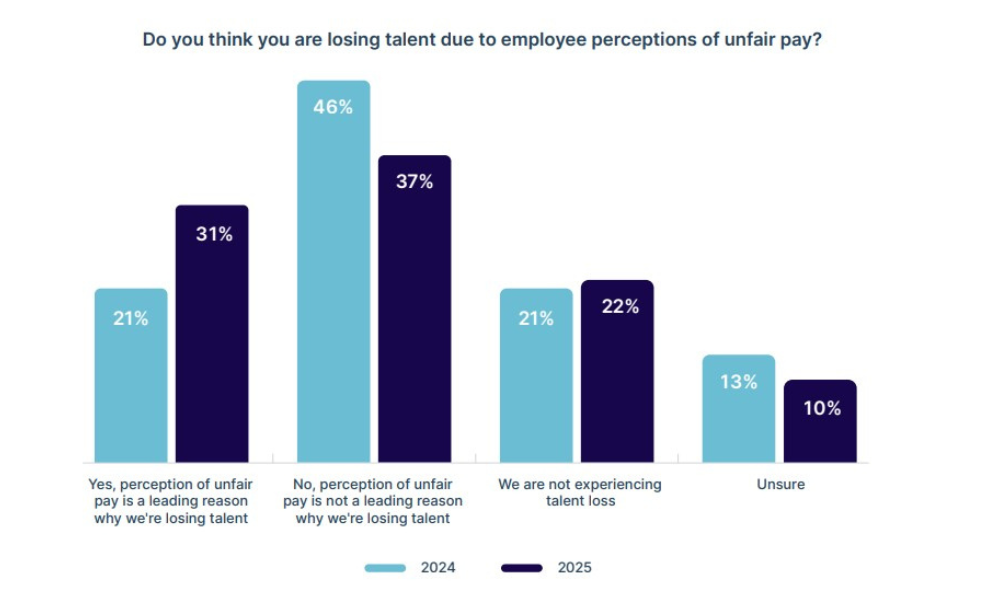 Source: Payscale
Compensation is not just about absolute pay levels, explains Cyrenne; it is also about how employees perceive their pay relative to others in the industry.
“In general, staff are concerned about not only absolute pay levels but relative pay levels,” he says.
“If payroll and HR staff can get an estimate of pay levels and raises at other firms, that would help relieve some pressure. Often this information is private information, but often compensation levels are related to new job hires. If a company is not hiring additional workers, then that is a good indication that the company is not doing that well.”
Employees may be more understanding of stagnant wages if they see that hiring has slowed across their industry, Cyrenne says. However, employers should still try to retain top talent – especially those with in-demand skills.
“It is important to keep in mind both short-term and long-term compensation strategies. Sometimes under stressful business times, companies have to determine who are the key employees in the long run,” he says.
“To give a rather unpleasant analogy, firms are often faced with a lifeboat type situation, having to keep key employees through compensation changes, sometimes at the expense of other employees.”
Linking pay to performance
Companies are re-evaluating their compensation structures to balance employee retention with budget constraints. As Cyrenne explains, linking pay to company performance can help organizations maintain financial flexibility while rewarding employees for their contributions.
“There are often short-term effects and long-term trends. For some companies, a bonus system based on overall success of the company, like they have in some banks, provides employees with some link between the company's overall performance and their compensation,” he says.
“Some companies use a combination of employee performance measures and overall company performance in their compensation practices.”
This approach ensures that payroll expenses remain sustainable while keeping high-performing employees engaged.
Assessing employee financial wellness
Financial stress among Canadians is rising, says Tzanetakis, citing NPI research from July 2024 that found employees are more worried about finance this year than they have ever been.
“Over four out of 10 working Canadians are financially stressed, and that's an increase of 10% from the previous year.”
People are bringing their financial stress to the workplace, “and the amount of time that they're worried about financial stress and thinking about it and trying to cope with it at the workplace has been estimated to create a $54-billion loss in productivity across all employers in Canada,” he says, referencing NPI research.
Twenty-five per cent of Canadians are living paycheck to paycheck, and over 50% say they would struggle financially if their pay was delayed by one cycle, Tzanetakis says.
For HR professionals, understanding the financial health of their workforce is no longer optional—it’s a business imperative, he says. “There's certainly an important role that employers can play in trying to assess how their employees are doing, from a financial wellness perspective.”
Transparency around compensation
Making employees aware of what their total compensation is can be a crucial component in keeping morale up during budget constraints, he says.
Employees often undervalue aspects of their compensation beyond their base salary, he adds, so HR leaders should ensure workers understand the full scope of their compensation package, including benefits, retirement contributions, and other incentives. Providing clear documentation of pay structures, bonuses, and benefits can reinforces trust and shore up employee confidence.
“It's really important for employers to make sure that, on a regular basis, at a minimum on an annual basis, really let their employees know the full scope of their compensation,” he says.
This communication and transparency also applies to overall company strategies; as Cyrenne notes, in uncertain economic conditions, clear communication around pay and job security is critical.
“Often employees want to know details about the present state of the company from the managers themselves. However, often employees get a sense of how things are going by changes to orders for products, or work coming in,” says Cyrenne, stressing that employers should be proactive in sharing this information.
“There does tend to be fear that sets in which can adversely affect performance and morale. Managers can play a role here. Sometimes no news is seen as hiding bad news.”