Canadian health officials warn steepest increases still to come

Influenza is tearing through Canada far earlier and faster than in recent years, and federal health officials say the worst is yet to come.
The share of flu tests coming back positive more than doubled in three weeks, from 6.4 per cent in the week ending Oct. 17 to 13.7 per cent in the week ending Nov. 7, according to the Public Health Agency of Canada’s latest FluWatch+ report.
That is more than six times the 2.1 per cent recorded at the same point last season, and roughly 17 times the 0.8 per cent seen two seasons ago.
The jump has been accelerating. Positivity rose by 1.5 percentage points between mid-October and late October, then by 3.1 points the following week and 2.7 points the week after. The agency expects week-to-week increases to keep growing larger until the season peaks.
Earlier flu season in Canada
This season also took off early. National positivity hit the 5 per cent epidemic threshold in the week ending Oct. 3. In each of the previous two seasons, positivity was still at or below 2.1 per cent by early November.
“The start of the flu season this year has been a little bit earlier than what we historically would expect,” said Dr. Fahad Razak, internal medicine physician at St. Michael’s Hospital, in a Global News report.
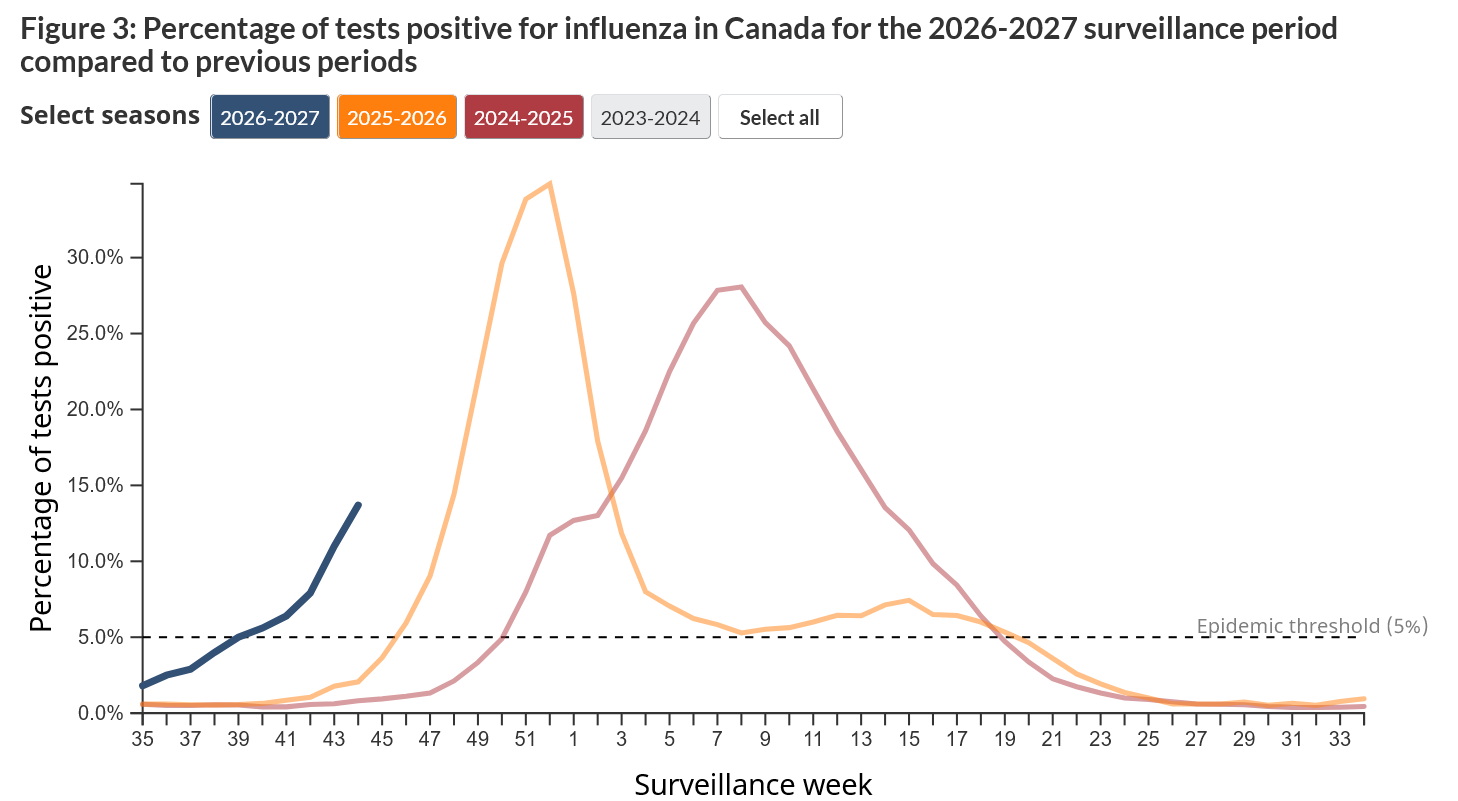
Laboratories confirmed 4,221 flu cases in the week ending Nov. 7 alone, about a quarter of the 16,493 detected since the season began on Aug. 30.
The earlier flu season may have snuck up on many Canadians before they could get their shots, said Razak, but people can still get the vaccine, which is an “excellent match” for the dominant H1N1 strain this year, he said in the Global News report.
B.C., Alberta see high flu rates
Activity is uneven across the country. Under the federal agency’s method, flu activity was rated high in British Columbia, Alberta and Yukon. It was moderate in Quebec, Manitoba, Nova Scotia and the Northwest Territories, and low in Ontario, Saskatchewan and New Brunswick. No data was available for Nunavut.
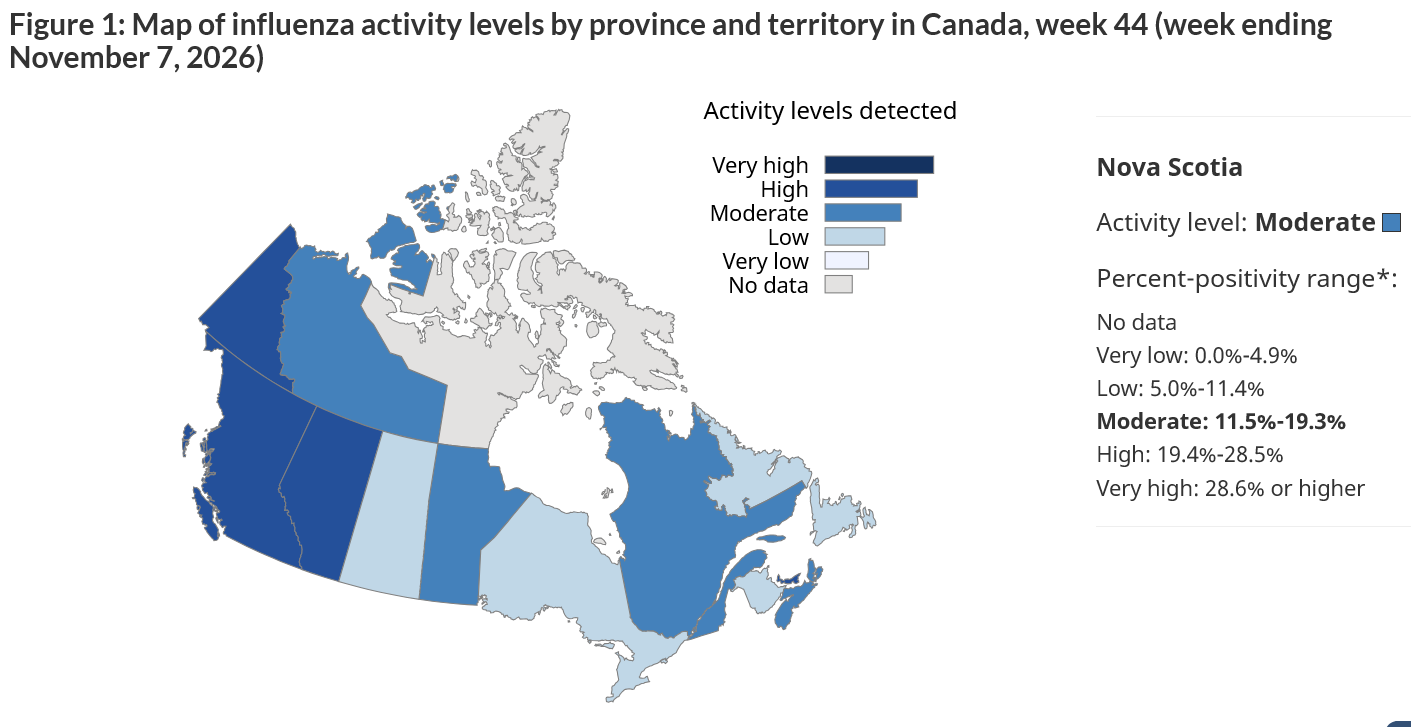
The agency notes that these federal ratings are designed for national comparison and may differ from levels reported by provinces and territories themselves.
Hospitalization rates from flu
The agency says hospitalizations, currently still at low levels, are expected to climb as the virus spreads, and that climb has already started. Provinces and territories reported 665 flu-related hospital admissions in the week ending Nov. 7, more than a quarter of the 2,505 recorded so far this season.
Eighteen people were admitted to intensive care that week, and 44 influenza-associated deaths have been reported since late August.
One strain is driving the surge. Influenza A(H1N1) accounted for 99 per cent of the influenza A cases subtyped in early November, and for 7,845 of the 7,947 subtyped so far this season.
Influenza B remains rare, with positivity at or below 0.2 per cent all season, says the government agency.
Seniors, younger people
Older Canadians are bearing the brunt. People aged 65 and older account for 7,878 of the 16,062 confirmed cases with age information reported this season, or 49 per cent. That is almost as many as all younger age groups combined, and nearly three times the 2,749 cases among adults aged 45 to 64.
Seniors also made up 45 per cent of the week’s cases where age was reported, and were hospitalized at a rate of 9.8 per 100,000 population in the week ending Nov. 7, more than five times the overall rate of 1.9.
“We see higher rates of hospitalizations among the very young and older individuals, those who are immunosuppressed or more susceptible,” Razak told Global News.
Children have not been spared. Children and teens under 20 account for 3,277 confirmed cases this season, about one in five of those with age information, including 1,657 among children under five. The SPRINT-KIDS pediatric surveillance network has recorded 131 flu-related hospitalizations among children and youth this season, including 24 intensive care admissions, as well as fewer than five deaths attributed to influenza.