Living wage gaps of up to $14 an hour raise pay and retention questions for Canadian employers

The minimum wage falls short of the living wage in every Canadian city and region where current data exists. Full-time minimum wage earners there can’t cover basic costs.
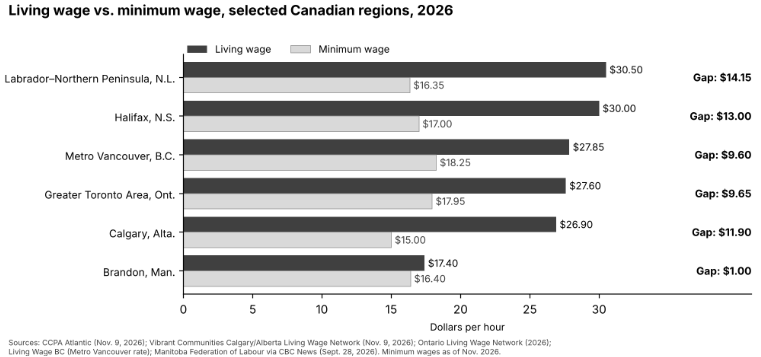
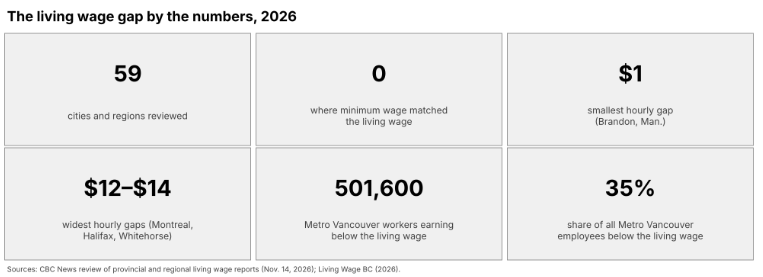
That finding comes from CBC News, which examined 59 cities and regions and found none where the provincial minimum wage matched the calculated living wage. Gaps ranged from $1 an hour in Brandon, Man., to between $12 and $14 in Montreal, Halifax and Whitehorse.
Those gaps exist because the two figures measure different things, according to one expert. He says that a living wage is the hourly rate a full-time worker needs to cover shelter, food, transportation, child care and other essentials in a specific community. The minimum wage is a statutory employment standard.
“The minimum wage is a political measure that is largely disconnected from the actual costs of living,” Tom McDowell, a lecturer at Toronto Metropolitan University, told CBC News.
Living wage gaps widen across regions
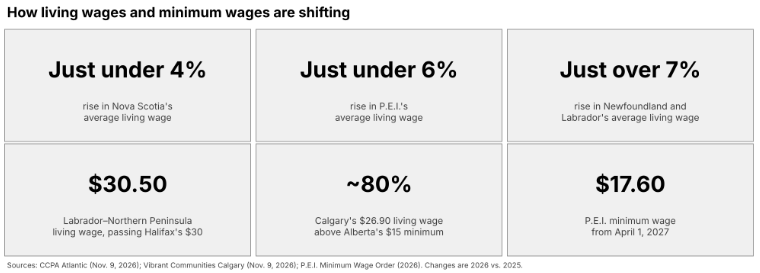
That disconnect is sharpest in Atlantic Canada. The 2026 living wage report from the Canadian Centre for Policy Alternatives–Atlantic (CCPA Atlantic) found rates rose across Newfoundland and Labrador, Nova Scotia and Prince Edward Island. The Labrador–Northern Peninsula reached $30.50 an hour, overtaking Halifax’s $30 for the first time.
The picture is similar in Central and Western Canada. Calgary’s 2026 living wage rose to $26.90, almost 80% above Alberta’s $15 minimum, according to Vibrant Communities Calgary, which worked with the Alberta Living Wage Network (ALWN). In the Greater Toronto Area, the Ontario Living Wage Network (OLWN) set its 2026 rate at $27.60, which is $9.65 above Ontario’s $17.95 minimum.
On the West Coast, the gap reaches deep into the workforce. Living Wage BC’s 2026 analysis of who earns less than a living wage found that 501,600 people earn less than the region’s $27.85 living wage. That is 35% of Metro Vancouver employees.
What does the wage gap mean for HR leaders?
For employers, numbers like these translate directly into hiring and turnover pressure. “When people cannot afford to live in the communities where they work, employers will continue to struggle to attract and retain workers,” said Daniel Cerdas Sandí, a researcher with CCPA Atlantic.
That pressure also falls unevenly across the workforce. “These are more likely to be women, immigrants and racialized people because that’s just how the labour force is stratified,” Molly McCracken, Manitoba director at the Canadian Centre for Policy Alternatives, told CBC News.
At the same time, employers face a statutory floor that keeps rising. Prince Edward Island’s minimum wage will increase to $17.60 on April 1, 2027, under the province’s Minimum Wage Order. Not every business can go further: the Canadian Federation of Independent Business told CBC News that a living wage is not very realistic for many small and medium-sized firms facing lower profits and tariff pressures.
Best practices for employers
For organizations weighing their options, the first step is data. Vibrant Communities Calgary points employers to BeLocal’s Living Wage Snapshot, a confidential comparison of pay against the local rate. Its Living Wage Roadmap then supports phased adoption.
Once the gap is measured, employers can look beyond base pay. ALWN-certified employers may meet the rate through a mix of wages and basic needs benefits. OLWN’s 2026 employer guide also asks certified employers to add living wage clauses to service contracts when they are renewed or awarded.
Those investments can pay off in retention. Alberta research cited by Vibrant Communities Calgary found that certified living wage employers reported higher retention and savings on rehiring and retraining. Even so, Christine Saulnier, CCPA Atlantic director, cautioned that “employers paying a living wage is only one part of the solution.”