Core-aged workers drive employment rebound in June
Updated July 14
Canada’s job market rebounded in June, posting its first significant employment increase since January.
The country added 83,000 jobs, a 0.4% uptick, nudging the employment rate up to 60.9% says Statistics Canada.
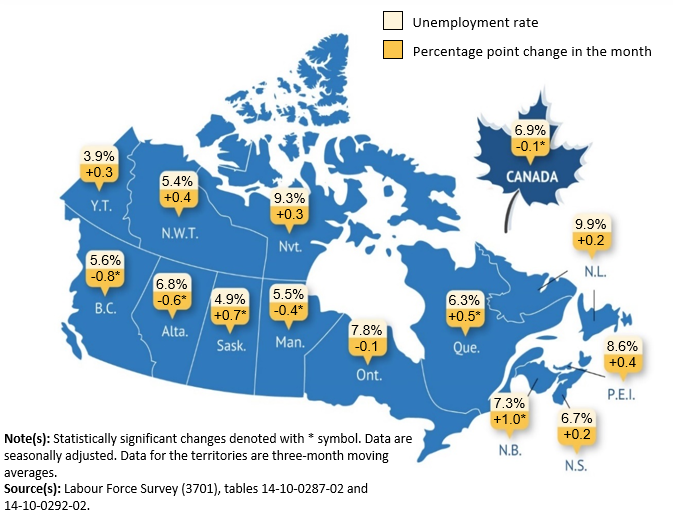
The unemployment rate edged down to 6.9%, reversing a three-month climb that had pushed joblessness to its highest level since 2016, outside the pandemic years.
“This marks the first decrease in the unemployment rate since January,” the government noted, highlighting a shift after a sluggish spring.
While the monthly Canadian labour market data is "notoriously volatile," the 83,000 jump in June along with the tick-down in the unemployment rate to 6.9% largely confirms earlier indicators pointing to "a bounce-back" in business sentiment and stabilization in hiring demand (as measured by Indeed.com job openings) after U.S. tariffs and tariff-related uncertainty put a freeze on labour markets in the spring, according to an RBC release.
"Canadian labour markets are still substantially weaker than they were a year ago with weakness concentrated in sectors and parts of the country more sensitive to international trade disruptions. And trade risks remain with Canada added to a growing list of countries facing threatened new tariff hikes from the U.S. administration on August first.
"Still, the most severely damaging international trade scenarios have yet to develop and and a backstop for duty free Canadian access to the U.S. market for exports compliant with the CUSMA/USMCA free trade agreement has held for the majority of Canadian exports to-date. And weakness in trade exposed sectors has yet to spill over significantly to other industries. While downside economic growth risks remain, the June labour market data is consistent with our base-case assumpiton that the BoC will not cut interest rates further after skipping reductions at each of the central bank’s last two policy decisions."
Core-aged workers lead the way
The bulk of the new jobs went to Canadians aged 25 to 54. Employment for core-aged men jumped by 62,000 (0.8%), more than making up for losses in May, while core-aged women saw gains of 29,000 (0.4%).
The employment rate for men in this group climbed to 86.6%, and for women, it reached 80.3%.
“These increases were concentrated among people in the core working age,” the release stated, underscoring the demographic’s central role in the June turnaround.
Despite the overall positive numbers, challenges persist for younger Canadians. The youth unemployment rate held steady at 14.2%, well above pre-pandemic levels. Students planning to return to school in the fall faced an unemployment rate of 17.4%—the highest for June since 2009, excluding the pandemic period.
Long-term unemployment also ticked up, with over one in five job seekers searching for work for at least 27 weeks, a notable increase from last year.
"We’ve seen a two-track Canadian labour market in recent years: those comfortably employed have enjoyed low layoffs and wage growth, but job seekers across a wide variety of circumstances are struggling," says Brendan Bernard, senior economist at Indeed.
"Reaction to trade uncertainty is the main focus in the near-term, but the difficult market for job seekers lingers."
Sector and regional highlights
Job gains were especially strong in wholesale and retail trade, which added 34,000 positions, and in health care and social assistance, up by 17,000 jobs,says Statistics Canada.
Retail trade drove most of the growth within its sector, while agriculture was the only industry to see a notable decline, shedding 6,000 jobs.
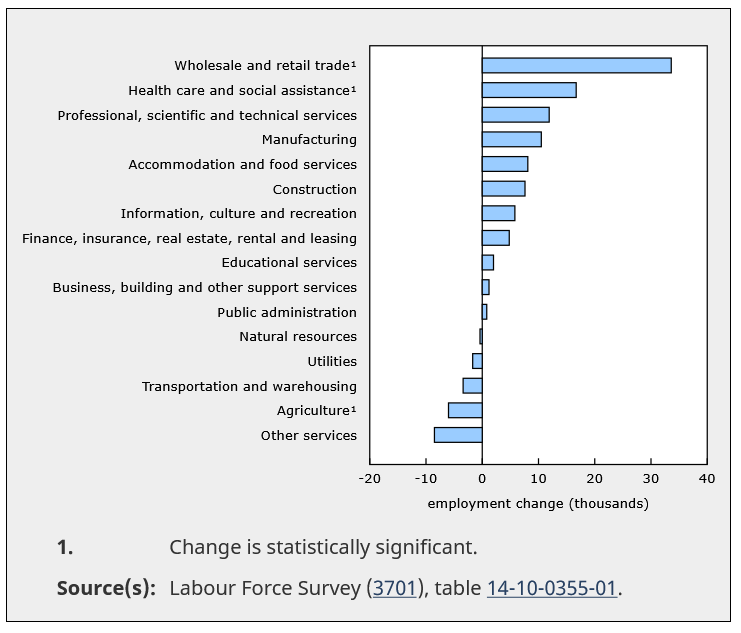
Gains were widespread across industries, with contributions coming from both private and public sectors and self employment, says Bernard.
"Helping the headline number was manufacturing, which had slipped in four consecutive months before edging up in June, reversing May’s decline. The sector remains down from the start of the year, but at least some employers are holding off on making dramatic movements amid the highly uncertain trade situation."
Regionally, Alberta led the provinces with a surge of 30,000 jobs, followed by Quebec (+23,000), Ontario (+21,000), and Manitoba (+8,500). Newfoundland and Labrador, as well as Nova Scotia, experienced job losses, though their unemployment rates remained largely unchanged.
Part-time work and wage growth
Part-time employment accounted for most of June’s job growth, increasing by 70,000 positions, while both the private and public sectors saw more employees. Self-employment was steady, says Statistics Canada.
Average hourly wages continued their upward trend, rising 3.2% year-over-year to $36.01. Total hours worked also increased by 0.5% in June and were up 1.6% from a year earlier.