More than half say finding opportunities matching their qualifications is a top challenge

Canadian job seekers are increasingly driven by economic anxiety rather than career ambition, which may signal rising turnover risk and shifting salary expectations among current employees, according to a survey.
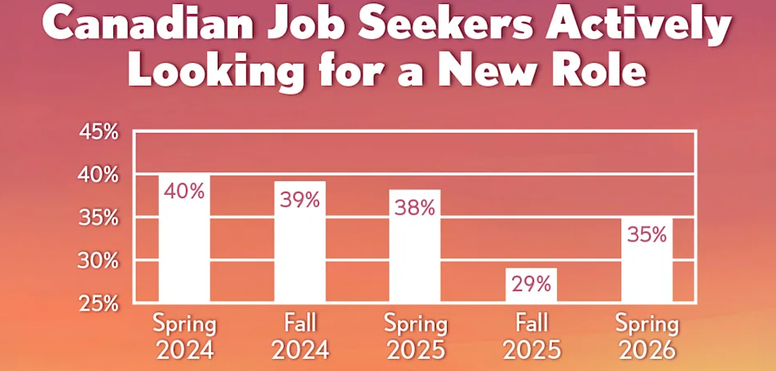
More than one-third of job seekers (35 per cent) are actively looking for new work, while 65 per cent browse more casually. Most respondents (80 per cent) are focused on full-time roles, though 43 per cent said they would accept part-time work.
Another three-quarters of job seekers (75 per cent) said they expect it will be difficult to find a job in the next six months, according to Express Employment Professionals.
The survey polled 508 Canadian adults aged 18 and older who are either employed but job hunting, or unemployed and looking for work. Fieldwork was conducted online from May 19 to June 8, 2026.
Barriers to finding the right fit
Express identified several pressure points shaping the job search. More than half of job seekers (56 per cent) cited finding opportunities matching their qualifications as a top challenge, while 50 per cent pointed to standing out in a competitive market and 45 per cent struggled to find pay covering basic expenses.
Roughly one-third (36 per cent) said balancing job searching with responsibilities such as caregiving or education was difficult, and 35 per cent said automated hiring processes left them feeling unheard, Express said.
Nearly one-third of job seekers (32 per cent) said companies that appear to be hiring but only collect resumés make the search harder, according to the survey. Meanwhile, 27 per cent said they felt overqualified for available roles and 26 per cent felt underqualified.
Employed workers also searching
Among employed respondents still job hunting, Express reported that 37 per cent worry they will not receive a deserved raise, while 34 per cent fear their employer will cut staff due to economic conditions. Thirty per cent anticipate a broader economic slowdown affecting opportunities, and 25 per cent are concerned technology or artificial intelligence will negatively affect their role.
Quality-of-work factors are also motivating searches, with 46 per cent hoping to negotiate better pay elsewhere, 38 per cent seeking improved work-life balance and 36 per cent pursuing stronger growth opportunities, according to the release.
Rising prices are a near-universal factor: 92 per cent of job seekers said cost-of-living increases have had at least some impact on their decision to pursue new employment, with 71 per cent describing that impact as moderate or large.
"The job search may feel difficult, but that does not mean the market is standing still," Bob Funk Jr., CEO, president and chairman of Express Employment International, said in the release. "Job seekers are being more intentional about what they want, and employers should be just as intentional about what they offer. Clear expectations, realistic qualifications and strong communication can help turn a challenging search into the right match."
Turnover, retention challenges
The average cost of turnover has risen to $30,680 per employee, up from $29,234 a year ago, adding pressure on organisations already competing fiercely for talent in a tight labour market, according to a report released earlier this year.
And compensation alone won't solve retention, according to a previous report. O.C. Tanner, advises employers to ensure competitive pay and strong health benefits so people feel financially secure.
Then, they must invest in career development, skill building and regular recognition, adding that retention strategies should include modern leadership, development opportunities, mental health support, and giving employees a say in how and where they work, since even physical work environment and technology choices affect whether employees stay long term, according to the report.