‘Organizations remain focused on adapting to new business conditions and ensuring they have the talent needed to meet their priorities’
Canada's hiring outlook has strengthened only modestly even as entry-level hiring seems to be improving, according to a new report.
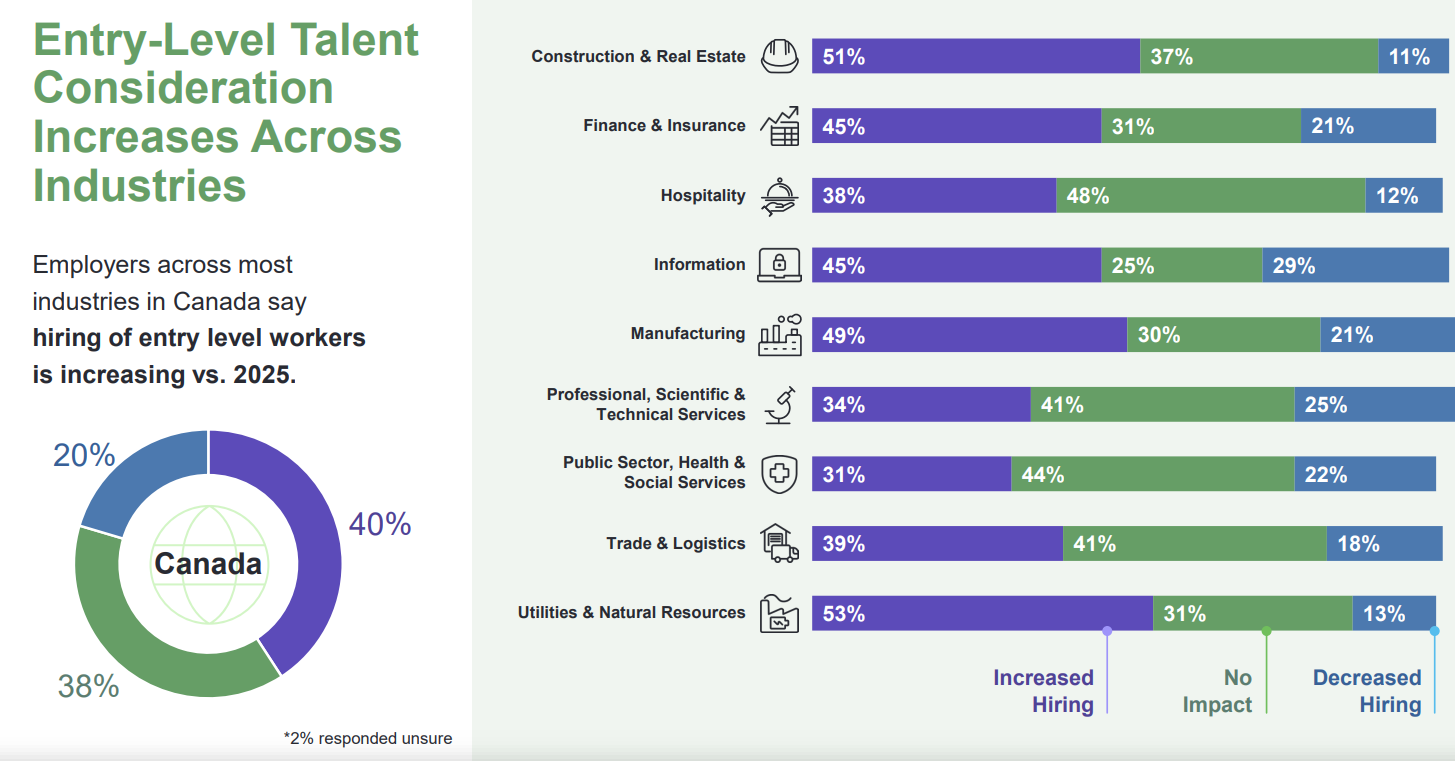
Overall, entry-level hiring is increasing across most Canadian industries compared with 2025, with 40 per cent of employers reporting increased consideration of junior candidates and 20 per cent reporting a pullback.
Utilities & Natural Resources led entry-level gains, finds ManpowerGroup, with 53 per cent of employers in that sector expecting increased hiring of newer workers in Q4.
This trend goes against the trend noted in a previous report from Resume.org, which stated that 1 in 5 companies has already stopped hiring entry-level workers because of AI, and nearly half expect to halt entry-level recruitment entirely within the next two years.
Among employers pulling back on entry-level roles, ManpowerGroup cited a general hiring slowdown, AI-driven automation reducing early-career tasks, and cost pressure pushing employers toward experienced candidates who are immediately productive.
National outlook strengthens modestly
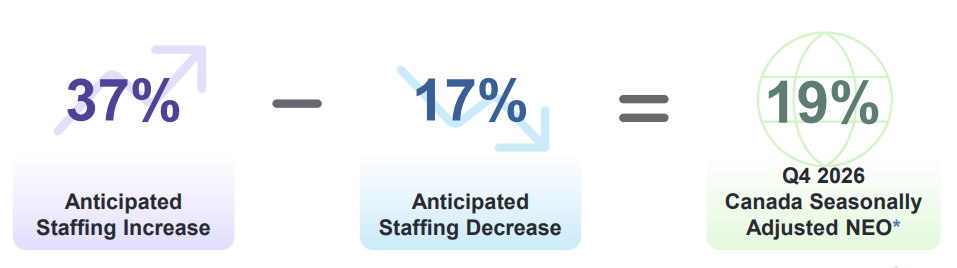
ManpowerGroup's Q4 survey found Canada's seasonally adjusted Net Employment Outlook (NEO) at 19 per cent. That’s up six points from the third quarter but down three points from the same period last year. The NEO measures the gap between employers expecting to add staff and those expecting to cut it.
The survey polled 39,878 employers across 42 countries, including more than 1,000 in Canada. It found 37 per cent of Canadian employers plan to increase staff between October and December, 17 per cent anticipate reductions, 44 per cent expect no change, and 2 per cent remain unsure.
Data collection ran from July 1 to 31, 2026, before tariffs affecting Canada-U.S. trade were announced. ManpowerGroup said the findings reflect employer sentiment at the time of collection and may not capture the impact of subsequent developments.
“Employers are navigating a complex and rapidly evolving environment," says Trevor Hawkins, country manager, Canada. "While developments in trade policy can create additional uncertainty, organizations remain focused on adapting to new business conditions and ensuring they have the talent needed to meet their priorities. As conditions evolve, organizations will need to remain agile and continue investing to support long-term growth.”
Canada's labour market cooled sharply in August, with employment falling by 42,000 positions and wage growth slowing to its weakest pace since 2017, according to the latest Labour Force Survey released today by Statistics Canada.
Regional and sector gaps widen
All six Canadian regions posted a positive NEO and improved quarter-over-quarter, ManpowerGroup found, though results varied sharply. The North reported the strongest outlook at 50 per cent, though ManpowerGroup cautioned this finding is not statistically significant due to sample size, followed by Atlantic Canada at 33 per cent.
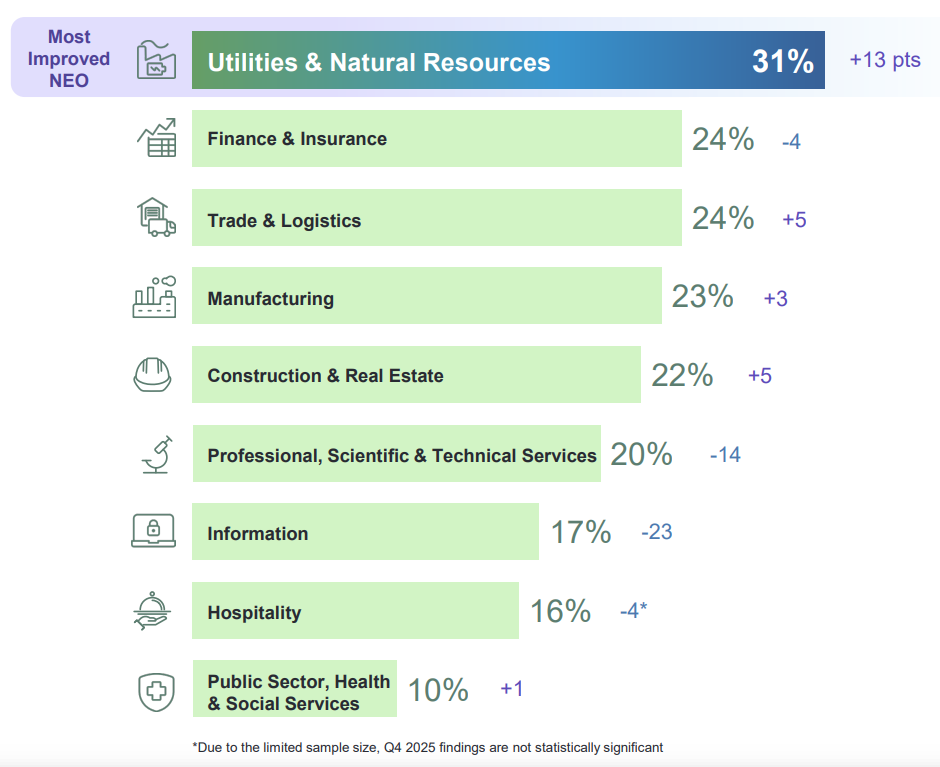
By sector, Utilities & Natural Resources posted the strongest Q4 NEO at 31 per cent and the largest year-over-year improvement at 13 points, while Public Sector, Health & Social Services reported the weakest outlook at 10 per cent.
Canada's 19 per cent NEO also trails the global average of 29 per cent reported by ManpowerGroup, placing the country behind hiring hotspots such as India at 54 per cent and Brazil at 53 per cent. The corresponding number for the United States is 36 per cent.
AI adoption hasn't sped up time-to-hire
Despite the rising use of AI in recruitment, ManpowerGroup found only 28 per cent of Canadian employers reported faster time-to-hire since 2025, while 43 per cent reported no change and 29 per cent reported it slowing.
ManpowerGroup identified skills shortages, a lack of qualified local candidates, mismatches between candidate expectations and job requirements, and a surge in AI-generated résumés as the leading obstacles slowing recruitment. HR teams leaning on AI tools to accelerate hiring should note that technology alone is not resolving these bottlenecks.
Employers did credit better candidate targeting, referrals through personal networks, and faster internal approvals with speeding up hiring where it is working thanks to AI, ManpowerGroup reports.
One way HR professionals can help address the need to hire skilled talent is to prioritize the upskilling of workers. According to the Canadian Chamber of Commerce’s Business Insights Quarterly Q1 2026, skills gaps persist across industries. However, many firms are responding by training their existing workforce rather than expanding headcount, particularly amid tariff uncertainty.