What employers need to know about new rules, greater transparency: lawyers

Ontario’s Immigrant Nominee Program (OINP) has undergone a significant transformation, placing employers at the forefront of the application process and introducing new compliance measures.
For HR professionals and employers, the changes mean greater involvement, new digital tools, and increased transparency in hiring foreign workers.
“The employer is now in the driver's seat,” says Jae-Yeon Lim, partner at McMillan in Vancouver.
“What Ontario is trying to do here — and I think maybe other provinces might follow suit — is to really have greater transparency over the process for employers.”
Ontario is the number one target province for immigration in Canada, she says, so there's always going to be demand for OINP: “I think it's positive that they made all these different systematic overhauls to make it a little more transparent.”
Provincial Nominee Programs
There are several programs by which immigrants can come to Ontario, such as job offer programs, family sponsorships and special circumstances (for example, refugee status). These are administered exclusively by the federal government, except for the Provincial Nominee Programs, which are meant to give provinces and territories a way to respond to local economic needs.
The OINP is Ontario’s economic immigration selection program aimed at giving foreign workers, entrepreneurs and international students an opportunity to be nominated for permanent residency in Ontario, while also giving Ontario businesses the ability to recruit international talent to offset workforce and labour market needs.
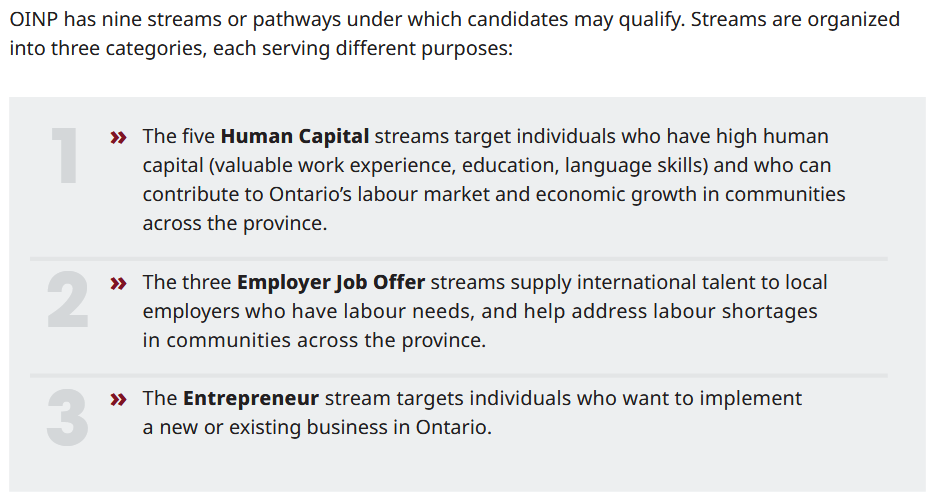
The OINP has two intake systems to select applicants: the federal government’s Express Entry system to select individuals to apply through three streams (known as Ontario’s Express Entry streams), while the intake of potential applicants in the remaining six streams is done through the province’s Expression of Interest (EOI) system.
Employer-centric approach to OINP
The OINP continues to operate multiple streams, including Employer Job Offer: Foreign Worker, International Student, and In-Demand Skills, as well as Masters Graduate and PhD Graduate streams.
But as of July 1, 2025, the Ministry of Labour, Immigration, Training and Skills Development (MLITSD) updated the OINP. The centrepiece is the launch of a new electronic Employer Portal, which shifts the Employer Job Offer streams to an employer-led application process.
Employers can now register their business information and submit employment position details directly through the portal, enabling a prospective applicant to register their EOI.
In the old system, the foreign national would put themselves into the pool, and then they would receive an invitation to apply for the OINP nomination, with the 14-day timeframe, but “the employer might have no idea that this potential OINP was coming down the pipeline,” says Bill MacGregor, partner at Gowling in Waterloo, Ont.
“The main change is to being employer-centric… in the sense that the employer puts the job and the person into the system now, so the employer knows upfront that this is a possibility [and] they're driving, at least initially, the OINP process.”
And hopefully it's more efficient, he says: “If someone's in the OINP pool, the employer will have had to know about it. So, there's a meeting of the minds that this is a position, a job, and a foreign national that's going to be supported through the OINP process.”
Misrepresentation with OINP
Lim says that the new system gives employers greater control and oversight.
“Previously what happened was anyone can go and create a profile and then say that they have a job offer from the Ontario-based employer, but the employer [didn’t] have actual control over what's submitted on these forms, on these profiles. Now… the employer’s in the driver’s seat.”
After the application, the employer must submit information to the OINP within 14 calendar days, and the foreign worker has 17 days to do the same.
“It’s kind of apportioned so that each has their own task to do, and different deadlines. And I think it’s really because of certain things that have gone wrong in the past about, perhaps, information that shouldn’t have been characterized a certain way, like misrepresented… by people creating fake jobs, by employees inflating their jobs,” she says.
“They’re trying to prevent that.”
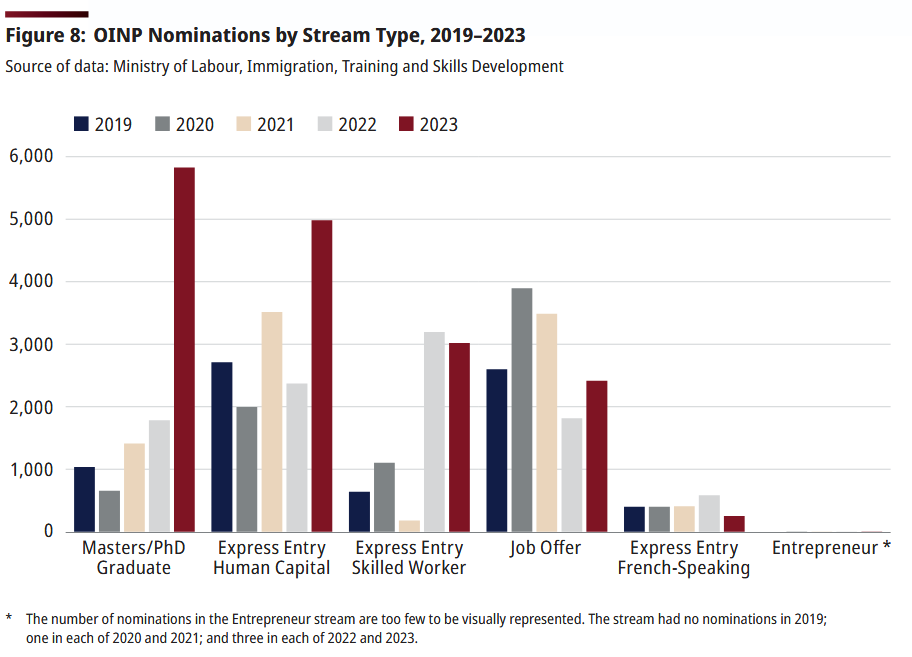
In a December 2024 report, the Office of Auditor General cited several gaps in the management and enforcement of the OINP that have made the program vulnerable to potential abuse and misrepresentation.
It cited common examples of misrepresentation by applicants, employers and representatives such as:
- falsifying past work experience to satisfy eligibility criteria
- falsifying job offers (for example, real business but fake job offers; fake business; company created by a representative or relatives/friends of representatives solely for the purpose of sponsoring workers)
- falsifying language test scores
- not working in the position approved in the application
- representatives preparing applications without the knowledge of employers.
‘Meeting of the minds’ with jobs
The changes will “weed out” any issues when it comes to the job, says MacGregor. With the old system, for example, the foreign worker may enter information about the occupation or job type that the employer didn’t agree with, such as being a supervisor when really they’re a materials handler.
“That occupation… makes a difference in terms of whether you’re qualified or at a high enough skill level or not,” he says, adding it could be a misunderstanding of the (National Occupational Classification) NOC code.
“But the employer might not agree with that, and then you're trying to deal with that issue at the back end — maybe they can't support the nomination because it doesn't align with the data that the foreign worker had put in at the front end under the old system.
“With this new way of having the employer go first, putting that information in, the employer is saying, ‘This is the job type, this is the occupational code,’ and there should be none of that that disconnect at the back end anymore.”
New portal, timelines, interview process
The changes to the OINP include a new Employer Portal meant to provide a secure, user-friendly digital platform, replacing the paper-based Application for Approval of an Employment Position. Employers initiate applications by submitting employment position details before the applicant can register an EOI.
Key features include seamless integration with My Ontario, online submission and management, secure document uploads, direct communication, and simplified tracking, according to the government.
Lim says she supports this change: “I'm a huge fan of moving from paper to paperless. It's better for environment sustainability, but it's also better for everyone involved. It's just much easier to turn around documents if you don't have to FedEx it.”
However, technical issues could be a concern. For example, recently some invitations went out and the system crashed, says MacGregor.
“There was a little note on the ... employer access today that still says, ‘We're having some technical issues, be patient,’ so hopefully that's just a volume issue and a growing pain,” he says.
“As long as it's accessible, and it's supposed to be generally, this is a good move to do digital, just like IRCC has gone digital in many of its application processes.”
Other major changes include:
- in-person interviews
- authority to return applications
- updated timelines
In-person interviews
The introduction of in-person interviews for both employers and applicants is a new compliance tool that Ontario has introduced.
This change “speaks volumes” about the government wanting to make sure that people are following up, says Lim.
“Something like that is there to protect the Ontario jobs for Canadians and permanent residents in Ontario. I think that's one of the emphases here, is protecting the integrity of the program… they’re looking for credibility and making sure that documents are lined up with what they’re saying.”
This approach makes sense, according to MacGregor, “to help address any potential concerns about how authentic the job offer might be, or how the employer is legitimate.”
But it will be interesting to see how this is used, he adds.
“This is a new system; we haven't had enough time… to see what they'll do. I think part of it is the program, using some due diligence, they can then authenticate if they have any issues. Maybe they'll do it on a random basis, I don't know, we'll see how it unfolds.”
Application returns with refund
Another change: The OINP can now return applications before a nomination is issued, with a full refund of the application fee. Reasons include nomination allocation, labour market alignment, and program integrity risks.
Even if a person does get an invitation, it doesn't guarantee that they’ll be nominated, says Lim.
“If there's any changes in the program — like the program priorities or labour market conditions change — Ontario reserves the right to return your application with the application fee, because things could always change, [they’re] always subject to these different factors external to the applicant.”
Again, it will be interesting to see how this transpires, says MacGregor.
“One of the reasons they cite ... is a change to the labour market. So, in theory, the OINP could refuse to process a nomination application that's in the kitty waiting to be assessed, if the labour market changes.”
Whether they would actually do that is unclear, he says: “That’s a pretty extreme response but, in theory, legally, they now have that ability.”
Best practices for meeting deadlines
Employers will still need to act quickly to meet the deadlines, while the timeline for individuals has gone from 14 to 17 days for uploads, says MacGregor.
“What I think employers should keep in mind with this new system is taking the time to assess at the front end whether the job offer and the foreign national and the employer meet the eligibility requirements.”
That’s because the system itself doesn’t check that the employer inputs meet the requirements, he says: “That would only be done at the back end if there was an invitation.”
For example, if the employer doesn’t meet the prevailing wage requirements, they won’t be told by the OINP.
“So, you’ve got to do some due diligence at the front end, if you’re the employer, to make sure eligibility is there — or there’s no point going forward.”
And if you miss the deadline, you’re out of luck, he says: “You have to put the job back into the system, the form work. You would have to go back in and do a new expression of interest to match up with that job offer if they failed to meet the deadline.”
Lim also advises being proactive with the new system.
“Generally, if anyone's going to be thinking about going into this pool, I think they should have in the back of their mind: ‘I might have to turn around some documents very quickly,’ so they might have to make sure they have those in in the meantime.”
Ongoing challenges with immigration
While the invitations are still based on occupations or NOC codes, Ontario’s changes come amid broader pressures on Canada’s immigration system.
Across Canada, there is a major freeze on Provincial Nominee Programs (PNPs) because the federal government reduced the allotments by half, says Lim.
“Provinces are struggling with a lack of resources, but higher demand because of more refusals on temporary applications like work permits. That used to be very straightforward, now it's a lot more complex,” she says.
“So, what's happening is people are really dependent on these Provincial Nominee programs to try to find pathways to stay in Canada, but the provinces have less room and less resources to support employers and foreign workers that are already contributing to the economy and working. So, it's a struggle I'm seeing everywhere.”