Which sectors showed the biggest increases?

Ontario's new requirement that employers disclose artificial intelligence (AI) use in hiring has caused the share of job postings mentioning the technology to nearly triple in seven months, according to a report.
The share of Ontario job postings referencing AI-related terms rose from 9% in October 2025 to 28% in May 2026, report Aubrey Woessner, associate economist, and Brendon Bernard, senior economist, at the Indeed Hiring Lab.
The increase followed provincial rules effective January 2026 requiring employers with at least 25 employees to disclose AI use in recruiting or screening candidates.
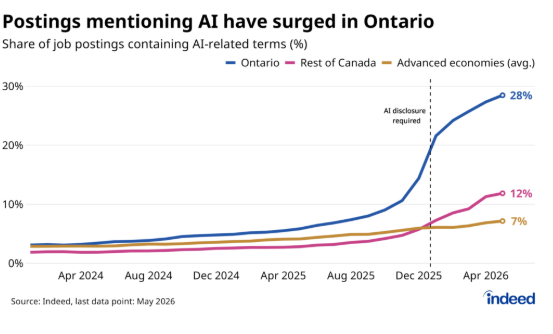
On Jan. 1, 2026, Ontario’s new job posting disclosure requirements under the Employment Standards Act, 2000 (ESA) came into effect.
Under Ontario’s Working for Workers Four Act, 2024, employers must disclose in any publicly advertised job posting whether artificial intelligence is used to screen, assess, or select applicants. The same disclosure must appear in any associated application form. Under the companion Working for Workers Five Act, penalties for Employment Standards Act offenses have increased from $50,000 to $100,000.
Woessner and Bernard describe the shift as making Ontario "a global outlier."
As of mid-2025, Spain held the highest AI-mention share among tracked advanced economies at 9%, says Indeed; those economies, including the United States, United Kingdom, Australia, Germany, France, Ireland, Italy, Spain and the Netherlands, averaged 7% in May 2026.
The report also found AI mentions climbed elsewhere in Canada, from 4% to 12% over the same period. Bernard and Woessner attribute this partly to employers extending disclosure practices to postings outside Ontario after complying with the provincial requirement.
Which sectors recorded the biggest increases?
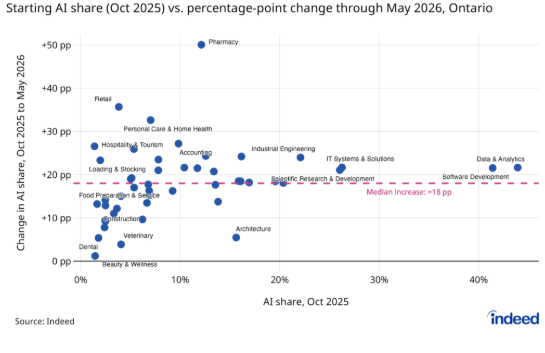
AI mentions rose across all 48 occupations tracked between October 2025 and May 2026, with 40 sectors increasing by 10 percentage points or more, according to the report. The median increase across all sectors was 18 percentage points.
Woessner and Bernard report that beauty and wellness, along with dental and veterinary services, showed comparatively small increases in AI mentions. Pharmacy, retail, personal care and home health sectors recorded larger-than-average gains.
The authors suggest employer size may account for some of this variation, since businesses with fewer than 25 employees are exempt from the disclosure rule. Large retailers employing cashiers, stockers and pharmacists complied with the Ontario law and, according to the report, also began including AI disclosures in postings in other provinces.
AI disclosures and application rates
Application rates have not been affected by AI disclosures, the Indeed report states. Outside the technology sector, daily applications per posting in 2026 were similar for listings that mentioned AI and those that did not.
Many postings that disclose AI use also state that human decision-makers retain final hiring authority, according to the report. Woessner and Bernard note this detail was commonly included alongside AI disclosures.
Matthew McCarthy, employment lawyer at Boughton Law in Vancouver, said Ontario’s Working for Workers Four Act, 2024 addresses a real and persistent grievance from candidates.
“The one major complaint from applicants across all industries is not knowing that AI is being used — whether it's at the screening level, at the interview level, wherever,” he said in a previous Canadian HR Reporter report.
Bill 149 is meant to address that base-level issue, but that disclosure on its own resolves very little, said McCarthy.
"It is connected in some ways to the Employment Standards Act, so there should be teeth to it, but all it does is make that base requirement: 'You have to disclose this,'” he said.
“There's still a pile of other potential liability issues that arise."