Canadian HR leaders say they're aware of the cheating problem — but the tools candidates are using are getting harder to spot

The signs are subtle — but once you know to look for them, they're hard to miss. A pause that runs a bit too long. Eyes that drift off-screen. An answer that is a bit too polished.
"We’ve experienced it a few times… You can absolutely tell when people are reading and pausing," says Sharon Robinson, HR director at Nova Scotia Pension, referring to job candidates "cheating" during interviews by using AI prompts.
Unfortunately, such behaviour is becoming commonplace. Blind, an anonymous community app for professionals, did a survey last year and found that 20% of 3,617 verified professionals in the U.S. have secretly used AI tools during job interviews.
How? The interviewer asks a question on a Zoom or Teams call, the job candidate's computer runs a transcription and feeds it to a large language model (LLM) which generates a quick answer either on the screen or through an earpiece.
Separately, an analysis of 19,368 AI interviews by Fabric, an AI hiring OS for staffing companies, found that cheating has become a structural problem in hiring, with rates jumping three times in late 2025:
- 38.5% of all candidates were flagged for cheating behaviour.
- Technical roles show 48% cheating rates versus 12% for sales.
- Junior candidates cheat at nearly double the rate of senior candidates.
"AI tools have fundamentally changed how candidates take interviews. Real-time assistance during live interviews, once rare and risky, is now common and nearly invisible," says the Fabric blog.
Warnings for job candidates on AI use
Nova Scotia Pension conducts virtual screening calls before inviting candidates in for an in-person interview, and the team has encountered AI-assisted responses often enough that they now address it head-on.
"We do ask candidates that they talk with us without the use of AI. And I think most people have been respectful," says Robinson. "But I have seen — or other team members have stated — that people have fallen into that and they're really doing themselves a disservice."
Robinson's message to candidates is direct: prepare with AI but show up as yourself.
"Use your AI. AI is a great tool. You could do a lot with AI, but do it as your prep," she says. "Let it give you feedback. There's all kinds of ways that you can use AI to help you.”
"But when you're using it in lieu of your own knowledge and skills, you actually are going to lose out in the end."
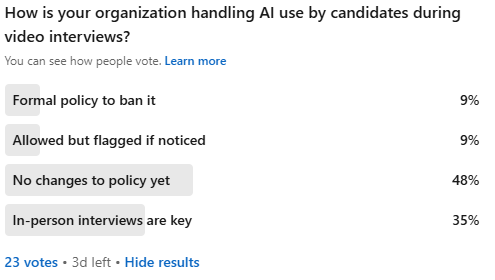
A Canadian HR Reporter survey on LinkedIn recently found most employers don't yet have a policy on the issue (note: just 23 responses):
At Porter Airlines, the same challenge is there, according to Lawrence Hughes, executive vice-president and chief people officer.
"It’s something that we’re keenly aware of… You can tell when you ask a question and there's a pause and you see them glance away at another screen," he says.
As a result, potential employees are required to attest, before a virtual interview begins, that they will not use AI tools, says Hughes.
"We have a standard script that we kick off with," he says. "We do ask the candidate to confirm that they will not be using an AI tool as part of the interview process."
And for key corporate roles, a virtual screen is always followed by an in-person interview, he says.
"It's not always easy when you're hiring a class of flight attendants or contact centre agents.”
The tools candidates are using
But the power of observation may not be enough given the advance in tools that allow people to cheat in virtual interviews. Hidden apps such as Cluely, InterviewCoder and Final Round AI can listen to the audio of the interview and within one or two seconds of a question being asked, generate a suggested answer.
"You just run it on your computer. It'll hide itself from any screen shares or anything like that — so you can have it right in the middle of your screen and be sharing everything. You can see it perfectly fine. The person on the other end can't,” says Michael Kuczynski, founder and CTO of InterviewGuard.
As far as you're concerned, the job candidate is looking right at the camera, everything's perfect, and they're responding in a second or two, he says.
“It looks totally natural… And then, two weeks into the job, you're like, ‘OK, what happened here? Where's the person I was talking to a month ago? Because something's definitely off.’"
Beyond real-time answer assistance, Kuczynski describes location spoofing, deepfake video and voice changers, and — particularly in finance and government hiring — candidates attempting to access organizations on behalf of foreign actors.
"In the finance space, they have a really bad problem with people from North Korea and China in particular just trying to get in and steal IP from them,” he says.
And location fraud can be costly on the payroll side, says Kuczynski: "If someone's an engineer in Ukraine but they say that they're an engineer in San Francisco, suddenly that's a 600% salary increase — for free."
False positives in detecting AI use
It's understandable that employers and HR lean on human observation rather than automated flagging because behaviour-based detection tools carry a real risk of getting it wrong, according to Kuczynski.
"We have one engineer on our team who is probably the most brilliant engineer I've ever worked with in my entire life. But you ask her a question, she's going to stare off into space for 30 seconds and then come back at you with what sounds like a PhD thesis. And to anything like that, or even just off a quick eye check, you'd be like, 'OK, this person just typed everything into ChatGPT and is now reading it off verbatim.'"
Kuczynski's advice for employers navigating this without detection software echoes both: trust what you're observing.
"If you notice that your candidate keeps looking to the right every time you ask a question and pausing for a bit, ask them. And if you're still not convinced, it's better to trust your gut than otherwise. That's my policy on it."
Greater accuracy in detection
The risk of false positives is why InterviewGuard installs software on the job candidate's computer, for greater accuracy. It monitors everything in the background like an antivirus would.
"We don't want to be wrong, because the job market is brutal enough as is for these people,” he says. “What we try to stick to ourselves is things that we can actually verify: 'Here is what happened. Here's what we can verify 100%...' and then use that data how you need."
The software requires candidate consent and stores no audio or video, says Kuczynski.
"The only thing that we do end up storing is purely an event log — 'On this specific interview at this time, the candidate searched this on Google, or they pulled up this tool at this time,’” he says.
“That's not going to be immediately a deal breaker, but we try to give as much information as possible as to what is actually happening.”
Amazingly, even when candidates are told upfront that detection software is running, roughly 40 to 45% still attempt to use AI tools, says Kuczynski, highlighting the severity of this behaviour.
"I know one of our clients in the tech space — they have somewhere around 68%. It is absolutely brutal."