
Conference panel cites challenges of building business case, finding proper talent
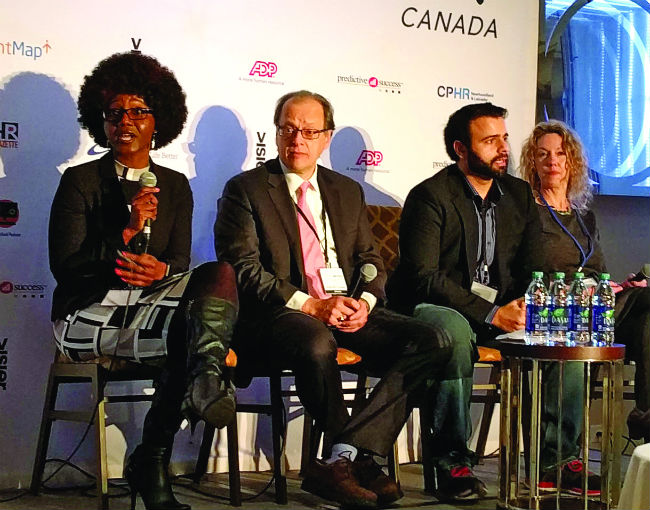
People analytics is a rapidly growing field in human resources, but because it’s still relatively new turf, sourcing the right talent can be a challenge.
Three panellists came together recently in Toronto to offer insights on how to form an effective HR analytics team.
And one place to start is in building the business case for people analytics, and taking ownership, they said, speaking at the People Analytics Canada conference on Nov. 2.
“The people analytics is a competitive advantage for a company… you don’t have the luxury not to build an internal team of the people analytics,” said Alex Uborcev, director of integrated people management at RBC in Toronto. “If you don’t start doing it now, you will be irrelevant in a few years, and the time is running very fast because that’s how tough the competition is.”
One of the biggest challenges is balancing demand with resources, he said, and universities cannot produce enough data scientists.
“Even if they do, it will just be data scientists with very narrow skills, and they need to have time to build broader capabilities.”
Globally, Xerox can’t count the number of employees it has because of the number of systems in play at any given time, according to Arun Kochhar, global HR insights and people analytics lead in Toronto.
“The main challenge we faced was getting buy-in from senior leadership to start taking our numbers seriously, versus what finance was providing.”
This divide between finance and human resources has come up before, according to Kochhar.
“The way that we address that is by, first of all, making it very clear what we’re counting in terms of people, so we’re not just counting fte (full-time equivalent), we’re counting noses, actual physical heads, and then also making sure that the client base actually understands what it is we’re doing and why our data is valuable. When you can present the case for why it’s important to look at things through an organizational lens as opposed to a financial lens, you’re far better off.”
In establishing an analytics function, Cornell University in Ithaca, NY, decided the skills of the HR community of about 150 people needed to be elevated, so it wasn’t just about analytics but about the HR partners owning the data and analytics, said Linda Croll Howell, director of HR analytics at the university.
But HR was incredibly decentralized, she said.
“We felt it was really important to provide them with basic tools because they were the ones who were closest to their business leaders and could really sell in what was important, because it’s different from school to school.”
First steps
Howell started with a basic set of dashboards that people could look at across the university and compare with their own college or unit, she said.
“A couple of things happened with that: First of all, we learned all about dirty data… so there’s great conversations going around that, about cleaning data up. But the other piece that we felt was most important was giving them the skills to be able to use these dashboards and go in and tell a story to their leadership.”
As a result, they recently rolled out an HR analytics academy for the HR community — and every class has been full, said Howell.
“A very basic skill that everyone in HR should get is basic Excel, so no matter what you end up using for dashboarding or whatever HRIS system you use, usually their reporting is sent out in a spreadsheet, so we felt it was a really important, basic thing to do. So we’ve introduced a basic Excel program and intermediate Excel program, and we’ve tied it into the HRIS system we use.”
It’s also about giving HR the data to tell stories, so they were given worklets, she said.
“Another thing that I’m doing is having them help me with a lot of pilot programs at their local college, their unit, so they can actually go through a process with me, hear how I explain the data and everything.”
When it comes to key deliverable, Xerox is not tracking towards one shining star, according to Kochhar.
“What we’ve done instead is build a road map, basically. It’s not a five-year road map, it’s a three-year road map. And the first step along the way is establish the team, draw the swim lanes… so every HR business partner and every COE (centre of excellence) in HR understands exactly who their touchpoint is and who their person is to go get insights. And then, as we move along, partner with HRIS to make sure we’re building out the platforms necessary to deliver value in the future.”
The commitment to business partners and senior HR leadership is about making them look smart to their client base, because that’s how HR gets in the conversation, he said.
“And smart doesn’t mean we’re showing up with statistics and basic statistics describing populations, it means we’re showing up with things that actually matter to the business and we’re speaking the language of the business. That will vary depending on the kind of organization that you’re in. The way that the business tracks themselves and measures success will be highly diverse, but as an HR analytics function, that is your trend line, that is what you should be optimizing towards in order to deliver value.”
Hiring: Focus on analytics or HR?
Of course, people are often limited by budget, said Kochhar, so your first investment is fairly critical. And if you can find an HR analytics individual, that’s great, especially if she’s got three to four years of experience — she can be a generalist to help build your base from.
Alternatively, it’s good to find people who have an analytic mindset, and a bit of HR experience, he said, “or even internally within your own company, if you can find people that are interested in HR analytics or analysts that are interested in HR in any way, and pull those people up, that can be a real value-add, especially if they already understand the business to begin with.”
Hiring a data scientist off the bat, somebody who has an extreme capability in terms of the analytical space, may actually not work out, said Kochhar, who hired two data scientists, for example, but when they started to get into the job, the quality of the data and data governance wasn’t quite there to do deep, dynamic modelling, so they were stuck doing advance analytics to a very small layer of predictive analytics, he said.
“It’s going to vary organization by organization. If you’re looking to get somebody to start up quickly, adjusting to HR often is the first shock value because we do things relatively differently. But for the longer term, you’re going to have to look at what that investment looks like.”
Howell was not able to hire a team from outside when she was putting together the HR analytics functions due to a limited budget, she said.
“So what I did was find people that were already super data users in different areas… kind of islands unto themselves where they are, and I was able to convince the head of HR… to have a couple of those people move into my area… I saw the potential.”
She has since assigned them client groups across functional areas of human resources based on their areas of expertise and where they came from.
The person doesn’t necessarily have to have an HR background, but should understand the basics of research design, “someone’s who good with numbers and with Excel spreadsheets,” said Howell, along with consultation and consulting skills.
“The good news is I think the market — in terms of recruits in people who have these skill sets — is starting to be developed, so you will definitely find that out there,” she said.
If you do hire someone who lacks an HR background but has consultative skills, is a good listener and gets out there and understands things, then he can succeed, said Howell.
“Where you have the benefits is if you have an HR business partner who comes into analytics (and) can provide that perspective of understanding the business, understanding the issues.”
But overall, it’s a team sport, said Uborcev.
“You create teams and you work together towards one thing. If you want to separate it, it depends because then we need to talk about what kind of a shared person, what kind of domain knowledge (goes) with what kind of technical skills... and it will be different project by project.”
RBC is doing really advanced machine learning, deep learning, system dynamic simulations, building a complex system, while at the same time, building simple, assumption-based models in Excel, he said.
“As soon as you focus on the decision, on the question that you’ve got and you need to answer, then you need to find the right stream and what to do about it: who’s the best person or what does the team need to be aligned towards, what kind of data do you need to have… to solve that problem?”



