Real GDP grows 3.3% annualized in second quarter — but economists warn pace unlikely to hold

Canada's economy rebounded sharply in the second quarter of 2026, posting annualized real GDP growth of 3.3% — a significant turnaround after a soft winter.
New data released by Statistics Canada confirmed the economy did not shrink for two consecutive quarters, with Q1 growth revised upward to a modest 0.1% from a previously reported flat reading.
“The data is consistent with an economic backdrop that has been gradually improving, particularly when measured on a per-person basis with Canada's population edging lower,” says an analysis from RBC Economics.
"The Q2 report confirms that the economy entered this latest period of trade disruption from a stronger starting point. Our base case remains for a gradual cyclical recovery.”
However, RBC cautioned that monthly GDP data are volatile and "the pace of growth in Q2 is unlikely to be repeated to the same extent in the quarters ahead," pointing to Statistics Canada's advance estimate showing July output was "essentially unchanged" from June levels.
Exports surge on auto recovery
The single largest driver of Q2 growth was a dramatic rebound in exports, which rose 3.6% — the fastest pace in more than three years. Exports of passenger cars and light trucks jumped 27.0%, recovering from production stoppages in Canadian auto plants caused by a global semiconductor shortage in late 2025 and extended factory retooling shutdowns in early 2026, says Statistics Canada.
Exports of intermediate metal products, energy products, and industrial machinery and equipment also contributed to the surge. Imports, by contrast, rose just 0.3%, resulting in net trade adding approximately 4.4 percentage points to annualized GDP growth.
Real gross domestic product and final domestic demand
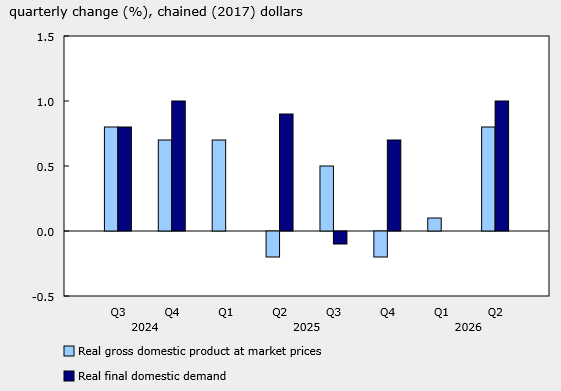
RBC noted that net trade "contributed substantially to growth as exports outpaced imports, led in part by a recovery in auto production and shipments following winter disruptions" — but flagged that the auto-related boost is "unlikely to be repeated to the same extent in subsequent quarters."
Domestic demand strengthens
Beyond trade, the recovery extended across the broader domestic economy. Final domestic demand — spending by Canadian households, businesses, and governments — rose 3.9% annualized, reversing a small decline in the prior quarter, says Statistics Canada.
Household consumption grew 3.3% annualized, with services spending outpacing goods. Despite elevated fuel costs weighing on purchasing power, the household saving rate edged up to 3.7% from 3.3% in Q1, supported in part by a one-time GST/HST credit top-up payment issued in June as part of the transition to the new Canada Groceries and Essentials Benefit program.
Business fixed investment jumped 9.5%, led by a 22% surge in machinery and equipment spending — including a 16.7% rise in computers and peripherals, driven largely by data centre-related imports of processing units. Engineering structures also rebounded after two consecutive quarterly declines.
Residential investment recovered as well, rising 2.5% after contracting in each of the prior two quarters. Resale activity picked up in Ontario, Quebec, and British Columbia, while new apartment construction in British Columbia led gains in new builds.
Industry-level picture
GDP measured by industry rose 0.9% in Q2, with 17 of 20 industrial sectors expanding. Mining, quarrying, and oil and gas extraction was the largest sector contributor, rising 2.2% as oil sands production rebounded from unscheduled maintenance disruptions and Atlantic offshore production ramped up.
The manufacturing sector grew 2.1%, largely recovering from two quarters of declines, with transportation equipment manufacturing posting its strongest quarter since mid-2020. The public sector also expanded, partly reflecting increased federal activity tied to the 2026 Census.
Main industrial sectors' contribution to percent change in GDP in June
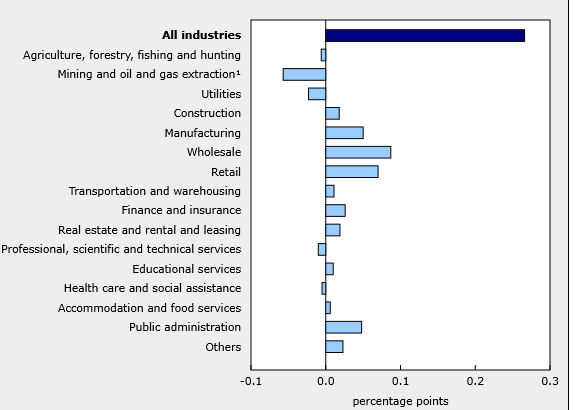
In June specifically, real GDP by industry grew 0.3% — a third consecutive monthly increase — led by wholesale trade, retail trade, and public administration. Canada's hosting of 10 FIFA World Cup matches in June provided a modest lift to broadcasting, spectator sports, transit, and food services, though accommodation and air transportation contracted in the month.
Tariff risks loom over second half
Despite the strong Q2 showing, the outlook for the remainder of 2026 is tempered by trade uncertainty. The most recent round of U.S. tariffs — set at 50% — adds meaningful downside risk, particularly for producers of plastics, electrical machinery, furniture, and wood products. Regional exposure is concentrated in Quebec, British Columbia, and Ontario.
RBC noted that more than 80% of Canadian exports continue to enter the United States duty-free under the Canada-United States-Mexico Agreement (CUSMA), which it said helps "preserve the broader growth backdrop." Still, the bank warned that "national growth figures will mask much more difficult adjustments for affected industries, communities and workers."
Canada's retaliatory counter-tariffs and government support measures, RBC added, "will help shape how widely those effects spread."
An advance estimate from Statistics Canada indicated that GDP was essentially unchanged in July, suggesting activity moderated at the start of Q3. Gains in real estate and professional services were offset by declines in retail trade and manufacturing.
RBC said it continues to expect the Bank of Canada to keep interest rates unchanged through the remainder of 2026,.
Statistics Canada will release Q3 GDP data on Nov. 30, 2026.