
Companies, workers adapting to volatile environment
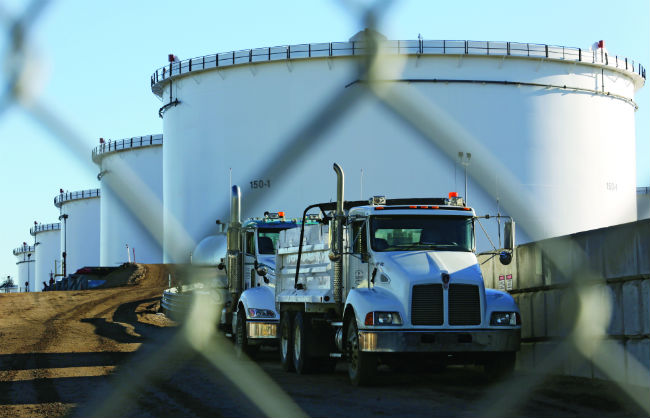
A full economic recovery is still an elusive reality in Alberta’s oil and gas sector, where volatile oil prices continue to plague the industry since major declines in 2014. Tens of thousands of workers have been laid off, directly or indirectly, with many people leaving the profession — and the province — to try and find work elsewhere.
But when the sector does finally make a comeback, it’ll be a different-looking labour force, according to experts.
“What we’re facing is a jobless recovery and that’s what people need to become mindful of,” said Jackie Rafter, founder, president and CEO of career transformation company Higher Landing in Calgary.
“We’re not seeing a lot of white-collar jobs coming back, and we’re really going to see the wage of incredible talent wars within organizations competing for fewer promotions and advancement.”
Signs of a recovery
While the oil sands sector experienced sustained cost-cutting, restructuring and deeper-than-anticipated job cuts in 2016, a modest recovery of about 3,400 net jobs is projected over the next four years, according to the Oil Sands Labour Demand Outlook to 2020 Update, released by PetroLMI in December.
Employment is forecast to grow by about six per cent, from an estimated 63,800 in 2016 to 67,200 in 2020 as companies shift spending from expansion to maintenance, repair and optimization of their operations.
“There’s more drilling activity at this time this year than there was last year… and we are starting to see some rehiring, particularly field workers and work related to the actual drilling activity itself,” said Carol Howes, vice-president of communications and PetroLMI division with Enform in Calgary.
There’s cautious optimism, according to Jim Fearon, vice-president of Western Canada at recruitment firm Hays in Calgary.
“We’ve obviously seen a minor rebound in the oil prices in the last three, four, five months, and that’s eased the purses somewhat, so we’re seeing some much-needed maintenance going on, a bit of drilling returning, and there’s a marginal amount of more activity going into new project work,” he said.
“We’re a long way from being at the stage where the industry’s in a boom, oil and gas companies are making massive profits and they’ve got money to throw around — everyone’s very, very cautious, the oil price is still very low.”
Most companies scaled back operations fairly significantly, including corporate head office support, “so a small increase in activity means that they’re stretched not to the limit, but enough that they have to start hiring in some form or other,” said Fearon.
Employers are “fairly reticent” to commit to a permanent headcount, he said.
“Everyone wants to see ‘How long is the recovery going to be for? Is it a permanent recovery, is it a short-term thing with another dip?’ So most companies… largely want to bring on contracts for extended periods of time, six to 12 months, and see what the economy’s doing thereafter.”
In Alberta, the industry has been decimated somewhat, especially for people aged 50 and older, said Iqbal Ali, managing director of Petro Staff International in Calgary.
Now, some people are getting contracts but they’re short term, in terms of weeks, not years, he said.
“And the folks who are in the 50-plus range are having it the toughest because they’re the highest paid and demand high salaries,” said Ali.
“It’s a wake-up call. Who knows, if the price of oil goes back up to 100 bucks, 90 bucks, we may see something different. The price of oil now is man-made, not market-made and, therefore, anything man-made is always problematic — they can bring it down as they took it up.”
A lot more discontinuous career paths are sprouting up, and contracting is picking up as employers are hesitant to hire somebody with all the benefits and commitments that go along with hiring a full-time person, said Rafter.
“They want to factor in that flexibility within their own business and financial model,” she said.
“This (downturn) has been so hard and for so long, some people have put up their hand and said ‘uncle’ and those that have adapted to change are coming out with some of the most remarkable change for innovation, and innovative ways of reducing costs with fewer or no headcount. So this whole economic downturn has resulted in some really cool innovations that are in alignment with whole future of work as we see it.”
The job cuts will continue to grow, said Rafter, because businesses are getting a lot smarter, and technology and innovation are taking over a lot of operational divisions. In looking at a business organically and holistically, employers are going to find cost reductions in ways they never otherwise would have thought of, she said, such as using automated vehicles in the oilsands.
“When you look at the fallout of that, you’re not only increasing operational efficiencies but you’re also decreasing costs and you’re decreasing headcount,” she said.
“The economy has really forced people to become innovative, creative and look outside the box just to survive, never mind thrive.”
In the past, the pendulum has swung back quicker than it has this time, said Howes, and traditionally the expectation was there would be a recovery.
“In this case, that’s not the case so much, so certainly companies are looking to find some longer-term solutions, and that includes improving productivity and creating efficiencies.”
There has been a restructuring of the industry, she said, “and we are going to see a smaller industry going forward, and by default, that means that you’re going to have companies with fewer employees than you would have had previously… It is a bit of a shift in mindset.”
There’s a broad spectrum of changes contributing to the new labour force, said Fearon.
“It’s changes in technology, changes in process, it’s restructuring to remove inefficiencies of organizations,” he said.
“I know a lot of the larger oil and gas companies have found ways to restructure finance departments and IT departments and that kind of thing, so there’s way less double-handling. A lot of organizations had grown very, very fast and, as a result, probably ended up hiring heads that they could easily have found another way to distribute that work to if they had more time available to them. And I think the downturn’s afforded them the opportunity to generate more efficiency within the organization structure.”
As for attracting job candidates, it can be difficult when it comes to the higher-skilled positions, while plenty of applications flow in for lesser-skilled jobs, said Fearon.
“Where you’re talking about skills that are still highly in demand... if (employers are) trying to attract people that are gainfully employed with other oil and gas firms or services firms, and they’re still having to turn their heads and attract them into their organization, then they’ve still got to be positioning their value proposition in the right way. Where the market is less competitive, then candidates have got to be doing the same thing, positioning themselves to be attractive to employers.”
Employees who are adverse to the change are the ones who are going to suffer the most, said Rafter.
“Old jobs are not coming back, not in the traditional way. We’re finding people are being now rewarded not for loyalty they’ve shown in a job but for the value they bring to an organization. So career security is replacing job security.”
SIDEBAR
Balancing headcount
When the crisis first hit more than two years ago, oil and gas companies soon realized they had to cut costs, and quickly. That largely meant layoffs, according to Lance Mortlock, partner and Canadian advisory strategy leader at Ernst & Young (EY) in Calgary.
“When rigs are not being used because wells are not being drilled, you’ve got all those crews, which is the bulk of some of these oil field companies’ organizational headcount, with nothing to do so, unfortunately, as a result, significant cuts have been made.”
Very few employers engaged in salary freezes or pay cuts, found an EY study completed in association with the University of Calgary’s Haskayne School of Business.
“It’s potentially easier to cut headcount without longer term business infrastructure issues, whereas if you start to play with wages, salary freezes, when things recover, it can be more complicated in terms of your process and your policies and all of those things, to then fix that.”
The 81 per cent of oil and gas companies that reduced headcount by 25 per cent to 30 per cent reported the highest level of reorganization success, according to the report.
“The caveat, however, is that this relationship becomes weaker once companies surpass a 50 per cent headcount reduction,” said Mortlock. “So we’re really seeing an optimal point.”
The sweet spot would really be dependent on where a company was at prior to the downturn, and what level of efficiency was created within the organization, said Carol Howes, vice-president of communications and PetroLMI division with Enform.
“It really depended on what they needed to do to be able to become more efficient and survive through a $50 to $55 barrel of oil… and how much they had beefed up in the previous years,” she said. “2014 was really a peak in terms of the hiring.”



