While WFH has its pluses, hidden downsides are becoming more evident

When we were required to work from home back when the pandemic first hit in early 2020, I wasn’t overly concerned — about working from home, that is, not the global threat of the unknown COVID-19 virus.
That’s probably because I was comfortable working from my house, I had the space to work, there were others in the house with me, and I’m largely introverted, so don’t have a great need to get out and see people to be energized.
But maybe I wasn’t entirely correct? Maybe I saw only the good when there were some definite downsides?
That’s a finding from a recent survey, which suggests many people express a preference for working from home (WFH) when, in fact, it may be harmful to their health.
Remote work risks
The study is from researchers Natalia Emanual of the Federal Reserve Bank of New York and Emma Harrington of Harvard University and Amanda Palais of the University of Virginia. They found that remote work, while often boosting productivity, also leaves many employees feeling socially isolated and leads to mental health issues.
“Our findings suggest that workers may not realize the costs of remote work for their well-being, which may take time to accumulate.”
The research, published in Science, drew on five national surveys of employees across a range of jobs and found that WFH increases time spent alone, worsens mental well-being across multiple measures, and increases use of mental health services and prescriptions.
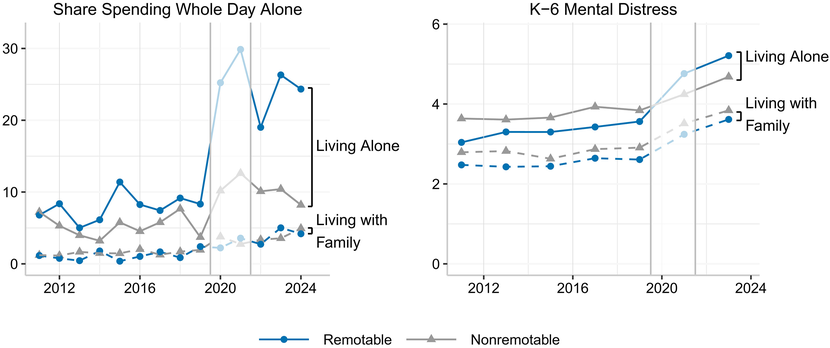
Over a roughly 10-year period before and after the pandemic, remote workers experienced a 58% rise in hours spent alone, compared to in-office workers, found the study. They also had more days spent entirely alone and decreased after-work socializing.
Eight years after the pandemic began, I know better the challenges of working from home. Because after a few years of five days a week of WFH, the isolation becomes readily apparent. Sure, I’m exchanging emails and engaging in Teams calls through the day, but the camaraderie and socializing of the office can’t be replicated over a laptop.
The rise in isolation was sharpest for those living alone, whose likelihood of spending the whole day without social contact rose notably.
Mental distress with WFH
Mental distress simultaneously increased, according to the U.S. researchers. Scores on the Kessler (K-6) measure of generalized psychological distress rose by 0.1 standard deviations for those in remotable jobs relative to those in non-remotable jobs.
The increase in distress was roughly twice as large for those living alone compared with those living with family.
“Alternative measures of mental distress — such as the frequency of depression, mental health care utilization, and antidepressant prescriptions — show similar trends.”
In contrast, workers not working from home did not differentially increase visits to non–mental health care providers or non–mental health prescriptions (statins, for example), “suggesting that the change was not merely driven by increased flexibility for doctor visits,” they say.
Over the years, I’ve come to fully appreciate the importance of human connections, especially for mental health. When you’re down and in no mood to talk to someone, a quick chat can surprisingly make a big difference — a bigger hurdle when working quietly from home.
Important role for HR
That’s not to say WFH should gradually wind down. We’ve seen plenty of research showing the pluses, such as reduced commuting stress, greater productivity, higher engagement with flexibility, and lower everyday costs.
But HR should definitely be taking into account the isolation that comes with working from home, and be sure to measure that through surveys that go beyond the usual engagement questions to delve into people’s challenges.
Once the results are in, or even to be preventative, HR can step up by reminding managers of the importance of one-on-ones with their teams, or reviving the coffee talks over Zoom that proved so popular during the pandemic, or encouraging remote workers to come into the office once or twice a month to connect with colleagues.