
How can you implement a proven retention strategy for your company? What benefits do employees care about most? Find out how Canada’s leading employers maintain an employee turnover rate below 5 percent, provide adequate benefits for a diverse generational workforce, and plan to expand their offerings – complete with data and stats on remuneration, rewards, benefits, and new initiatives for 2025

Source Details:
(a) Data collected from employers and employees throughout Canada
(b) Surveyed company sizes ranged from 10 to 2,999 based on headcount
(c) Participation was open to all industries
(d) Survey included 2,659 Canadian employees
(e) Survey included 641 Canadian employers
(f) Survey included 750 employees from companies recognized as “best employers”
(g) Survey included 25 employers recognized as “best employers”
(h) Data collection period: June 2023–January 2024
Report Purpose:
This report aims to uncover the retention strategies utilized by some of Canada’s top-rated companies and the best tactics to engage with for each of Canada’s diverse work generations. CHRR gathered comprehensive data from employers and employees across diverse industries and provinces across Canada. The goal was to analyze and identify effective and proven practices that reduce employee turnover and to understand the factors employees consider crucial for job retention.
Report Intro:
This report identifies key trends when it comes to employee retention and the factors encouraging these employees to stay with their organization. These trends, particularly as they result in employee benefits, rewards, and recognition programs, differ across the varied generations currently in the workforce.
Report Insight Part 1: Canada’s Employment Landscape
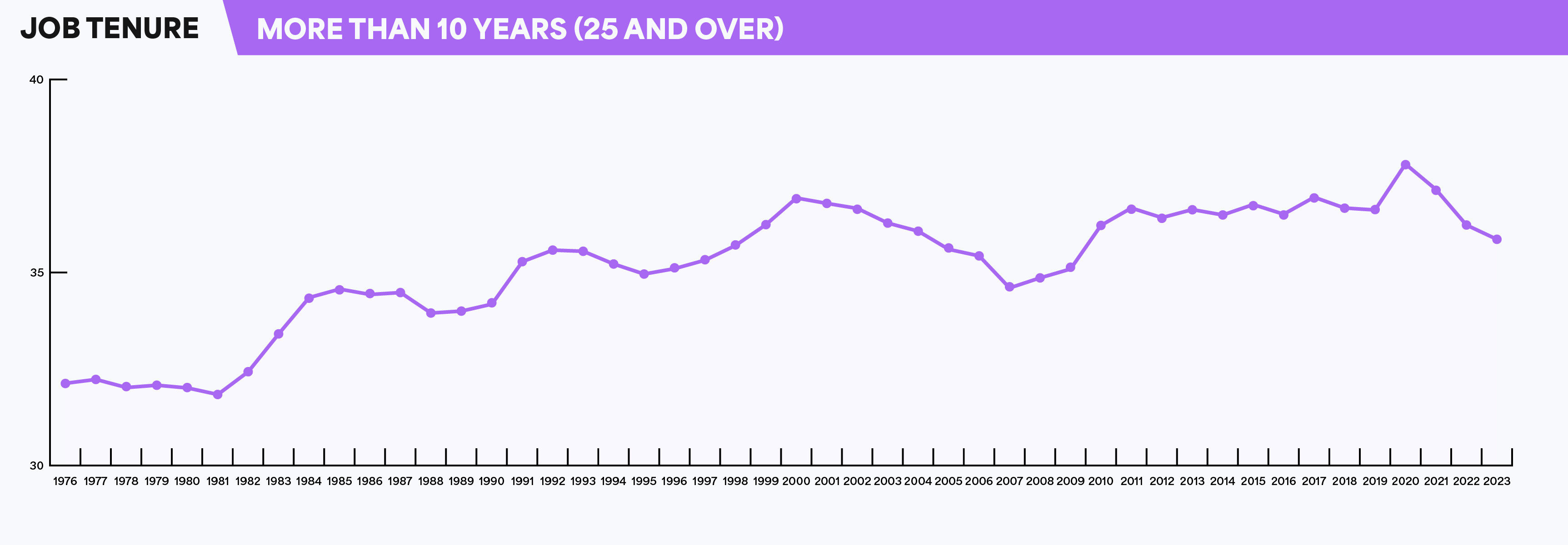
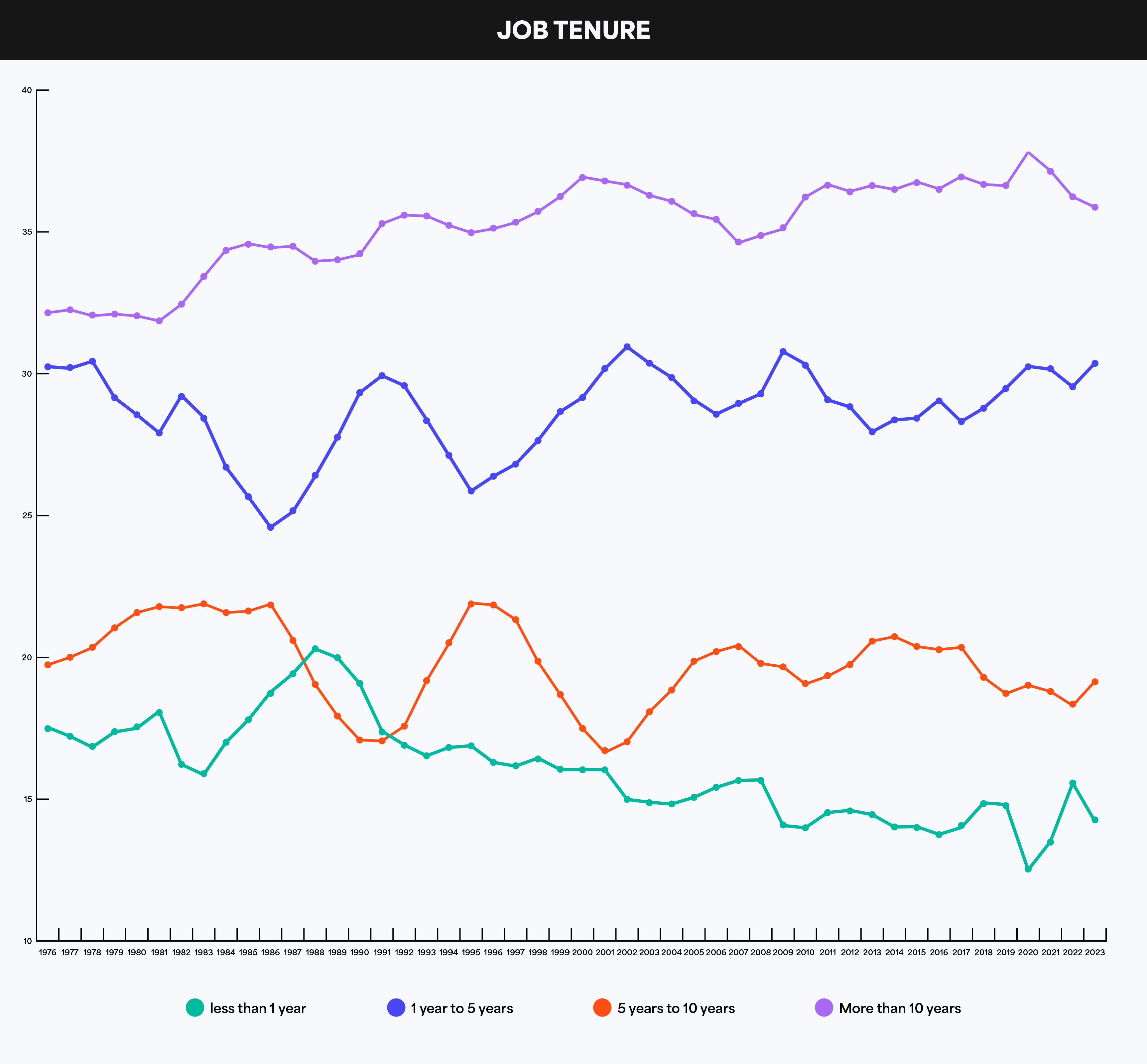
Canada’s employment landscape has shown increased job stability in recent years, with a notable rise in long-term employment; the proportion of workers aged 25 years and over who stayed with the same employer for 10 years or more grew to 37.8 percent in 2020. However, this stability has since seen a decline, with 10-year tenure reaching hitting its lowest point in 2023 since 2009. Meanwhile, short-term employment has declined, reflecting a shift toward longer job tenures and potentially greater employee satisfaction.
Report Insight Part 2: Defining the Generations
Four generations make up the current workforce – Baby Boomers, Generation X, Millennials, and Generation Z – all of whom have different workplace values. While Baby Boomers and Gen Xers hold more traditional values, Millennials and Gen Zers are more adaptive to the evolution of technology, making it important to ensure the needs of all employees are met.
Report Insight Part 3: Employer Benefits by Generation: Which Benefits Motivate Your Employees?
While different generations value benefits differently, dental coverage, medical coverage, and flexible work options came out as the top three benefits rated “very important” by employees. Career development opportunities and flexible work options are important to younger generations, while older generations place higher value on retirement plans, health care, and extra vacation days.
Report Insight Part 4: Benchmarking Benefits
Benefits emphasizing physical and mental well-being are key offerings for employees, with 40 percent of employers who do not currently offer a wellness spending account planning to add one in the future. Meanwhile, paid vacation leave was the most highly rated additional benefit valued by employees, with 4 percent of employers offering unlimited time off.
Report Insight Part 5: The Cost of Employee Turnover
Canada’s overall turnover rate is 11.9 percent, a significant decrease from 2023. High rates of employee turnover can create direct and indirect costs ranging from as low as 20 percent to as high as 150 percent of a worker’s salary.
Part 1: Canada’s Employment Landscape
What was once good news for Canada’s employers may now be shifting, with the trend of employees staying with companies for longer taking a downward turn. National figures show that from 1976 to 2021, there were two significant long-term trends in the distribution of employed Canadians across different job tenure durations. However, this has since shifted.
-
Long-Term Employment Shifts:
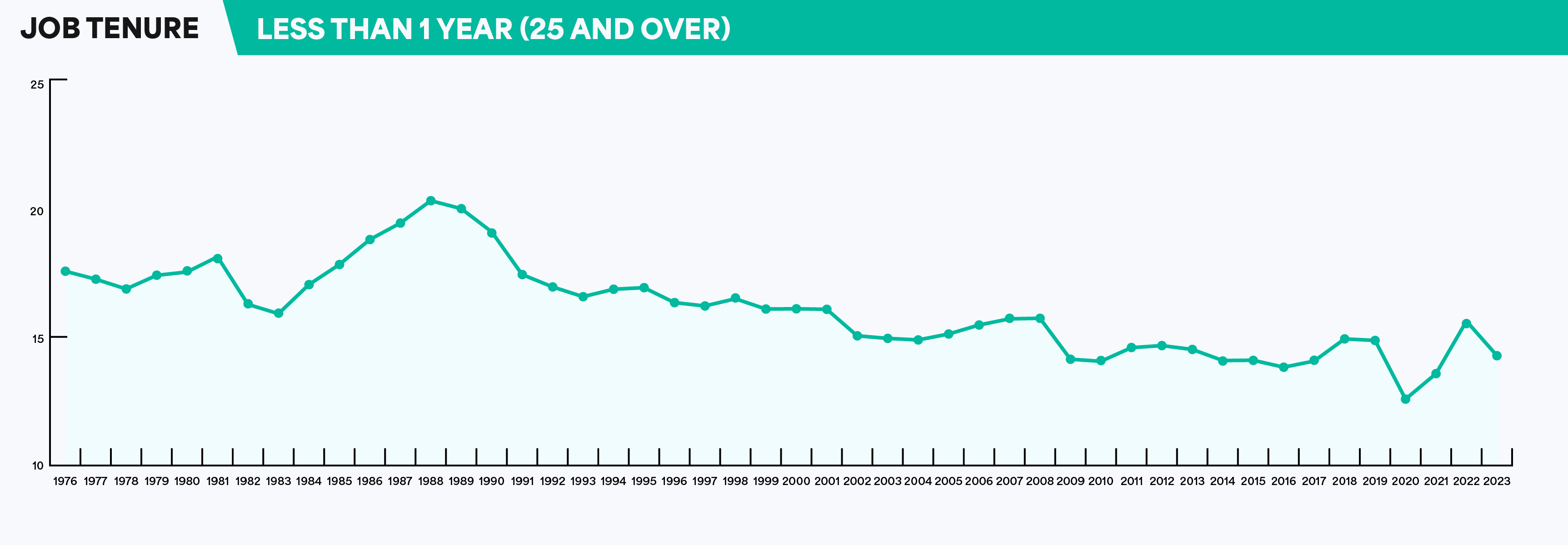
Between 1976 and 2020, Canadians were staying put longer; the proportion of workers aged 25 and over who stayed with the same employer for 10 years or more increased by 5.7 percentage points since 1976, reaching a peak of 37.8 percent in 2020. However, these rates have experienced a downward trend, with the same group of workers declining to 35.9 percent in 2023 – the lowest since 2009.
-
Decrease in Short-Term Employment:
At the other end of the scale, the share of workers aged 25 and over with a tenure of less than a year declined from 17.6 percent in 1976 to 14.3 percent in 2023, the latter decreasing from 15.6 percent in 2022.
During economic downturns, short-term employment tends to decrease more sharply:
- 2008/09 Economic Downturn:
- The proportion of workers aged 25 and over with less than one year of tenure fell by 1.6 percentage points to 14.1 percent from 2008 to 2009.
- COVID-19 Pandemic in 2020:
- The proportion of workers aged 25 and over with less than one year of tenure fell from 14.9 percent in 2019 to 12.6 percent in 2020, marking a historic low.
- The share of workers aged 25 and over with 10 or more years of tenure increased by 1.2 percentage points to 37.8 percent in 2020, a historic high in line with the trend of increasing tenure during this time.
As employment began to recover in 2021:
- The number of workers aged 25 and over with less than one year of tenure increased by 1 percentage point to 13.6 percent.
- The share of workers aged 25 and over with 10 or more years of tenure decreased by 0.7 percentage points to 37.1 percent.
As the workforce and economy restabilized following the pandemic:
- The proportion of workers aged 25 and over with less than one year of tenure increased by 2 percentage points to 15.6 percent between 2021 and 2022. However, this shifted again, decreasing to 14.3 percent in 2023, returning to levels consistent with those of 2009 to 2019.
- The number of workers aged 25 and over who stayed with the same employer for 10 years or more declined 0.9 percentage points in 2022 and a further 0.3 percentage points in 2023, reaching 35.9 percent – a new low since 2009.
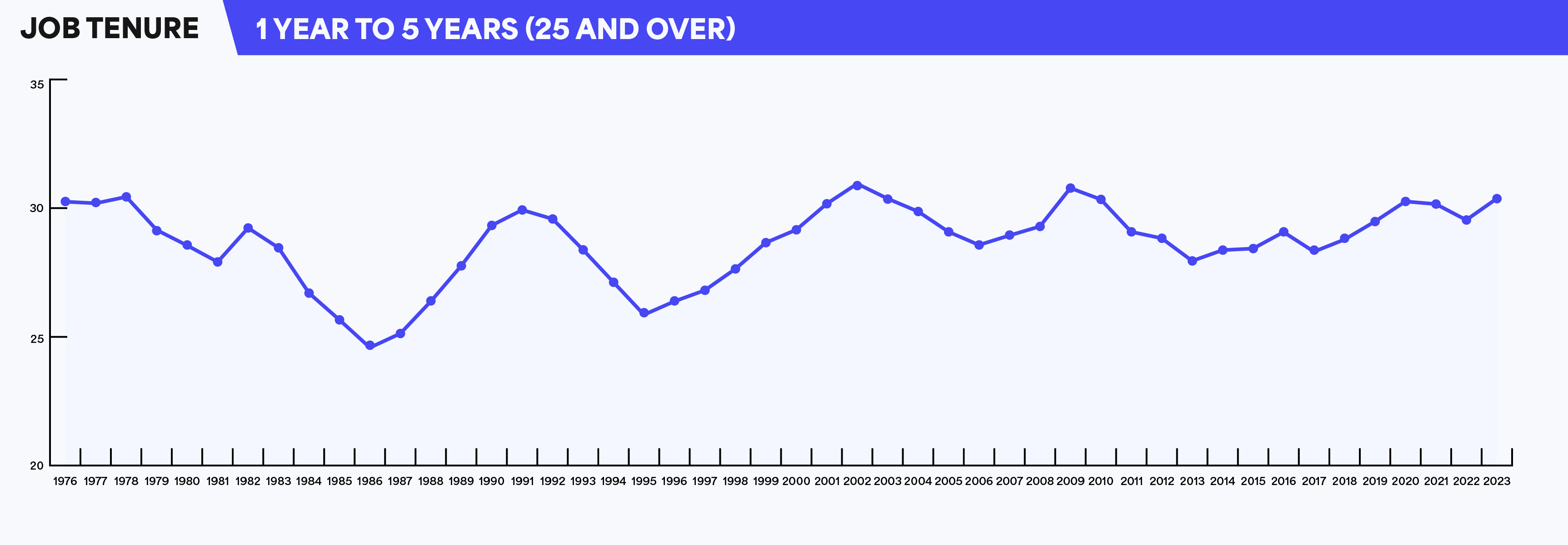
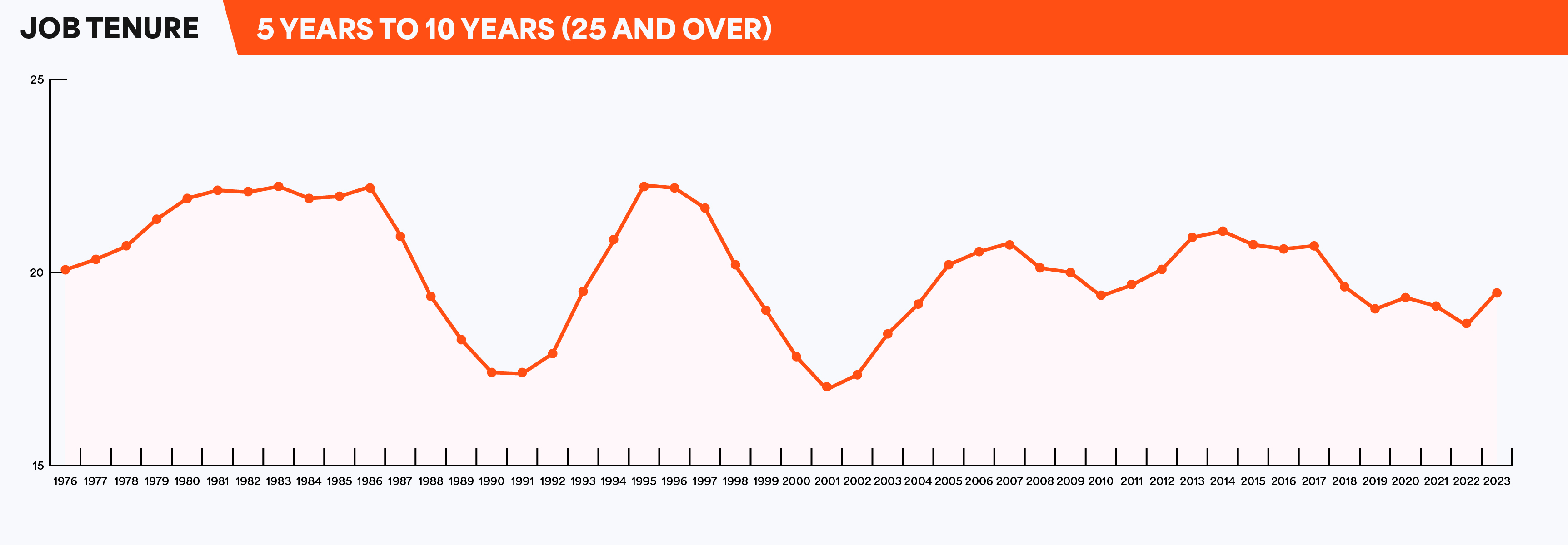
Despite the shifts in job tenure distribution during the pandemic, key differences between demographic and labour market groups have remained consistent.
- Age and Job Tenure:
- Younger workers typically have shorter job tenures due to their later entry into the labour market.
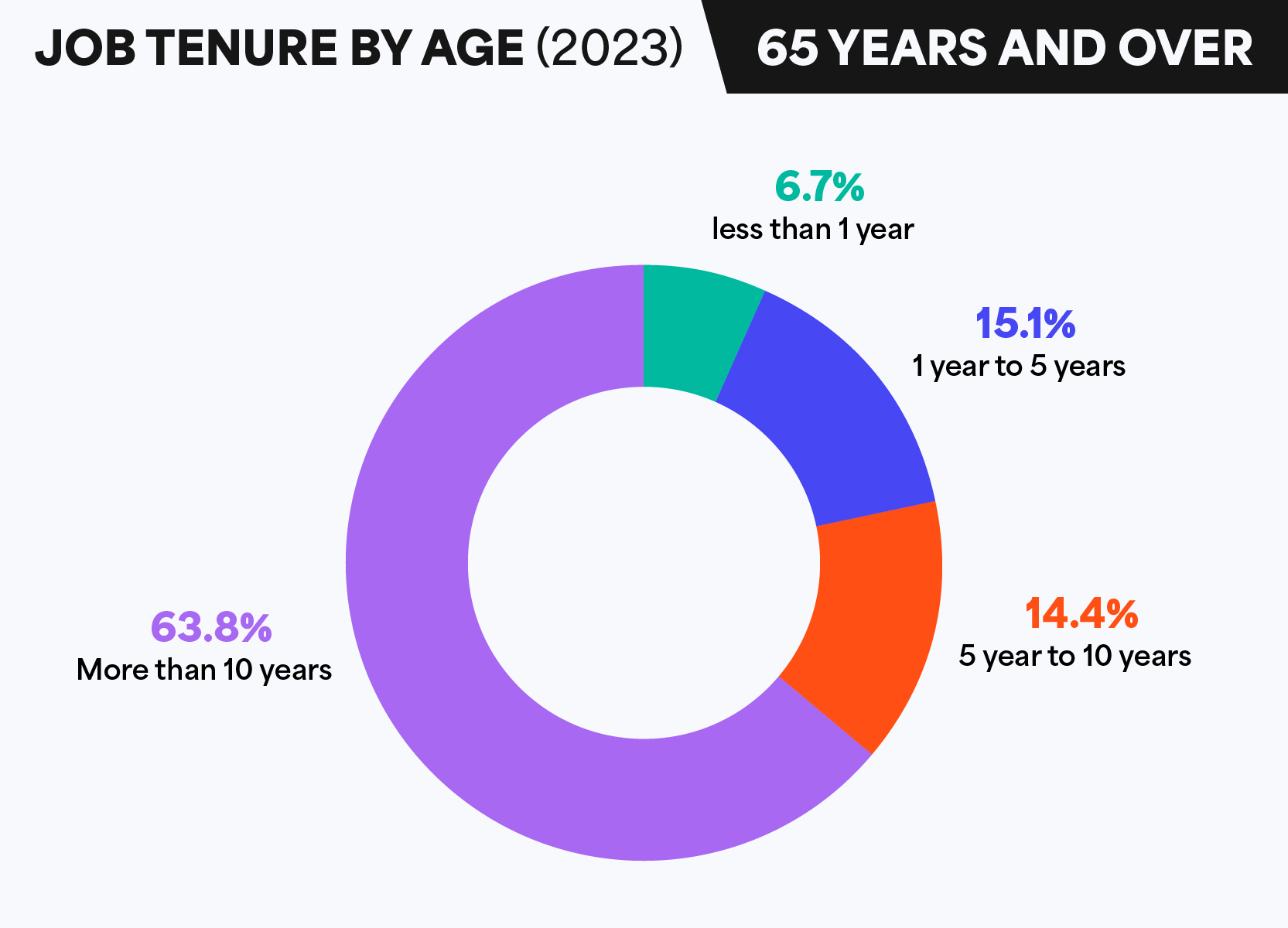
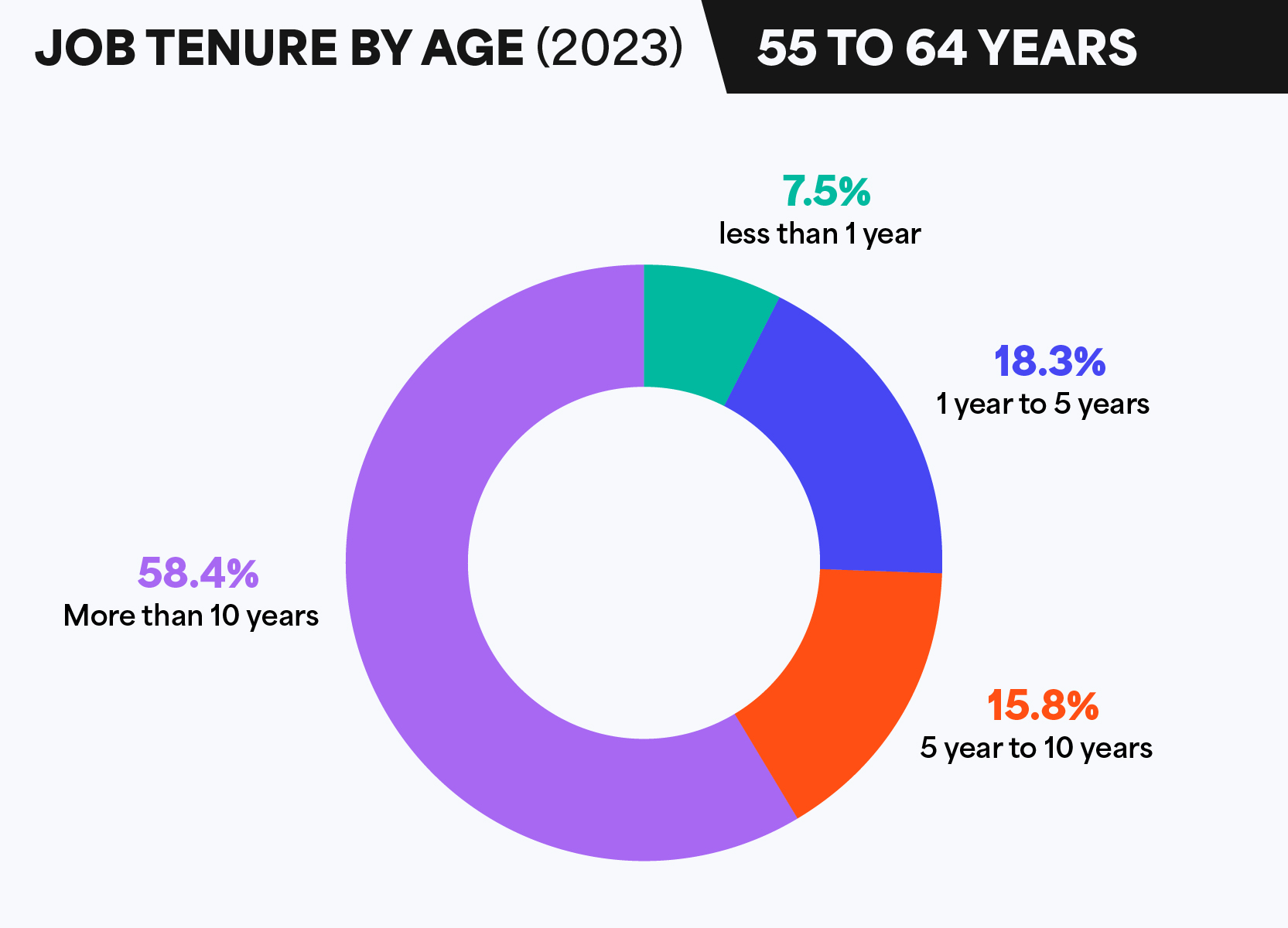
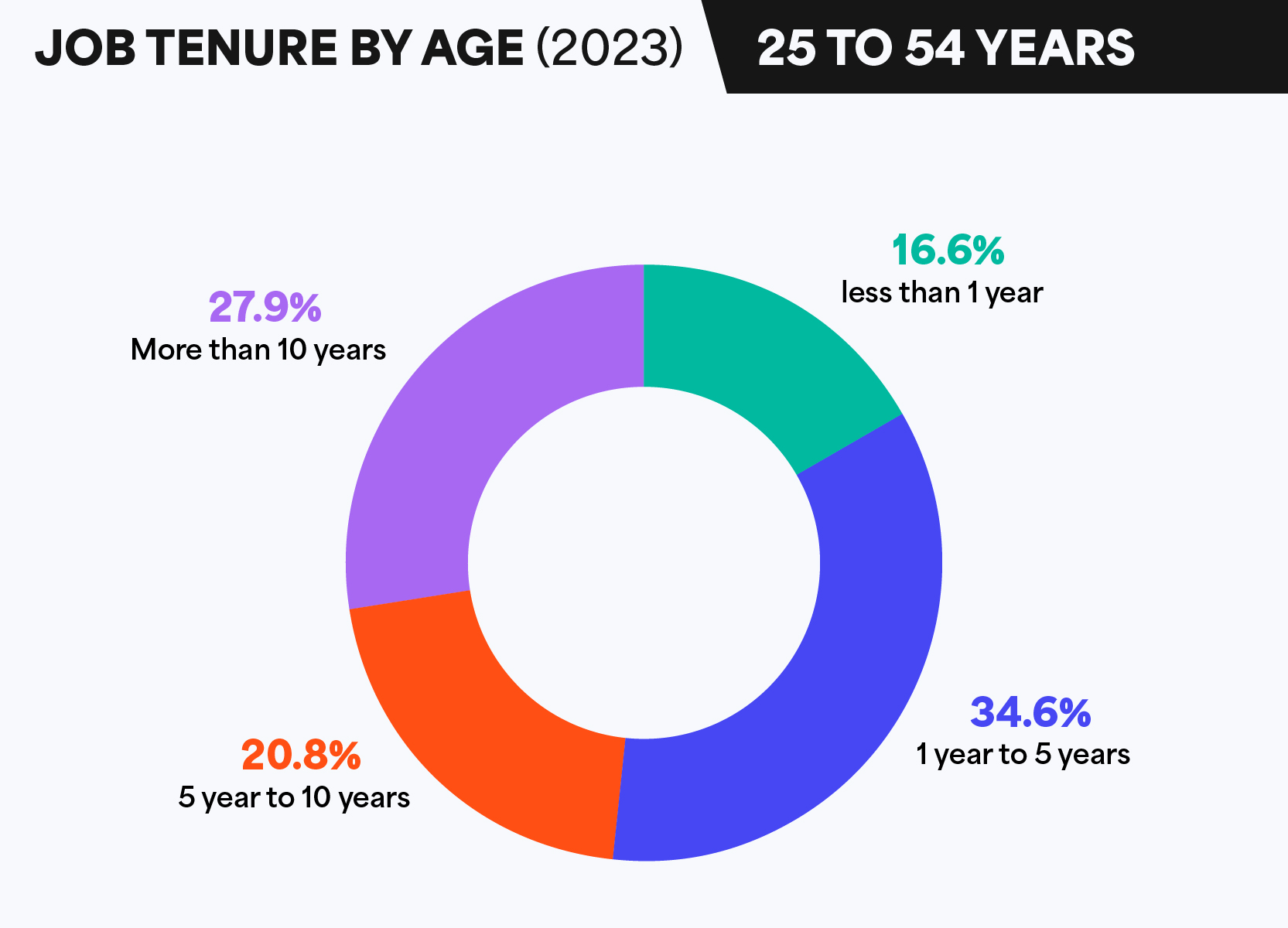
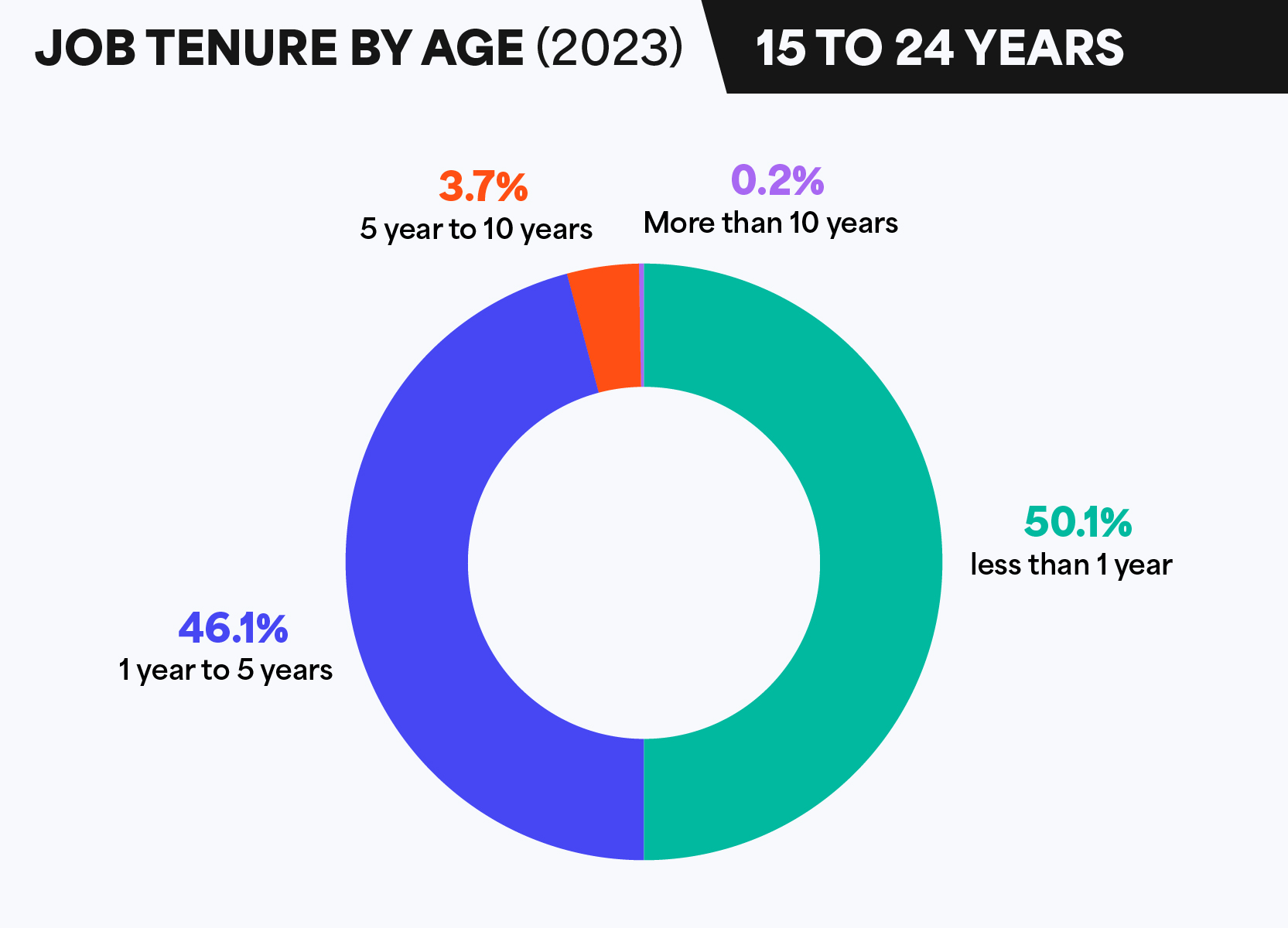
- According to Statistics Canada, in 2023, only 19.2 percent of workers aged 25 to 44 had been with the same employer for 10 years or more. However, with the typical employee graduating college at 21 and entering the workforce shortly after, for this age group to be with the same employer for 10 years, they would have started working there between the ages of 15 and 24. For workers aged 55 to 64, this proportion was 58.4 percent, and for those aged 65 and over, it was 63.8 percent.
- Gender Differences:
- In 2023, a slightly higher proportion of men (36.6 percent) had tenures of more than 10 years compared to women (35.1 percent). This difference is partly due to the average age of male workers (45.1) being slightly higher than that of female workers (44.4).
What is an acceptable turnover rate?
Although Canadian employers face lower turnover rates compared to their U.S. counterparts, complacency is not an option. Mercer reports that from 2023 to 2024, Canada’s average total turnover rate was 16.9%, with a voluntary turnover rate of 11.9%. This marks a decrease from the previous year, where total turnover reached 19.6%, and voluntary turnover was 15.5%.
In 2023, voluntary turnover rose to 15.5%, up from 12.4% in 2022, while involuntary turnover dropped to 4.1% from 5.6%. This shift is notable, especially considering earlier forecasts. PwC’s 2023 Hopes and Fears survey had predicted that nearly 1 in 4 Canadian workers would change employers by mid-2024, reflecting global uncertainty in the job market.
Interestingly, while voluntary turnover has declined since 2023, involuntary turnover has increased, returning the rate closer to 2022 levels.
|
Year |
Total Turnover |
Voluntary |
Involuntary |
|---|---|---|---|
|
2022 |
18.0% |
12.4% |
5.6% |
|
2023 |
19.6% |
15.5% |
4.1% |
|
2024 |
16.9% |
11.9% |
5.1% |
In the United States, turnover rates have been higher than in Canada. The average voluntary turnover rate in the US from 2023 to 2024 was 13.5 percent. This figure continues a downward trend observed over recent years. For reference, the average turnover rate in the US was 24.7 percent in 2022 and 17.3 percent in the subsequent year.
Currently, the rate of unemployment and elevated number of job vacancies have not been beneficial to employers. However, the tide may be turning. When looking at your internal year-on-year retention figures, it is important to be aware of the effects of current unemployment rates and job vacancies, as they may heavily skew the results from your company’s retention strategies.
Which companies suffer most from turnover?
Unsurprisingly, industries with traditionally high turnover continue to suffer. The retail and wholesale industry tops Canadian organizations with a 25.9 percent turnover rate, while the energy industry has one of the lowest at just 8 percent.
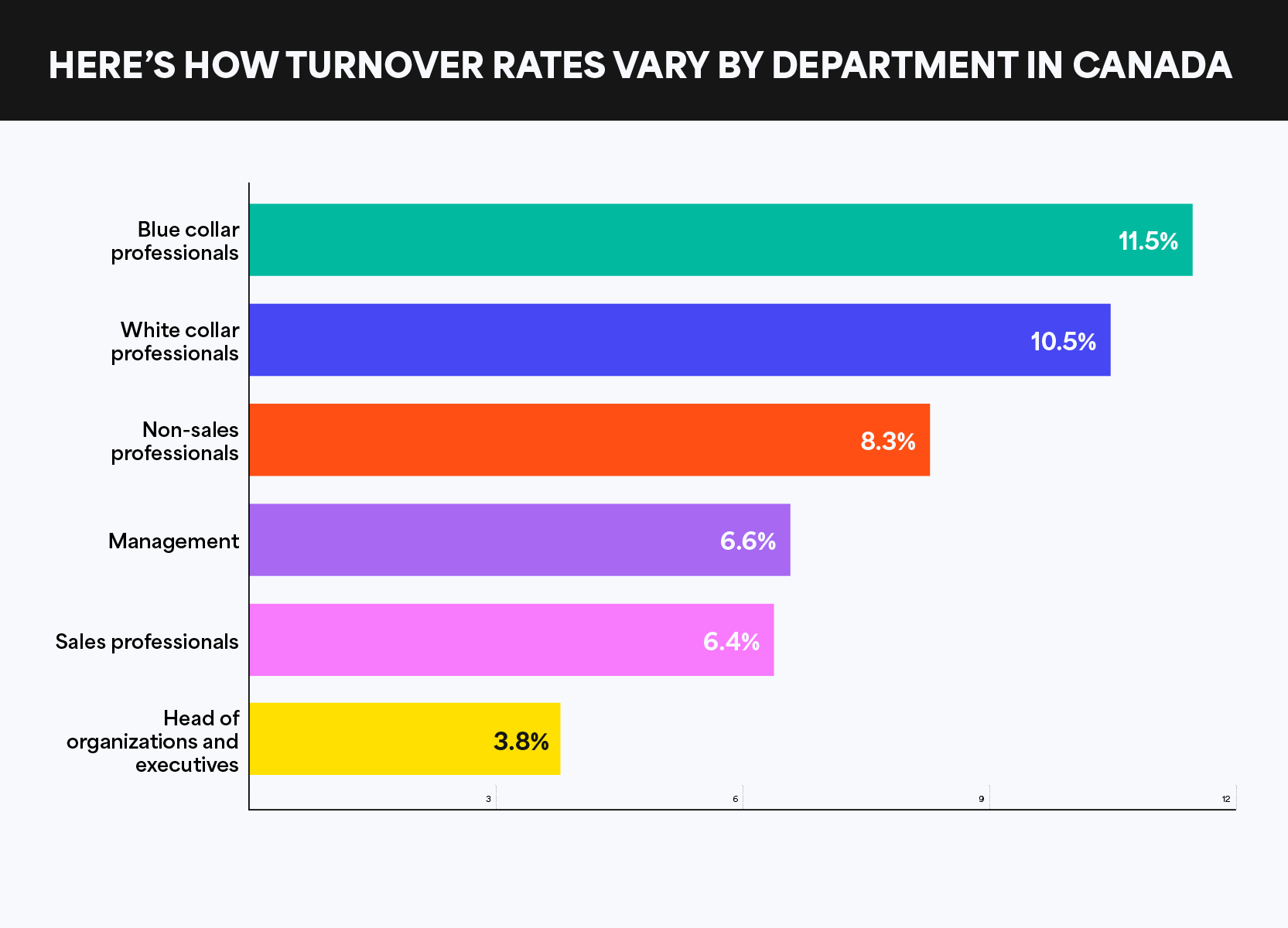
The roles that fare better and show low turnover rates are those with more experience and higher pay, like executives and management. This may not come as any surprise, as moving to a senior position typically takes tenure, and promotions may come to employees who are seen as having long-term plans to stay with the company.
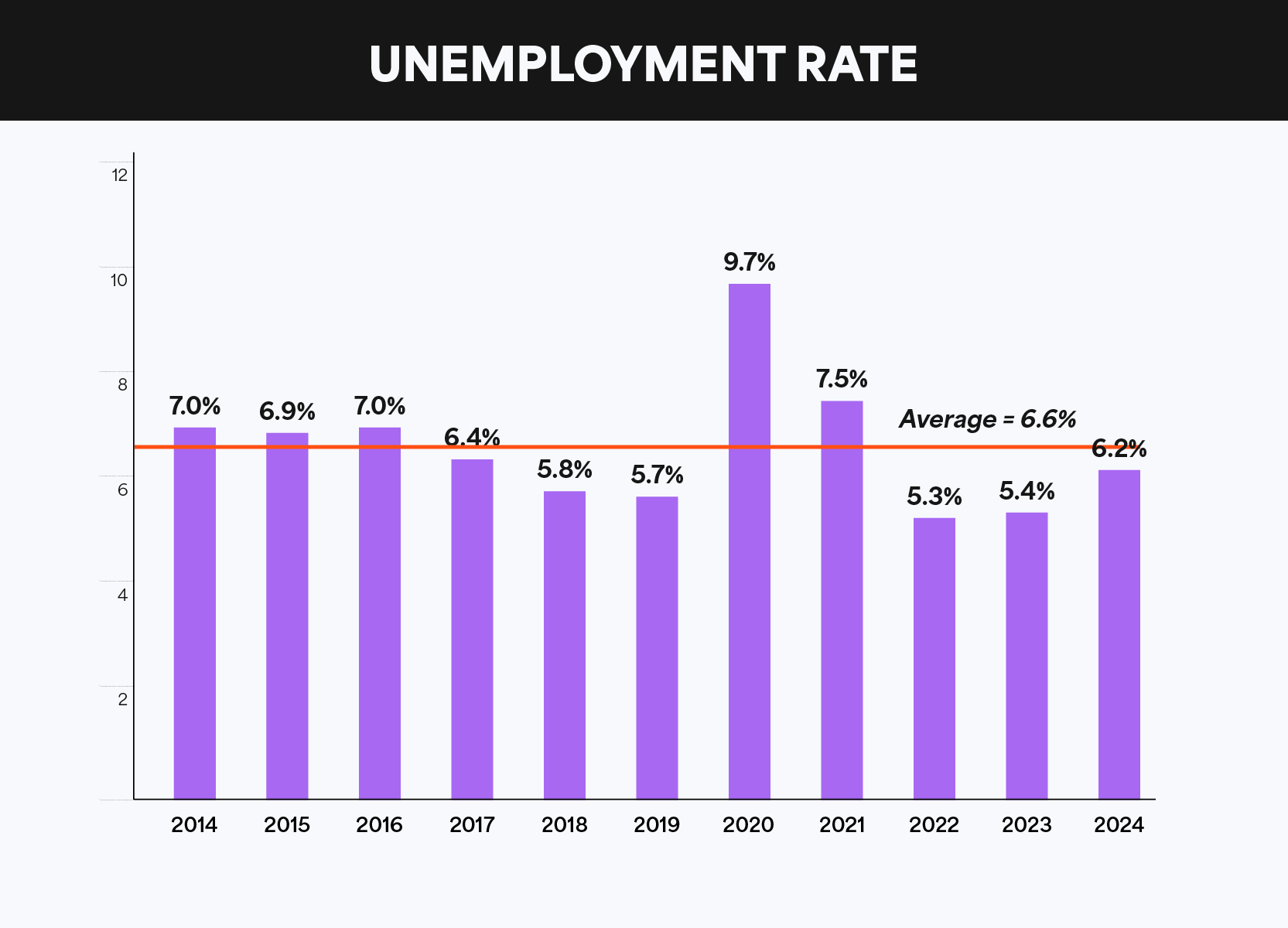
Historically, low unemployment rates have also helped fuel “the grass is greener” feeling, as staff see an easy opportunity to switch jobs. This is particularly prominent when there appears to be an extensive safety net of unfilled vacancies advertised. Market forces may be influencing certain generations, resulting in them being labelled as more likely to job hop. Although, with a number of companies advertising “just in case,” these open jobs may be far more illusory than job switchers might expect. A sudden sentiment change would see numerous paper vacancies close as companies try to save money or realize they don’t need a raft of applicants after all.
Although the unemployment rate is now rising again, it is still substantially below the long-term Canadian average of over 8 percent.
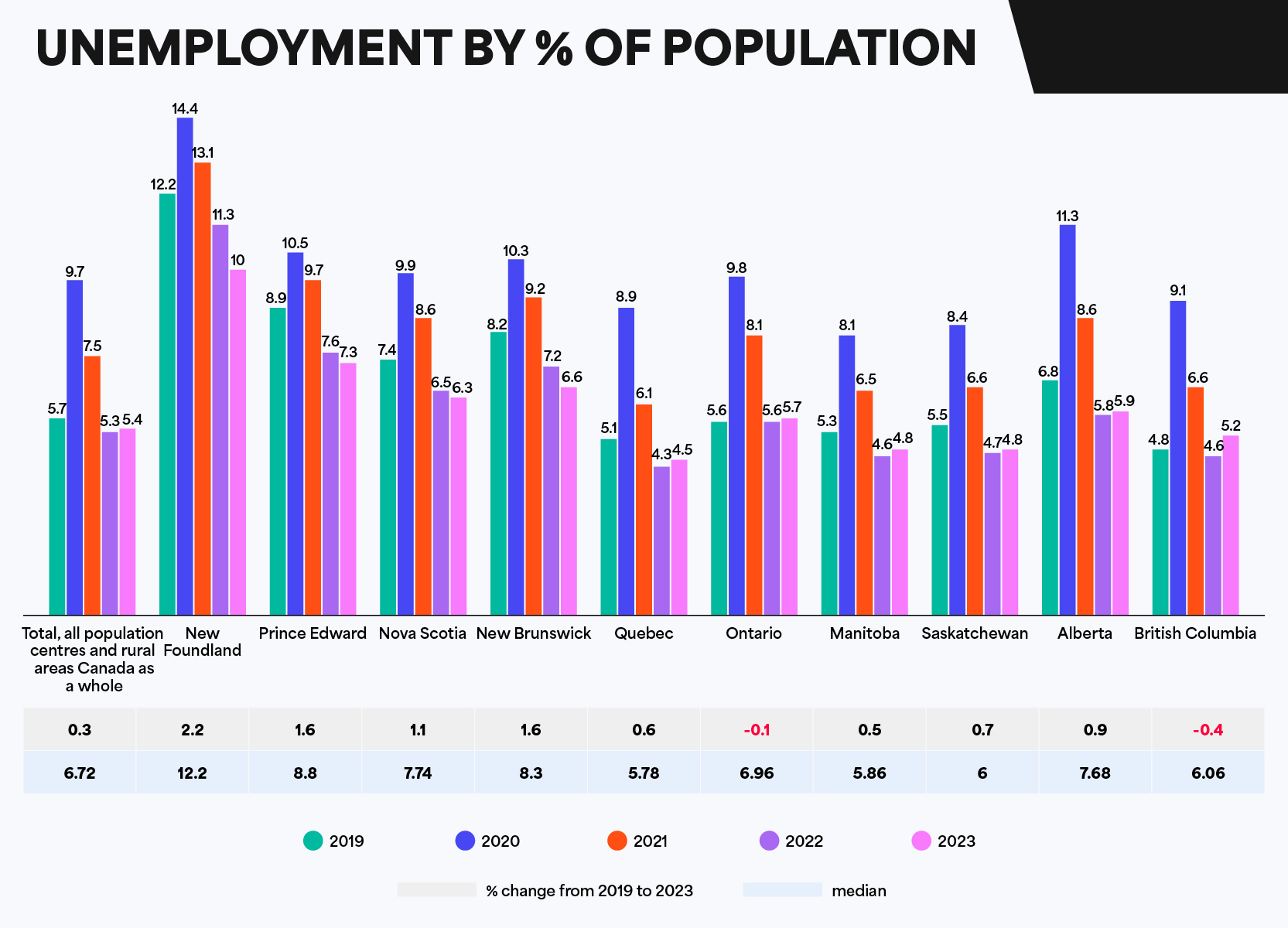
This chart shows unemployment rate by percent of population for each province and territory in Canada over the past five years. In 2023, Newfoundland saw the highest unemployment rate, and Quebec saw the lowest, at 10 percent and 4.5 percent, respectively.
However, despite Newfoundland’s high rate, unemployment has been steadily decreasing across the province since 2020. Quebec, however, has seen fluctuations in the rate, increasing slightly from 4.3 percent in 2022.
Prince Edward Island, Nova Scotia, and New Brunswick have also seen steady decreases, while Ontario, Manitoba, Saskatchewan, Alberta, and British Columbia saw slight increases in unemployment rates in 2023, despite downward trends between 2020 and 2022. While most of these increases differ by only 0.1 or 0.2 percentage points, British Columbia’s rate increased by 0.8 percentage points – the highest across all of Canada.
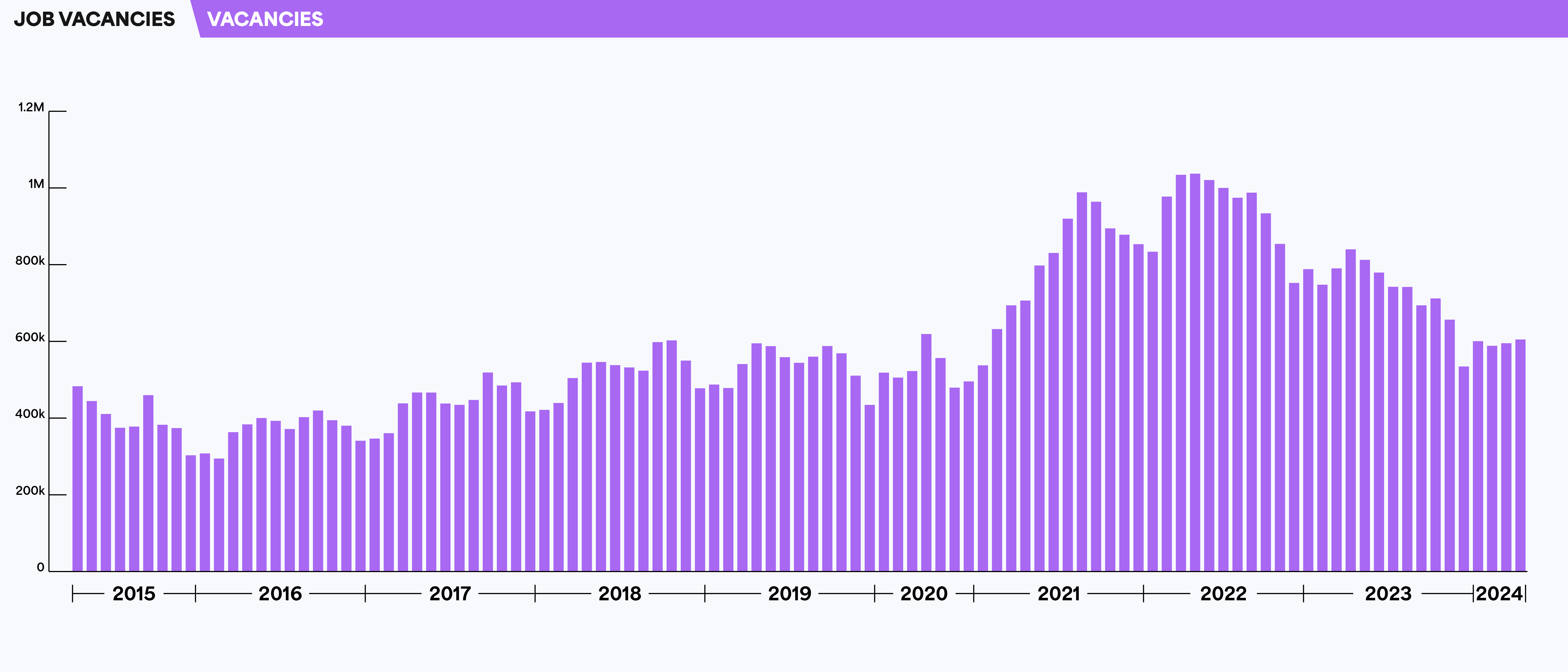
According to Statistics Canada, job vacancies in Canada have continued to drop since June 30, 2022. The second quarter of 2024 saw a drop of 9.2 percent, bringing the total number of vacant positions to 582,600. The drop in the second quarter of 2024 was approximately twice the decline observed in the previous quarter (-30,200; -4.5 percent).
Permanent positions saw a significant decline of -43,400, with a reduction of -45,400 for full-time roles compared to -13,600 for part-time jobs.
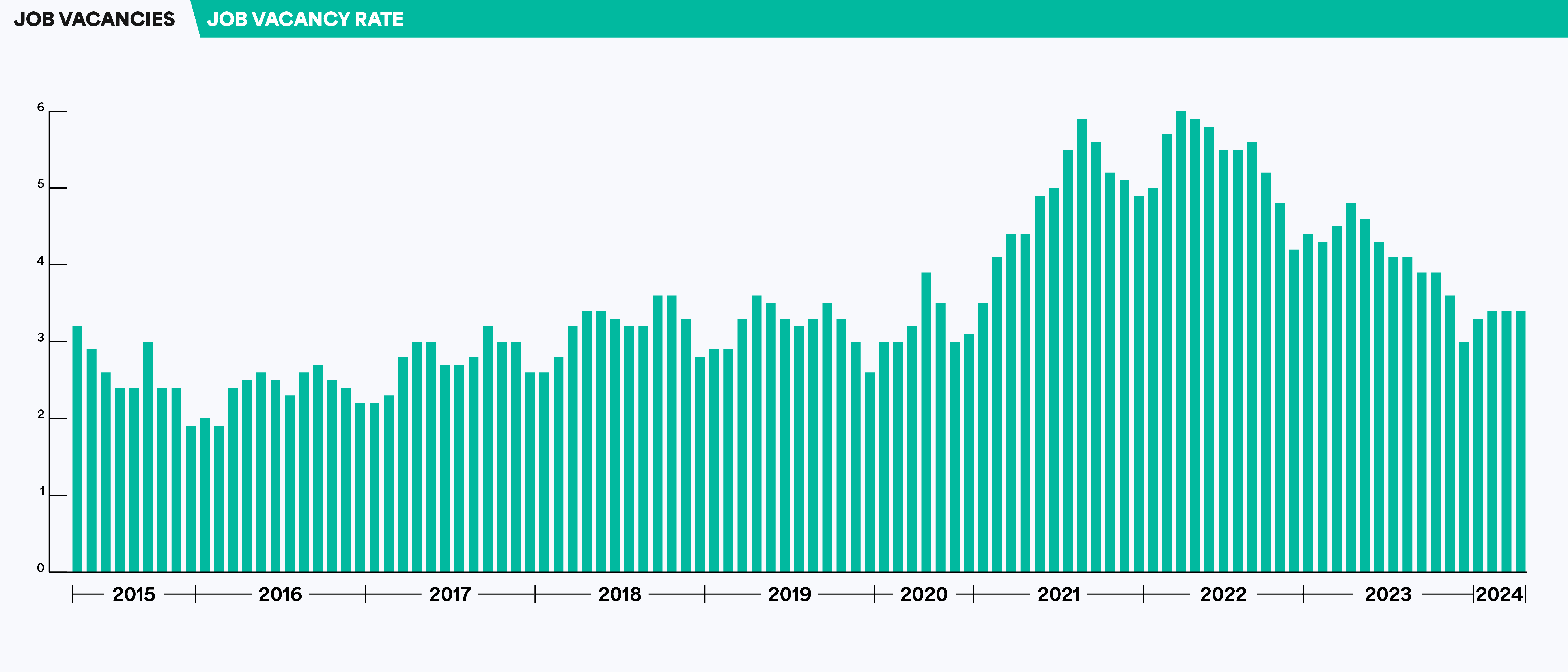
The job vacancy rate, which indicates the number of vacant positions as a proportion of total labour demand, fell by 0.3 percentage points to 3.3 in the first quarter of 2024. This continues a seven-quarter downward trend, bringing the rate to its lowest point since the first quarter of 2020.
Unemployment-to-Job Vacancy Ratio Highest Since 2021
In the second quarter of 2024, there were 2.4 unemployed individuals for every job vacancy. This increase was driven by a decrease in job vacancies (-374,500; -39.2 percent) combined with an increase in the number of unemployed persons (+315,600; +29.9 percent), according to the Labour Force Survey. Hopefully this is good news for employers.
Part 2: Defining the Generations
Although we can look at overall figures to see which benefits are key for staff (or at least which benefits they say are key), the data should also be viewed through a generational lens. Different age groups want different things from their work environment.
Traditionalists
Born between 1925 and 1945, traditionalists are known for being dependable, straightforward, tactful, and loyal. This generation was shaped by significant historical events such as the Great Depression and World War II, as well as by the cultural influences of radio and movies. They are motivated in the workplace by respect, recognition, and the opportunity to provide long-term value to their companies. In communication, they prefer a personal touch, often opting for handwritten notes over emails. Their worldview prioritizes obedience over individualism, viewing age as equivalent to seniority, and they believe in advancing through hierarchical structures.
Baby Boomers
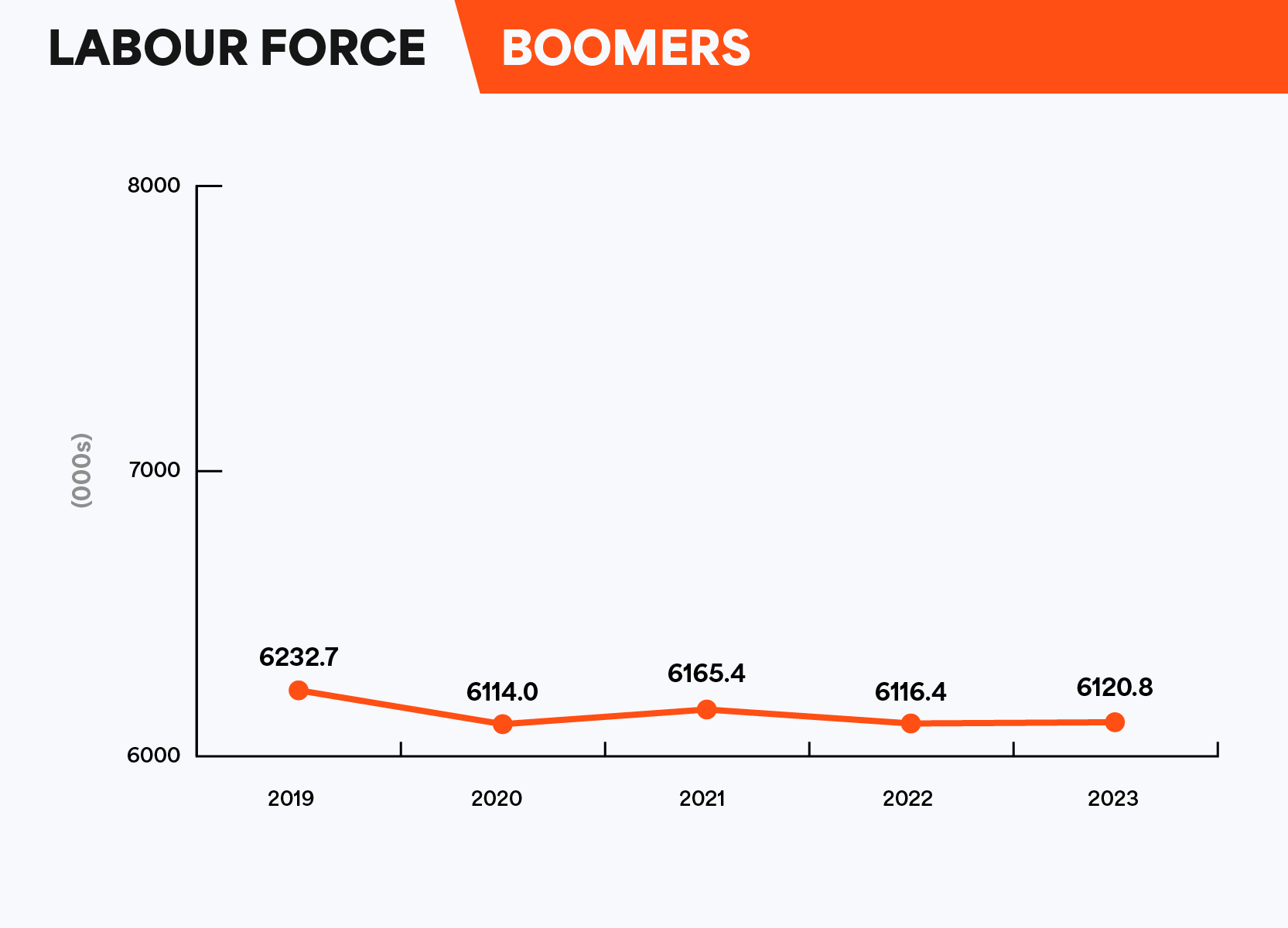
Baby Boomers, born from 1946 to 1964, are characterized by their optimism, competitiveness, workaholism, and team-oriented nature. They communicate using whatever means are most efficient, including phone calls and face-to-face interactions. Boomers believe that achievement comes after paying one’s dues, and they often emphasize the importance of sacrificing for success. Notably, 49 percent of Baby Boomers expect to or already are working past the age of 70, with many not planning to retire. Additionally, about 10,000 Baby Boomers reach retirement age every day. The baby boom in Canada spanned two decades, during which over 8.2 million babies were born, averaging nearly 412,000 births annually. In contrast, despite the population being twice as large in 2008, there were only 377,886 births that year.
Despite their advancing age, the Baby Boomer generation remains the largest demographic group in Canada. However, the proportion of Baby Boomers in the overall population is decreasing. In 2021, for the first time, they constituted less than a quarter (24.9 percent) of the Canadian population. In contrast, they made up over 40 percent (41.7 percent) of the population in 1966, marking the end of the baby boom period (1946 to 1965).
Between 2016 and 2021, the Baby Boomer population declined by 3.1 percent, primarily due to increased mortality rates as they age. This generation is now at an age where higher mortality is expected. Additionally, Baby Boomers have surpassed the prime age for relocating to Canada, so immigration no longer significantly boosts their numbers.
As Baby Boomers age, they place increasing demands on the health care and home care systems, as well as on pension plans. Many continue to work longer, but by 2031, the oldest Baby Boomers will reach 85 years old, an age where limitations and loss of independence become more prevalent.
Generation X
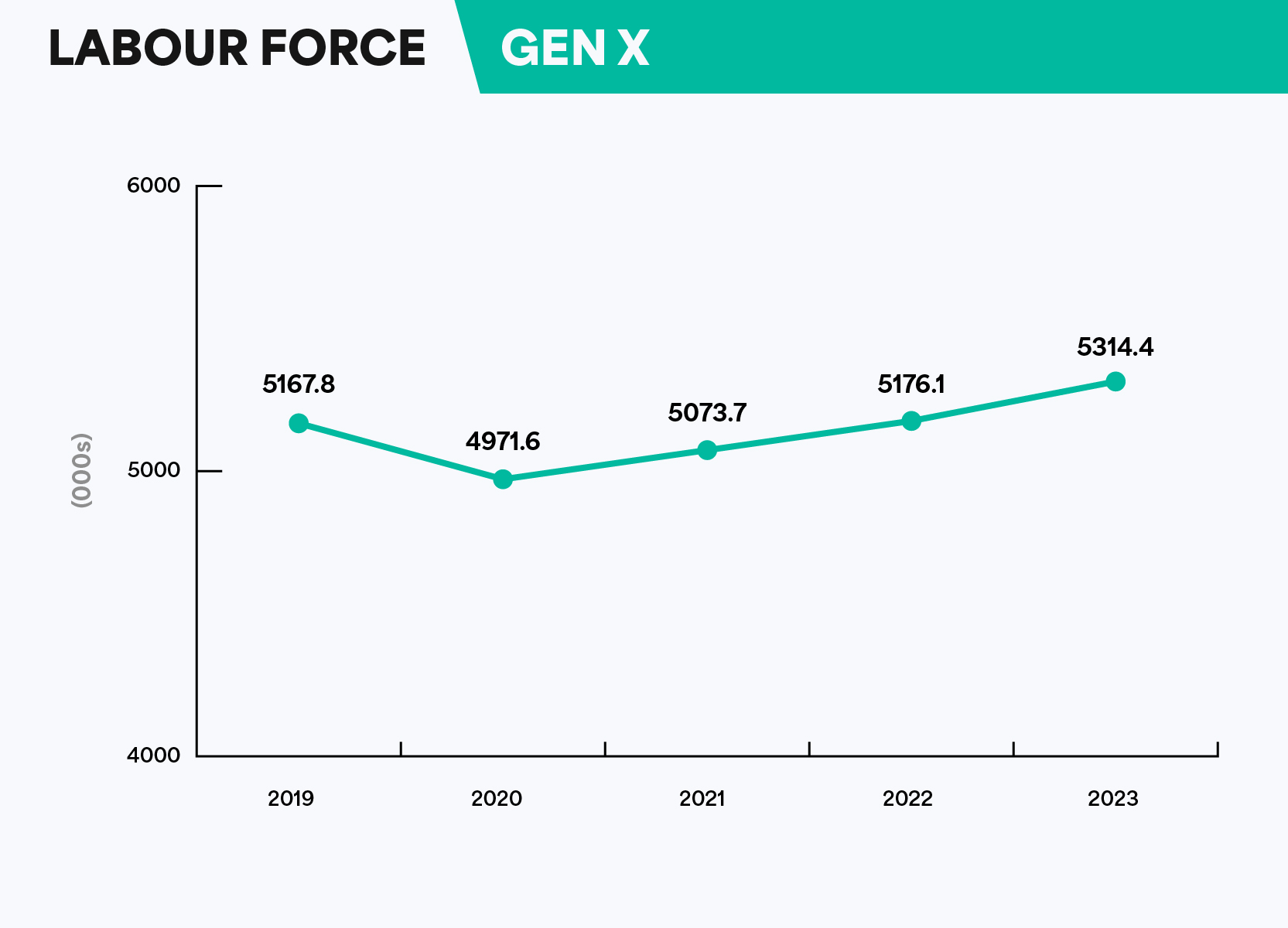
Born between 1965 and 1980, Generation X individuals are flexible, informal, skeptical, and independent. Their formative years were marked by the AIDS epidemic, the fall of the Berlin Wall, and the rise of the dot-com boom. Due to its smaller size, Generation X is not projected to become the largest generation. Even when it surpasses the number of Baby Boomers around 2036, it will likely still be outnumbered by both Millennials and Generation Z.
These demographic shifts are largely driven by the aging Baby Boomer population and sustained immigration, which continues to increase the numbers of Millennials and Generation Z.
A significant number of individuals from this generation, particularly men, faced challenges in securing employment during the 1980s and 1990s. These difficulties were largely attributed to economic downturns and the reality that they were entering the workforce after the substantial baby boom generation. They value diversity, work-life balance, and personal professional interests over company loyalty. Gen Xers communicate in the most efficient ways possible, including phone calls and face-to-face interactions. They favour diversity and are quick to move on if their employers fail to meet their needs, although they resist changes at work if it impacts their personal lives. Interestingly, 55 percent of start-up founders belong to Generation X, and by 2028, they are expected to outnumber Baby Boomers. They are something of a “sandwich” generation, hemmed between parents who need more care and children who also need attention.
Millennials
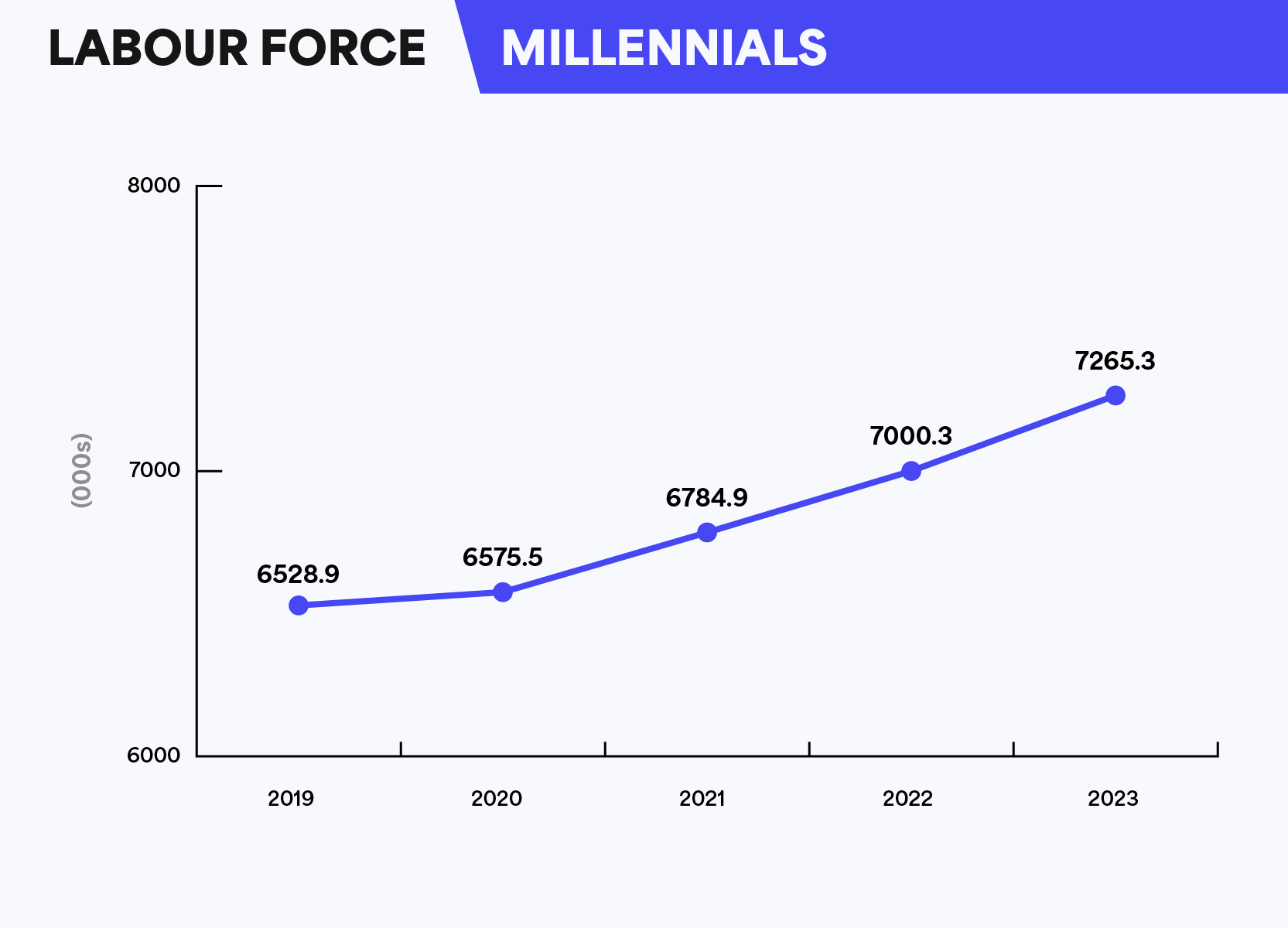
Millennials, born from 1981 to 2000, are competitive yet open-minded, civically engaged, and achievement-oriented. They were shaped by events such as the 9/11 attacks and the advent of the internet. They are motivated at work by a sense of responsibility, the quality of their managers, and unique work experiences. They favour instant messaging, texts, and emails for communication. Millennials seek challenge, growth, and development and desire a fun work environment with a good work-life balance. They are likely to leave organizations if the employer does not like change. By 2025, Millennials are projected to make up 75 percent of the global workforce.
Population forecasts indicate that Millennials might soon become the largest generation in Canada, potentially surpassing Baby Boomers by 2029. Projections estimate there will be roughly 8.6 million Millennials compared to 8.4 million Baby Boomers at that time. By 2046, the Millennial population could more than double that of Boomers, with projections of 9.1 million and 4.1 million for those generations, respectively. By then, Millennials will be aged between 50 and 65, while Baby Boomers will be over 80.
Generation Z
Generation Z, born from 2001 to 2020, is described as global, entrepreneurial, progressive, and less focused. They grew up in a world shaped by the aftermath of 9/11, the Great Recession, and ubiquitous access to technology from a young age. Generation Z is expected to outnumber Baby Boomers by 2032 and could surpass Millennials by 2045.
This generation values diversity, personalization, individuality, and creativity. Their preferred communication methods are social media, texts, and instant messaging. Gen Zers see themselves as digital device addicts and value independence and individuality. They prefer working with Millennial managers, innovative coworkers, and new technology.


