While the new format made some things easier, not all labour leaders were satisfied with the results
“It’s more of a challenge and it would be a lot better served in-person.”
So says Barry Sawyer, executive at the United Food and Commercial Workers union (UFCW) Canada in Orangeville, Ont., in talking about the move to virtual bargaining amid the pandemic.
“We’re doing 90 per cent or more of the bargaining virtually, which changes things — just the chance to have face-to-face conversations with people… when you’re not in-person, you can’t get to the nitty gritty of issues.”
The dramatic move to online talks is just one of the changes facing labour relations as Canada copes with the effects of the COVID-19 virus. Issues such as pandemic pay came to the forefront, while other benefit entitlements may have been shunted aside. But there were also fewer disputes and longer agreements were negotiated.
Pros and cons to virtual discussions
Moving the talks to cyberspace put a damper on how robust negotiations have been, says Sawyer.
“You don’t have the same feel — maybe the bargaining takes longer, and because you’re not in-person [you can’t] say, ‘This is what I really mean,’” he says.
“If you’re in-person along with eight other committee members, you’ll have that downtime for person-to-person talks where you’ll find out nuances that are going on in the workplace.”
Negotiation via videoconferencing proved to be tricky at times and it may have silenced some important workplace voices, he says. For example, bargaining committee members who are front-line workers that know intimately the specific conditions of each workplace found it hard to be heard.
“When we do it virtually, someone could speak up and say, ‘Hey, this goes on in my department,’ but it’s just become less likely to bring up those one-off situations in their workplace,” says Sawyer. “The camaraderie of talking through things and maybe bringing that to the employer’s attention — you lose some of that because of the virtual.”
However, when it came to reaching out to union members during discussions, the response was pleasantly surprising with the new virtual world, says Francois Bellemare, assistant director of organizing and regional services at the Canadian Union of Public Employees (CUPE) in Montreal.
I expect that into the future, online bargaining will stay with us [but] it certainly won’t be used universally
“Actually, it’s got more people involved that usually wouldn’t go to the meeting because it was difficult for them to free themselves from daily tasks. [And] the fact that now we do it through the internet platform, that allows those people to participate in the union life. It’s brought some people that we didn’t see before.”
Union members quickly got accustomed to the new way of doing business, says Larry Savage, professor of labour studies at Brock University in St. Catharines, Ont.
“It was like a sacred cow, this idea that you negotiate in-person, but I didn’t detect that there were significant changes in the mechanics of collective bargaining by moving to an online forum. We were able to caucus more efficiently because all we do is press a button and then half of us were swept away virtually into our own caucus room,” he says.
“It meant people didn’t have to travel from far distances in order to come to a meeting that may have lasted only two minutes, and so a lot of people have gotten over this hang-up around perceived ideas of how negotiations should be conducted.”
Areas of focus in talks
Early on in 2020, when the pandemic was still fresh, the focus of union-management talks shifted to pressing day-to-day matters in the workplace, says Bellemare.
“Anything to do with health and safety became really important: protection equipment, ensuring the safety of our members; wages remained important; but health and safety became a big topic, and it’s evolving now to schedule flexibility and allowing people to work from home.”
With all of these challenges, some topics of discussion may have been shunted aside, to the detriment of union members, says Savage.
“A lot of the issues about things like pandemic pay or paid sick leave or time off and pay for quarantine… don’t seem to have been addressed through the collective bargaining process, but rather through some informal arrangement,” he says.
“I wonder if it means a missed opportunity for unions to try to secure broader benefit entitlements as part of the collective agreement process, because when you negotiate these things in an ad hoc manner, there’s no lasting legacy in the collective agreement of entitlements. It’s interesting, although it will likely take a little more time to see if unions turn their attention to those kinds of things.”
One silver lining that may have emerged from the dark clouds of the pandemic was a recognition of the importance of certain types of workers, says Sawyer, such as a cashier at a grocery store.
“It really brought to the forefront how important these jobs are to the day-to-day lives of Canadians.”
Longer deals, fewer clashes
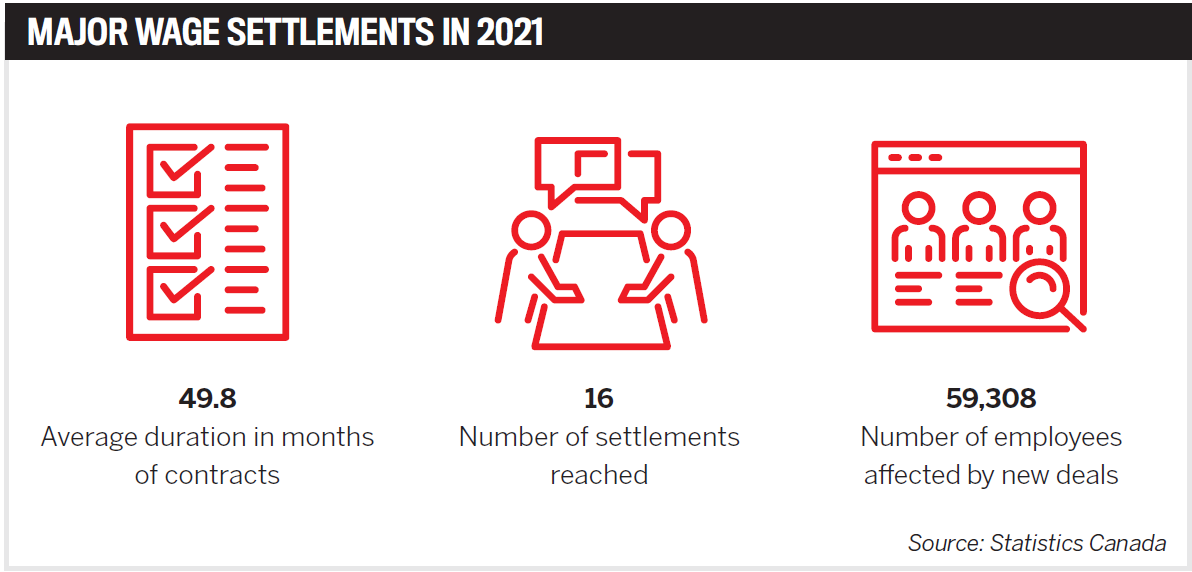
In looking at Statistics Canada numbers for major wage settlements the past year, there’s been a significant reduction in the number of labour disputes during the pandemic, to near all-time lows, says Savage. The number of private sector agreements dropped from 230 in 2019 to 120 in 2020, and for the public sector, 147 to 87.
“The second thing is that the contracts that have been negotiated tended to have longer durations. And so, pre-pandemic, the average duration of a collective agreement was closer to three years and post declaration of a state of emergency, that average has been pushed up close to four years. That is significant,” he says.
These two findings point to a “desire on the part of both employers and unions for stability in a period that’s been characterized by incredible instability,” says Savage.
Labour disputes continued during the pandemic, but their composition varied across the country, according to Bellemare.
“Some jurisdictions, like in Quebec, you could do rallies as long as you had a mask and you kept your distance. Other provinces didn’t, during the really hard period of the pandemic. It all depended on what the province or the health authorities were allowing,” he says.
“We’ve adapted and we’ve recreated some ways for members to rally, whether it be through Facebook or using some platform… but it’s been a challenge.”
Looking ahead
With an increased scrutiny and exposure while the pandemic raged on, unions suddenly provided a very popular voice, says Sawyer.
“Our media exposure went up thousands of times. I can’t quantify it, but we were getting media requests all the time… and then [we had] exposure to governments of all levels — federal, provincial and municipal — reaching out to us for advice.”
And once COVID recedes, many union leaders will revert to the old ways, says Bellemare.
“Our conventions, our large gatherings will still happen in-person, and some training will still happen in-person, but in the meantime, we’ve developed the capacity to [negotiate] using the [virtual] platform,” he says.
The camaraderie of talking through things and maybe bringing that to the employer’s attention — you lose some of that.
“When we come back from the pandemic, there’s a chance that we get some sort of a hybrid in-between: have some communications using the platform and still have those in-person meetings, which is much more personal when you actually see people in real-time.”
Savage would agree.
“I expect that into the future, online bargaining will stay with us, [but] it certainly won’t be used universally.”