
Flight attendants couldn’t work without requalification
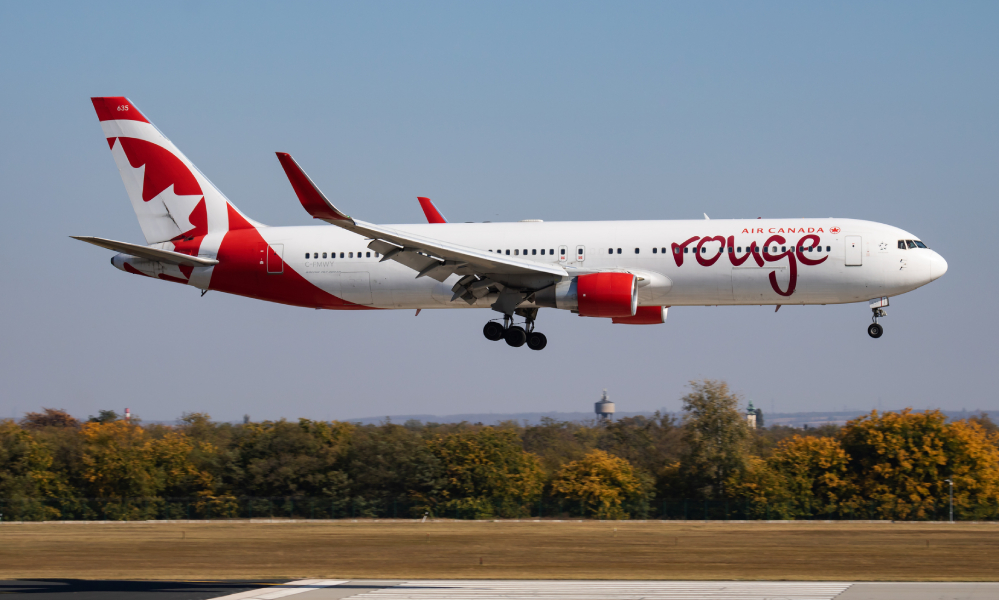
Air Canada Rouge discriminated against flight attendants when it didn’t offer requalification training when they returned from maternity leave, an arbitrator has ruled.
The Montreal-based subsidiary of Air Canada lacked training facilities so it used those of its parent company to provide legally required flight attendant training. The training schedule was determined by operational needs and pilot availability.
Rouge’s collective agreement with its flight attendants allowed maternity and parental leave in accordance with the Canada Labour Code. Rouge couldn’t coerce anyone to end their leave early or attend training while on leave, but flight attendants had the discretion to voluntarily end their leave early to attend requalification training.
In mid-2015, three flight attendants — Sarah Drouin, Amelie Perreault, and Julie Demontigny — took maternity and parental leave. Drouin and Perreault were scheduled to return on July 10 and contacted Rouge a month earlier about training, but Rouge informed them that training wasn’t available until Aug. 8. They each used one week’s vacation and went without pay for three weeks until the training started.
Demontigny anticipated returning to work on June 12, so she contacted Rouge in mid-May about her requalification training. However, she was told no training was available until July 5 — although Rouge didn’t mention training that was being conducted before her return date. Demontigny used vacation credits and then went without pay for two weeks until the training began.
A fourth flight attendant, Emily McKenzie, planned to return from maternity leave in March 2017. Shortly before then, she was told there was a shortage of trainers and it could take months before she could receive requalification training. She agreed to take initial technical training (ITT) intended for new flight attendants, for which the airline would pay half of her regular wage. McKenzie used two weeks of vacation followed by three weeks without pay before starting the ITT.
The union filed a grievance claiming Rouge violated the collective agreement, the Canada Labour Code, and the Canadian Human Rights Act (CHRA) by failing to provide the flight attendants with the training they needed to return to their positions after their leave.
The arbitrator noted that the collective agreement didn’t require Rouge to immediately retrain flight attendants after their qualifications lapsed, so it didn’t appear to violate the collective agreement. However, both the legislation “set a floor with respect to human rights” that can’t be contracted out of, the arbitrator added.
The arbitrator found that the flight attendants experienced an adverse impact because they took maternity and parental leave — which was connected to their sex — but being qualified for flight duties was a reasonable requirement for the job. The issue was whether Rouge could reasonably accommodate the flight attendants.
The arbitrator found that it would be too much to retrain all flight attendants returning from leave immediately, so accommodation would involve training within a reasonable period of time — which could mean one-on-one training if the wait was for an extended period. There was no obligation to pay unqualified flight attendants returning from leave because “requiring work in return for compensation is a reasonable and bona fide requirement,” said the arbitrator.
The arbitrator found that Rouge failed to accommodate the four flight attendants. Drouin and Perreault contacted Rouge a month before their return, so making them wait two months after that was unreasonable. As for Demontigny, Rouge should have informed her about an option of returning a few days early for training available then, the arbitrator said.
The arbitrator also found that although Rouge accommodated McKenzie with the ITT, she still suffered a loss of income because Rouge didn’t try to get her back to full status within a reasonable amount of time.
The airline was ordered to make its “best efforts to address each individual case and accommodate flight attendants returning from maternity and parental leave to the point of undue hardship.”
Reference: CUPE and Air Canada Rouge. John Stout — arbitrator. Gillian Round for employer. Aug. 5, 2020. 2020 CarswellNat 3215


