IMF credits AI investment with propping up global growth, but calls payoff uneven

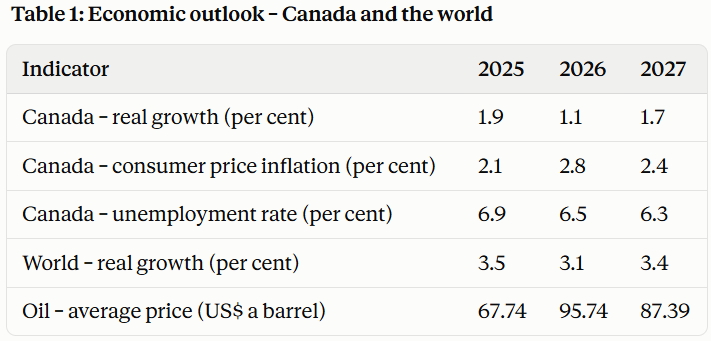
Canada’s economy will grow by 1.1 per cent in 2026, according to the latest global economic outlook from the International Monetary Fund (IMF), as an energy shock from the war in the Middle East and trade uncertainty weigh on activity.
The forecast, published in the IMF’s World Economic Outlook (WEO) for October 2026, is down from 1.9 per cent growth in 2025 and 0.4 percentage points below the fund’s April 2026 projection. Growth is expected to recover to 1.7 per cent in 2027.
For HR leaders, that points to another year of tight budgets, cautious hiring and pay pressure.
Global economic outlook
The IMF projects global growth of 3.1 per cent in 2026 and 3.4 per cent in 2027. It says supportive policies and better prices for Canada’s exports are partly offsetting weaker momentum and elevated trade uncertainty.
Inflation is the bigger concern for compensation planning. The IMF projects Canadian consumer prices will rise 2.8 per cent in 2026, up from 2.1 per cent in 2025, before easing to 2.4 per cent in 2027. The fund’s baseline assumes oil averages US95.74abarrelin2026,upfromUS67.74 in 2025. Its tables show unemployment edging down from 6.9 per cent in 2025 to 6.5 per cent in 2026.
Silvana Tenreyro, economic counsellor and director of research at the IMF in Washington, wrote in the report’s foreword that the global economy’s resilience is under strain. “The task ahead is to move from coping to rebuilding,” she wrote.
Cost-of-living pressure lands unevenly
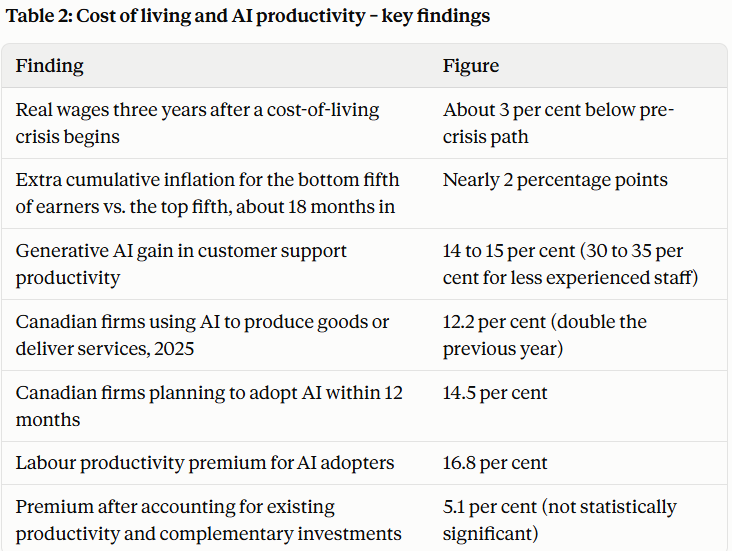
A WEO chapter examines cost-of-living crises – sudden jumps in the prices of food, energy, transport and housing that outpace other prices and wages. Studying 85 economies from 2005 to 2025, the IMF found real wages stayed about 3 per cent below their pre-crisis path three years after such an episode began.
Lower-income households were hit hardest because essentials take up more of their budgets. About 18 months into a crisis, the bottom fifth of earners faced nearly two percentage points more cumulative inflation than the top fifth.
The IMF found targeted, temporary support for vulnerable households far more cost-effective than broad price relief, a lesson for employers weighing one-off payments. The squeeze is visible: employers had signalled smaller base salary increases for 2026 amid economic uncertainty, and a Bank of Canada survey on employers planning for recession found hiring intentions subdued.
AI productivity gains lacking
The IMF credits artificial intelligence (AI) investment with propping up global growth, but says the payoff is uneven. It cites a 2025 study finding generative AI raised customer support productivity by 14 to 15 per cent, and by 30 to 35 per cent for less experienced staff. Across whole economies, adoption is widespread but effects on wages, hours, employment and measured productivity remain limited, the fund says. It points to inadequate training and organizational bottlenecks as possible reasons – echoing findings that AI is boosting productivity while fuelling worker anxiety.
Statistics Canada reported that 12.2 per cent of Canadian firms used AI to produce goods or deliver services in 2025, double the previous year’s share, while another 14.5 per cent planned to adopt it within 12 months.
A study by Jiang Li of Innovation, Science and Economic Development Canada (ISED) and Huju Liu of Statistics Canada, released April 22, 2026, found AI adopters were 16.8 per cent more productive than non-adopters. That premium shrank to 5.1 per cent – and was no longer statistically significant – once the researchers accounted for firms’ existing productivity and complementary investments such as research and development (R&D), data analytics and technology training for employees.
The authors concluded that AI’s impact depends on digital infrastructure, workforce skills and R&D rather than the technology alone. The IMF similarly recommends investing in workforce skills and easing labour mobility, and lists a sharp reassessment of AI-driven profits among its main downside risks.