Mercer survey shows compensation budgets steady amid economic headwinds

Canadian employers are planning to keep salary budgets largely unchanged for a third straight year in 2027, according to new data released today by Mercer Canada, a business of Marsh.
The July 2026 survey draws on responses from over 470 Canadian organizations across 15 industries, and found that employers plan to budget an average merit increase of 3.0% and total salary increases of 3.2% in 2027.
This is virtually identical to actual increases reported in both 2025 and 2026, when merit came in at 3.0% and total increases at 3.3%.
Canadian economy looms large
More than half of respondents — 60% — said they expect the economy to have at least a moderate impact on their compensation decisions in 2027. The caution is also reflected in how far along organizations are in their planning: as of July, 89% were still in the information-gathering stage for 2027 salary budgets, with only 6% having proposed budgets to leadership and 5% having secured final approval.
"Most organizations are still early in the annual planning cycle, and while the current news cycle points to continuing instability, past data shows these projections are likely to be accurate," said Elizabeth English, senior talent and careers leader at Mercer Canada (which is transitioning to the Marsh brand as of Sept. 1).
"Right now, economic uncertainty plays a huge role in employers' compensation strategies, so organizations are planning to make the most of their spending by using data to ensure their spend goes to areas of labour need and where talent risk is high."
Industry gaps widen
While national averages appear stable, planning is diverging meaningfully by sector. High Tech leads the market with a merit budget of 3.3% and total increases of 3.6%, followed by Retail & Wholesale, also above average at 3.3% for merit and 3.4% for total increases.
At the other end, Banking and Financial Services is planning the smallest increases at 2.7% for merit and 3.0% total, while Consumer Goods and Energy also fall below the national merit average at 2.9%.
The Mercer findings are consistent with other early reads on the 2027 compensation landscape. A separate survey by Normandin Beaudry, reported by Canadian HR Reporter in August, found that early data points to average salary increases of 3.1% in Canada for 2027, with more than half of participating organizations planning to allocate an average additional discretionary budget of 0.9%, down slightly from 1.1% in 2026.
Beyond the annual merit cycle
The data shows employers are increasingly relying on tools beyond the standard annual raise to manage compensation. Half of Canadian organizations have provided or plan to provide off-cycle salary adjustments in 2026, with a similar pattern expected in 2027.
Governance, however, remains uneven: among organizations offering off-cycle increases, 30% track and report on them regularly, while 45% log them in systems but do not actively monitor them throughout the year.
Promotion activity is also part of the picture, though it is slowing. Canadian employers expect to promote roughly 6.4% of their workforce in 2027, down from 7.6% this year. Non-executive salaried professionals see higher promotion rates (7.3%) compared to executives (5.4%), consistent with typical career progression patterns.
About half of employers say they take a continuous, as-needed approach to promotions, while others structure them around key business moments.
AI in compensation planning
The survey also tracked the growing role of AI in compensation planning. Nationally, 57% of organizations report at least some automation in compensation processes — 43% with some automation and 12% largely automated — yet only 2% describe themselves as having reached advanced modernization.
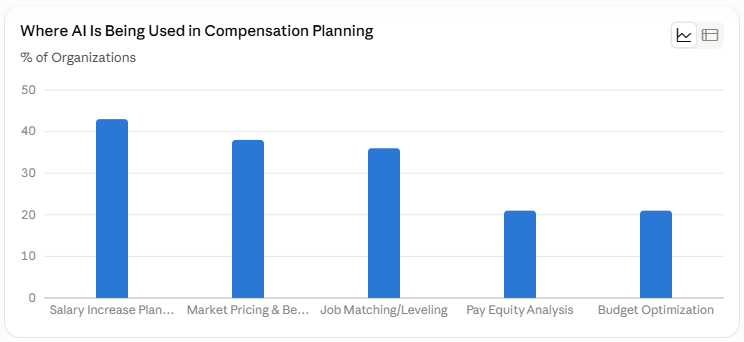
AI adoption is most common in annual salary increase planning (43%), market pricing and benchmarking (38%), and job matching and leveling (36%), while higher-stakes applications like pay equity analysis and budget optimization lag at 21% each.
The top barriers to deeper adoption are:
- data quality (37%)
- system integration (36%)
- limited internal resources (34%).
"We are still seeing most of them limited to repeatable tasks, rather than more deep integration," said English. "The data shows the interest in doing more with AI exists, but is still constrained by both technical challenges and internal resources."