
Is HR relying too much on employee surveys and industry benchmarks?

Are employers missing the mark when it comes to employee benefits?
A new report is suggesting Canadian employers rely too much on a limited set of data resources to guide their decision-making, making assumptions about what employees value.
While engagement surveys and benchmarking studies are valuable, their limitations can lead to benefit gaps and missed opportunities to drive engagement and boost productivity and retention, it says.
“Employers who ask the right questions and utilize a fuller array of data resources will drive meaningful improvement in their employees’ satisfaction with benefits.”
And that’s especially important now, given that 72% of employers surveyed by HUB are planning to make changes to their employee benefits and total rewards programs this year because of the economic environment.
Of these, 75% are looking to add new or enhanced offerings.
Employee benefit gaps
So where are some of these gaps? More than eight in 10 (82%) of employers believe their programs reduce stress, boost productivity and improve overall wellness — but only 63% of employees surveyed share this view.
Just 16% of employers believe health concerns are a top factor impacting employee productivity, but health concerns negatively impact absenteeism and presenteeism for 42% of employees, according to the survey.
Less than half (48%) of employers offer employee discounts as part of employee benefits, but these are a popular offering with workers, as 64% said they would use these if offered. Similarly, only 22% of employers provide discounted home and auto insurance, but this is valued by 40% of employees.
Employers are also split in their views about what employees value most, with 33% citing job security, 31% selecting flexibility and 31% choosing compensation and benefits. In comparison, 40% of employees ranked flexibility and work-life balance as their top value.
Leveraging data insights
So, why are there these disconnects?
It goes back to that fundamental question of “Why are you offering this particular benefit?’” says Faizal Mitha, chief sales officer and chief innovation officer at HUB. “[It’s] an underlying question that not enough organizations review regularly.”
And that leads to other questions, he says, such as: “What are you trying to accomplish from it? Is it the ROI?... Is it because we see incidents that we need dealt with? And, if so, what is our metric for success?”
When determining future benefits, decision-makers report to HUB that they rely on the following resources:
- employee satisfaction surveys (64%)
- internal HR guidance (60%)
- industry benchmarks (60%)
- employee demographic data (50%)
- employee utilization (36%)
- insurance broker/carrier guidance (30%)
In looking at the first one, Erin Reid, professor of human resources and management at McMaster University, says employee feedback is definitely important — but there’s a caveat.
“Employers might want to look at response rates to the survey and see are they getting a good response rate or are only 20% of people responding? If it's only 20%, you don't have great data.
“But if you can get a higher response rate, that where you're reasonably certain you're getting people from across your organization responding, then you have better data.”
Another issue with employee surveys? Many employees are concerned about confidentiality, worried that managers may reverse engineer the responses to figure out who answered what, says Mitha: “I think that prevents honesty.”
In addition, HR should do a better job of approaching the surveys like a marketing person, he says, looking at stats around age, gender, salary or socioeconomics.
“Even though we're trying to create something that has demand amongst the employees, we don't understand them that well. So, I think the real miss is that employee surveys and benefit surveys don't have that demographic front-end that marketing surveys do.”
Benchmarking and demographic data
As for relying on benchmarking, there are risks there too, according to Mitha.
“There's a big rush to the middle, and a benchmarking study also assumes somebody's hit the North Star, and you're trying to get to that North Star. But a lot of times, everyone's just doing the same thing that they've always done, and now we're trying to benchmark to them.”
Instead, there's an opportunity to use employee data to benchmark according to your own fingerprint, he says, targeting a segment of customers or employees.
Demographic data can serve up a variety of stats, such as age, years of service, type of role, family status and postal code.
That’s useful when it comes to thinking about employee benefits like a broad package, says Reid, who is also the Canada research chair in work, careers and organizations at McMaster.
“So, you would have some that are for everyone, and you would have some that are for some people at some parts of their lives,” she says, citing parental benefits as an example.
“It's an important thing for a lot of people at a certain point in their careers that can make or break whether they stick with the organization. So, just because it's only used by people for a year or two doesn't mean you shouldn't offer it.”
‘Personalized clusters of data’
There’s also the concept of data-driven empathy, which is about using data to help walk a mile in the shoes of employees, says Mitha.
“It's not going to give you direct, individual data, but it'll give you personalized clusters of data… for employees that fit together. And the cluster of data could be on the life cycle of where they are; it could be on their tenure with the organization; it could be on their financial picture.”
These clusters can then tie to different job positions to better help decision-making on benefits, he says.
As an example, one employer was looking to reduce its dental coverage from 100% to 80% for basic coverage, as a cost-cutting measure. But looking at the organization’s data, there were a lot of long-tenured employees set to transition out, with many newer employees coming onboard, says Mitha.
“When we looked at the data of the financial fragility, almost 100% of those new entrant employees were financially fragile, i.e., living paycheck to paycheck. So, if you're going to cut dental benefits by 20%... there was a big risk of them not being able to get dental coverage.”
Third-party guidance on employee benefits
As for guidance from a broker or carrier, it’s about being thoughtful as an employer, says Reid.
“You want a trusted partner, but you always have to [appreciate] that they have an interest... that doesn't mean you totally overlook their advice — just remember that they have an interest in selling more benefits.”
While employers will want to approach guidance from a broker or carrier with caution, it’s also about having a broad source of data on what’s happening in the marketplace, says Mitha.
“The danger is when you only use benchmarking data provided by a third party, or even internally, and make decisions based on that. Because that could be a race to the middle — maybe that third party is only delivering data on their book of business, which might have an inherent bias on consulting styles and that type of thing.”
It’s about ensuring the data set is broad and that external data is combined with HRIS data on your internal fingerprint, to get a “fulsome picture,” says Mitha, because two different employers in the same industry may have very different personas. One may be focused on succession issues and longevity, while the other has a younger demographic and concerns about turnover.
“Why would the two of them ever benchmark against each other?”
Budgeting and ROI for employee benefits
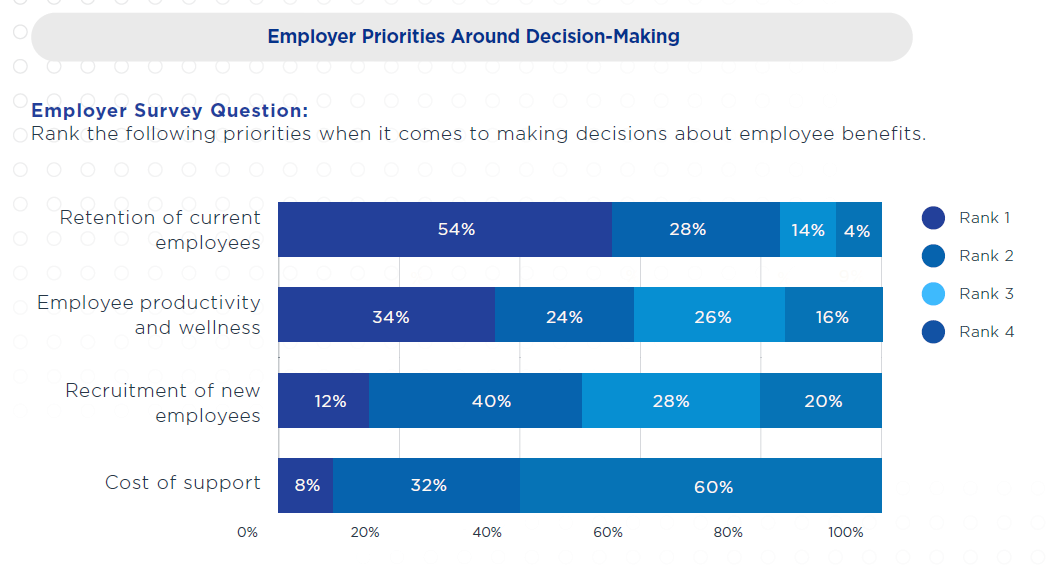
When constructing a total rewards program, the HUB report says employers should consider value per employee as a driver of decision-making versus cost per employee.
“It goes back to that fundamental question of ‘Why are you offering benefits?’” says Mitha.
Take, for example, mental health programs: the cost for an employee for an EAP may be $4 per month, with the utilization only 7%, so the value is really low, he says.
“But, in some cases, the value might be 20% utilization, and people rely on it, and if we didn't have that program, they couldn't get counseling otherwise.”
Source: HUB
Another change that’s needed is around measurement, in using KPIs when it comes to benefits, says Mitha. For example, providing a mental health program may be important if the data shows your employees are struggling
“But very few, if any, organizations I've come across have actually set a KPI to say, ‘We're expecting this level of utilization because we see this level of incidents.’ So they just put it in there. They check a box to move on, and it's not really there to support what the employees are needing. So, I think that there's that element too.”
Overall, 55 per cent of Canadian employers plan to reallocate or rebalance spend on benefits over the next three years, up from just 10 per cent in the past year, found a survey by Willis Towers Watson.
What’s popular? Flexibility, affordability
Given these insights, where should HR be focusing when it comes to bridging the gap and connecting better with employees on their benefits?
Discount programs and perks are definitely popular, says Mitha.
“The reason why they're coming back now is affordability. So, if you can put in something that gives someone a discount to buy everyday items, or if you can do things like provide discount items for home and auto insurance and things like that that are escalating [in cost], those are actually valued by employees… because it's helping them with the affordability issue.”
With 49% of employees saying that financial stress is their biggest burden, and 60% saying it reduces their productivity, the cost-of-living issue needs to be addressed, he says.
“When it comes to financial tools, employers usually rely on a pension plan, a defined contribution or defined benefit pension plan, or an RRSP-matching program or deferred profit-sharing program. All of those things have a long-term view of financial health… and employees are thinking more short term — expenses, cost of living, affordability — so there's a mismatch there.”
Flexibility is obviously another important area for many people, says Reid.
“I think there is a strategic opportunity here to be the employer who still lets people work from home one day a week or two days a week. And the data, the research, is showing that for white-collar work, three days in the office is kind of the sweet spot in terms of performance and wellbeing,” she says.
“Flexible work is probably an area of benefits where there's a lot of space to compete.”



