
'Employers and workers alike are just hoping we're hitting a period of relative stability'

Three new surveys came out recently, painting another cautious picture for 2024 when it comes to Canadian employers and compensation planning.
Overall, the results are not too surprising, though some forecasts have fallen slightly from predictions made in the summer of 2023.
“There's no question that the last three or four years have been brutally hard on everybody,” says Jason Foster, associate professor of human resources and labour relations at Athabasca University.
“I think everybody — employers and workers alike — are just hoping we're hitting a period… of relative stability, to have the waters be calm. And I think one of the ways employers can do that is that assurance of ‘OK, yeah, we got you, we understand your grocery bills are up, so here's a little bit of a pay bump.’”
Salary budgets, increases for 2024
Over half (55%) of the Canadian workforce is anticipating a pay raise in 2024; on the flip side, 62% of Canadian employers are planning to offer pay increases in 2024.
And the leading reason for pay rises (according to managers) has been to support employees with cost of living (67%), followed by: to aid morale and retention (17%); or for a promotion, time served, or targets being met (17%), according to a Robert Walters survey.
On average, Canadian employers are forecasting 3.1% merit increase budgets and 3.6% total increase budgets — lower than what was reported in August: 3.3% merit and 3.7%, according to Mercer’s recent survey of almost 600 participants.
Source: Normandin Beaudry
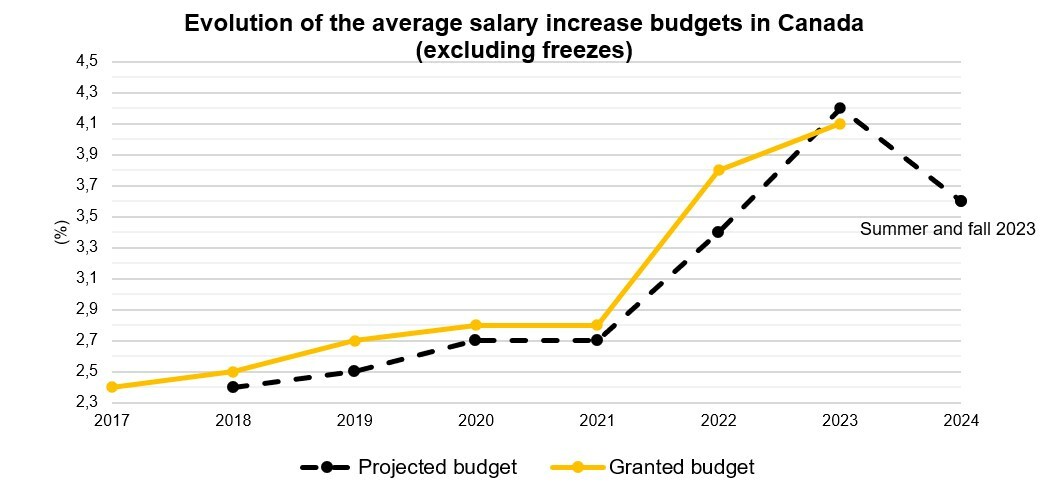
Overall, the average Canadian salary increase budget forecast for 2024 remains steady at 3.6%, the same as the summer forecast, finds a separate survey by Normandin Beaudry. However, on a year-over-year basis, the average salary increase budget is expected to decline, after the upward trajectory seen between 2021 and 2023.
Notably, 36% of participating organizations reported changes to their initial budget forecasts made over the summer months, with 44% increasing their budget, and the remaining 56% decreasing their initial 2024 salary budget, found the survey of more than 430 Canadian organizations.
Salary increases to boost morale
The numbers aren't surprising, says Foster, citing inflation rates and the economic cycle.
“I think it’s just a reflection that employers are, within the constraints of their own cost pressures, trying to find a way to meet that legitimate worker interest,” he says.
“We had a rough couple of years of inflation, workers’ wages did not keep up, and so workers are looking around now and saying, ‘Well wait, I need a little more money because all my costs have gone up,’ so I think [the 3% to 4% range] makes sense.”
While attraction and retention are always the primary driver for compensation planning, lately it’s also about morale in the workplace, says Foster.
“Recognizing that there is this broader economic malaise that a lot of workers are feeling, because they're seeing the grocery bills go up, so it's causing them stress... acknowledging that and helping do something about that creates a happier worker. So not only is that worker more likely to stay, but they're probably more likely to put more effort in, because we know that about satisfied workers being more productive,” he says.
“Competition isn't always just about wages, it can be about some of those ancillary things, that can be just as important. That just feels like in the zeitgeist right now where employers are trying to pay attention to that overall malaise in order to try and increase satisfaction, which helps the bottom line.”
Cost of living and employee wellbeing
All three of these Canadian surveys are basically showing the same trends, says Sara Mahabadi, assistant professor at the University of Alberta.
“In general, for the last two years, we have had an all-time-high inflation rate. And [workers] were struggling with the steep prices for food, housing, health care, and so on, so forth. And so this high cost of living really had negative impacts on employees wellbeing — both physical wellbeing and mental wellbeing — and I think employers, generally, can see that, can feel that. And so they understand that they need to somehow help employees with their needs.”
But at the same time, there are some differences in different sectors, she says.
“For instance, in the high tech industry, we have been seeing increasing salaries previously… now they are not increasing as much as they used to, because they think that they are already competitive,” says Mahabadi, while energy, mining and data processing are seeing boosts.
“It really depends on the nature of organizations and what is available: Who is available in the labour market? How competitive is it? And what is the likelihood of them needing more people, and also being able to have enough people who want to apply and come and join their organization? So, these are all the factors or contingencies that employers need to think about when they are thinking about salaries and budgeting and so forth.”
Variable pay budgets for 2024
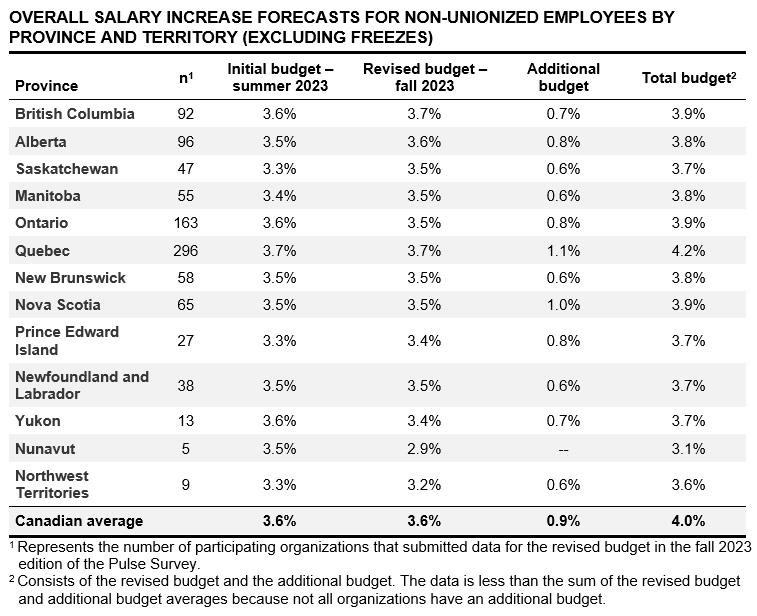
Beyond the traditional salary increase budget, 41% of respondents in Canada have set aside an average of 0.9% of payroll for additional budget funds, says Normandin Beaudry. The primary intents of these additional budgets are to:
- implement ad hoc market adjustments (69%)
- differentiate compensation for high performers (52%)
- retain strategic or mission-critical employees (50%).
Source: Normandin Beaudry
While employers’ use of off-cycle increases has slowed, it has not disappeared, according to Mercer. Just under half of employers surveyed reported that they have provided or will provide off-cycle increases in 2023, citing retention concerns, internal equity, and market adjustments as the most common reasons for doing so.
Foster says he has “mixed feelings” about the use of variable pay. While on the one hand it can be a useful component in certain industries and workplaces, on the other hand, it pushes “the uncertainty down to the worker level,” he says.
“I think an employer has to assess very carefully: Is their situation one where this can be more of a sharing of the of the windfall [meaning] profits are up, productivity is up and things are going well — are we sharing in that together? That's one message. A different message comes from ‘Well, you’re going to have to perform to a certain level if you want to get this extra pay bump.’”
A lot of it has to do with the way an employer frames it, and what the variation is based on, such as collective success, says Foster.
“I really think there's a sense of ‘Look, it's been a rough couple of years for all of us, we're hoping to turn the corner, so if we do, if we have turned the corner by the third quarter, maybe we can give you a bonus, or we can bump up that extra 0.5%’ — you can give them something to hold on to and they recognize it's anchored in something real and substantive. Then they're sharing in any benefit that's coming out of that. I think that's the key principle and making that a valuable piece of a compensation package.”
Another reason for an off-cycle increase might be in response to a counter-offer, when an employee is offered a better salary from another employer, says Mahabadi.
“That happens off cycle, obviously, because they cannot wait for another cycle to increase [pay] because that person might decide to leave the company. And so these are the some of the internal challenges and individual case-by-case [situations] that organizations need to deal with.”
Pay transparency around salary ranges
Of course, pay transparency has been increasingly in the news in Canada, with new legislation — such as that in Ontario and in British Columbia — pushing the trend as an emerging best practice.
Beyond where legally required, 17% of Canadian employers are including salary ranges in job postings nationally with another 11% planning to do so, according to Mercer’s survey.
As a result, 22% said they have not experienced compression or internal equity issues; another 20% stated they “don’t know” or are “unsure.” The remaining respondents stated that they have done the analysis and are making adjustments (28%), that they are considering making adjustments outside the annual increase cycle (9%), or that they plan to address in 2024 (21%), says Mercer.
It means employers and managers know that they have to be not just equitable and fair, but they have to be seen as being equitable and fair, says Foster.
“I think that that changes the dynamic a little bit… and I think allows for more fairness to enter into the equation.”
People who are trying to figure compensation know that there's greater transparency both within the organization and between organizations, he says, so they need to have “a defensible wage structure that can make sense to people when they see it… at the end of the day, it makes for a better system overall.”
This is an important practice to establish trust between employers and employees, says Mahabadi.
“They know who is getting paid how much, at least within a reasonable range, and the reasons behind it.”
And employees are becoming more aware of their rights, and the fact that they can ask for what they deserve, she says.
“Women [for example], who are now holding really important positions within the organizations, are realizing ‘Why should I be paid less if I'm just as efficient, and I have the same level of knowledge or background?’
Bringing in this level of transparency in the organization can also calm down the pressure and anxiety that might come from the unknown, says Mahabadi.
“This is what organizations and employers need to do, from the get-go, is have a very solid, transparent conversation with the candidate about what is the base salary, and what are the other perks, and on what level, and… why is it similar to other jobs or different to other organizations? I think that gives the candidates the power to decide, and to see things clearly, and manage their expectations.”
Total rewards big part of compensation planning
Recognizing that increases to cash compensation are not the only effective way to compete for talent, 67% of Canadian organizations said that a strategic priority for 2024 involves ensuring the competitiveness of their total rewards programs, found the Normandin Beaudry survey.
It’s possible that approach is more important than ever — for two reasons, says Foster.
“On the employer side, on the supply side, just being able to raise wages by 5% might be difficult to do, depending on your markets,” he says, while being able to offer “softer costs” such as training, in-house daycare or time flex “are all things that I think workers are taking a lot more seriously, in terms of looking at the overall evaluation of whether a job is worth it.”
As an example, maybe five years ago, location of work wasn’t such a big issue, says Foster.
“Even though it's not about pay, it's very much seen now as part of the compensation package; it is seen very much as being part and parcel of those ancillary components that an employee is going to use when evaluating the value of a package. And so those are things that are much more important in the conversation.”



