In slower labour market, employers can 'take their foot off the gas,' says expert – but internal equity, communication are key

As Canadian organizations brace for an economic slowdown in 2025 and 2026, HR professionals are facing a new reality: salary increases are shrinking, and compensation strategies will have to adapt.
With the OECD forecasting slower growth and rising unemployment, and recent Canadian surveys confirming that most employers are planning smaller salary increases for 2026, HR’s role in navigating this environment is critical.
Jason Foster, professor of human resources and labour relations at Athabasca University, points out that an “uncertain economic environment” is driving these trends.
“Clearly, in the last couple of quarters, the economic signs have been downward pointing. And obviously we don't quite know what the impacts of the tariffs will be and how serious things will get.”
Economic growth is slowing, he says, while inflation is down and there’s an uptick in unemployment, “which is always a bit of a lagging indicator, but I think that's also an indication that the labour market is softening.”
Factors behind salary decreases
Darcy Clark echoes Foster in highlighting factors such as the broader domestic economy in Canada, the impact of the U.S. tariffs, lower productivity numbers cited by Statistics Canada, lower inflation rates and the easing of the labour market.
“These are all obviously interconnected, but that balance of power is more stabilized,” says the senior principal, compensation at Normandin Beaudry.
“One could say it's probably an employer's perspective or benefit right now on a macro level [in that] you don't have issues with job postings, finding the right candidates… so you can take your foot off the pedal a little bit, so to speak, on payroll costs.”
According to Gallagher, nearly two-thirds of organizations are expecting lower salary increases for 2026 compared to 2025. The average salary bump for non-unionized employees is projected to drop to 3.1% in 2026, down from 3.5% in 2025 and 3.8% in 2024—a return to pre-pandemic norms.
Normandin Beaudry’s annual survey parallels these findings, reporting a projected average increase of 3.1% for 2026, excluding salary freezes.
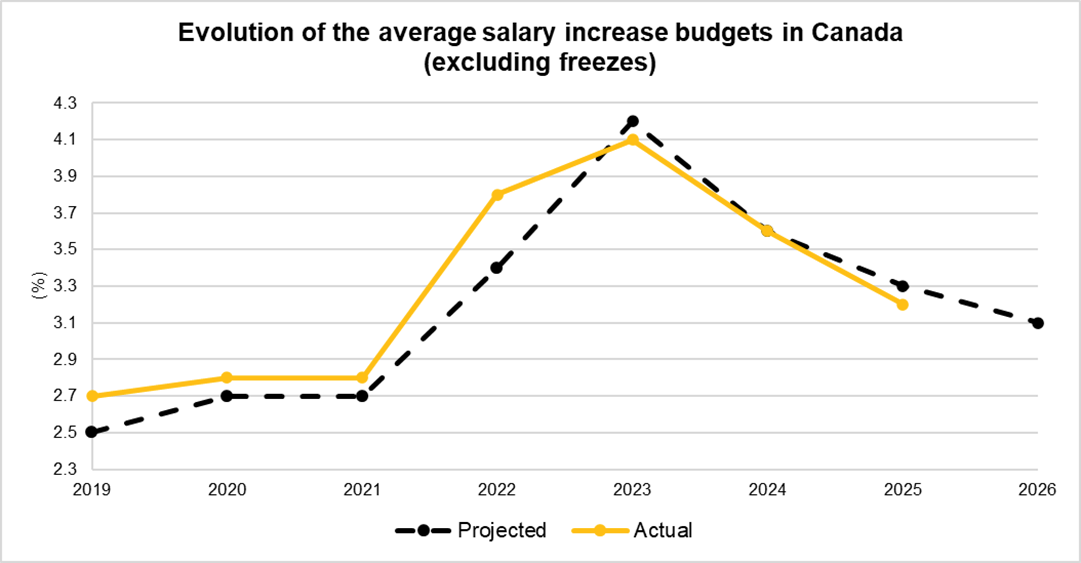
Source: Normandin Beaudry
Roughly 70% of respondents to the survey did a markdown in projections from last year's actual increases, says Clark, marking “a significant trend.”
But nothing is certain, he says.
“Economic tides can change like the wind, so the next three months will tell us a lot in terms of the validity of these numbers and how they will hold,” he says, adding that 3.1% is a “very Canadian outlook — we're not putting all our chips on one side of the fence or the other, it's that middle of the road.”
Playing it safe with comp planning
Clark says its’ about “playing a safe and a long game” at this point because the market can change quickly, for better or worse.
“Companies are being thoughtful about it, because employees will remember what happened in maybe the not-so-good times,” he says.
“If you can take that middle-of-the-road approach and do your best for your people — from an investment and business strategy perspective and a people perspective — people will remember that.”
Foster also recommends a “conservative but balanced” approach to compensation planning and “trying to find ways where you can keep things contained, so that you have options down the road.”
Inflationary considerations amid slowdown
Despite the slowdown in the market, he cautions HR not to lose sight of employee experience.
“We are months removed from extraordinarily high inflation, and, just generally, a very difficult few years for everybody, and workers in particular… that's still very much in people's memories, it's still very much in their experiences.”
Since wage increases in recent years have not necessarily kept pace with inflation, employees are “still feeling that pinch,” says Foster, so as an HR leader, I should “make sure I've got the ship nice and tight, but I also need to make sure that I'm taking care of the people that work here, that I haven't forgotten that they've been through a rough few years, and then we might be in for a rough couple of years [ahead].”
Extra budgets and internal equity
Normandin Beaudry’s survey results show that 42% of organizations are setting aside extra budgets for special cases — market adjustments, high performers, accelerated progression for lower-wage employees, and internal equity and off-cycle salary increases.
For the latter, a special budget may be reserved to “carve out” an extra half per cent or one per cent, says Clark.
“It can be to make market adjustments for certain jobs — maybe you're aligned to market for all your jobs except your cybersecurity roles are behind — so you're going to put a bit more of your funds there that you're not drawing from your broad salary increase pool.”
But HR wants to be careful it’s not setting unreal expectations for future comp cycles, he says, and giving newer hires bigger increases is always going to be problematic.
“Buying talent today is going to be more expensive than what you have in-house already, almost always. So, going back to those extra budgets, internal equity, particularly in the last two years, there's going to be a lot of plugs [employers] need to fix. Where you and I may have the same job, but you've been there 20 years, and I just got hired, we're not going to get paid the same, so how big of a delta should that be, and why?
“It’s a huge concern, particularly in the last couple of years, and companies are looking to fix that.”
Salaries and pay transparency
That internal equity will be even more important for Ontario employers with the enforcement of pay transparency legislation in January, following that of B.C. in 2023.
“If you're an Ontario employer, and you're getting ready for pay transparency next year, you're going to post jobs with salary ranges, and your current employees are going to see these salary ranges. So, you're truing up maybe a few internal inconsistencies on pay before you have to pull the curtain,” says Clark.
“So, you're going to need to find extra funds to make adjustments so that you don't disengage current employees when they see the hiring ranges externally. That's very tricky.”
Communicating salary increases
Overall, effective communication is essential as organizations adjust to smaller salary increases, in terms of clearly communicating the situation, your intentions and your reasoning, says Foster.
“This might be a time for lower increases or even pay freezes, depending on what sector you're in, but it feels like it's even more important in that circumstance to be clear in your communications. Make sure that there's a really clear understanding about why this is happening — you're not doing it just because you can, you're doing it because it's a set of circumstances that makes it more necessary.”
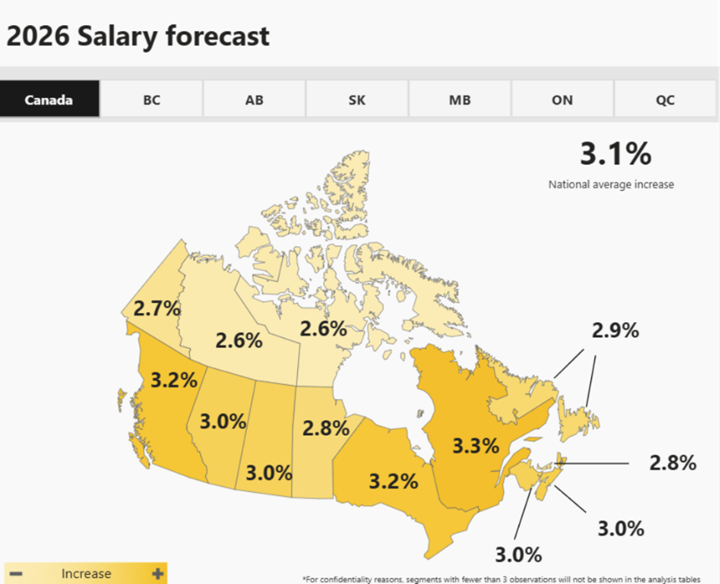
Source: Normandin Beaudry
He adds that workers are aware of the broader economic context.
“That means you're in a place where you can level with them. It’s like: ‘You see what's going on around, right? We're going to do our best here. But, your pay increase may not be as big as it was in 2023 and 2024 just because we have to try and keep our options open.’”
HR can also offer the reassurance that after the company has “weathered the storm,” salary budgets may be revisted, says Foster: “Just be really clear and upfront — I think that's always the best practice.”
Explaining rationale of decisions
Clark agrees with the importance of explaining the rationale behind salary decisions:
“If you have a pay philosophy ‘We target the median of the market or the 75th percent of the market, what's our position as a company?’ you can educate employees on that at a high level.
HR can talk about how the organization does benchmarking to align to market, showing the decision points for how they landed on 3.1%, he says.
“Or maybe the story is ‘We're higher than the market average because… we were behind market; we're looking to catch up and fix what we identified as problems.’ So there's always a story, explaining the building blocks as to where t9hat number comes from.
“And there's also just internal affordability — sometimes it's just an absolute budgetary decision.”