Sector ‘serves as an entry point into the workforce for many young people and newcomers,' says StatCan

New Statistics Canada data show retail employers drawing on a smaller share of young workers, more staff aged 65 and older, and nearly five times the share of non-permanent residents they employed in 2017.
The study, released Oct. 21, 2026, by Statistics Canada researchers Adam Howe and Benjamin Tobin, used tax records to track the sector from 2017 to 2024. Retail had about two million employees in 2024, according to the agency's Survey of Employment, Payrolls and Hours.
The sector "serves as an entry point into the workforce for many young people and newcomers," Howe and Tobin wrote – the two groups whose shifting presence drives their findings.
Retail workforce demographics
Workers aged 15 to 24 made up 31.7 per cent of retail staff in 2024, down from 35.5 per cent in 2017, and the youth share fell in every subsector. The steepest drop came at clothing and accessories retailers, from 51.7 per cent to 42.0 per cent, as that subsector's employment contracted 16.9 per cent.
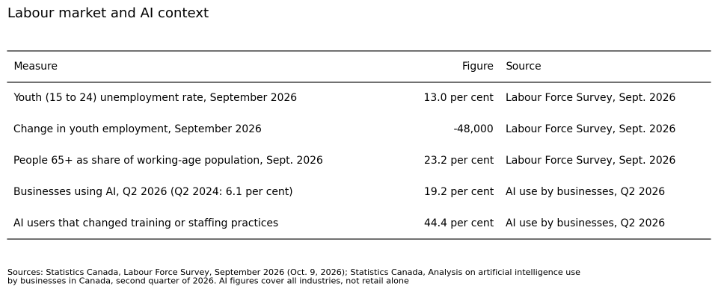
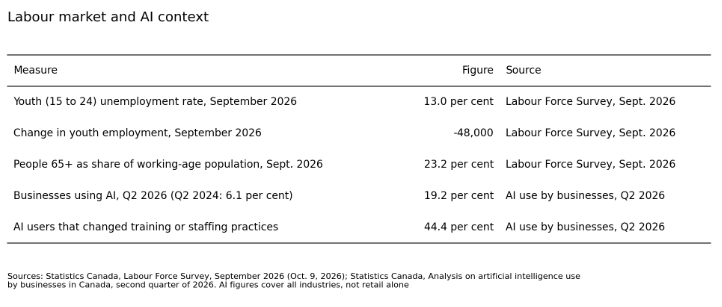
That shift has come even as young Canadians look for work. Youth employment fell by 48,000 in September 2026, while the youth unemployment rate held at 13.0 per cent, Statistics Canada's Labour Force Survey found. "High youth unemployment does not guarantee a readily available local workforce," Molly MacCormack, policy analyst at the Canadian Federation of Independent Business (CFIB), said in July 2026.
Meanwhile, workers 65 and older rose from 3.7 per cent to 5.5 per cent of retail staff. Building material and garden supply dealers had the oldest workforce: 10.0 per cent were 65 or older in 2024, and more than a quarter were at least 55. That mirrors the wider population, where people 65 and older made up 23.2 per cent of the working-age population in September 2026, Statistics Canada said.
Non-permanent residents take larger share
As youth hiring slowed, retailers leaned on newcomers holding temporary status. Non-permanent residents – a group that includes international students, temporary foreign workers and refugee claimants – held 13.7 per cent of retail jobs in 2024, up from 2.8 per cent in 2017. Shares were highest in general merchandise (19.6 per cent), clothing and accessories (16.5 per cent) and food and beverage (16.0 per cent).
That reliance now collides with tighter federal rules. The data do not capture the full effect of Ottawa's further changes to the Temporary Foreign Worker Program.
Employment and Social Development Canada (ESDC) requires employers of temporary foreign workers to keep relevant records for six years, can inspect employers during that period, and can permanently ban the most serious violators from hiring foreign workers.
What does this mean for HR leaders?
Scheduling is the next pressure point. Part-time employees made up 72.0 per cent of retail staff in 2024, and general merchandise retailers raised their part-time share from 73.6 per cent to 79.2 per cent. That dependence on flexible labour peaks during the holidays, as Amazon's plan to boost end-of-year hiring in Canada shows.
Technology adds a further layer. Nationally, 19.2 per cent of businesses used artificial intelligence (AI) to produce goods or deliver services in the second quarter of 2026, triple the 2024 rate, and 44.4 per cent of those users changed training or staffing practices because of it, Statistics Canada found. The retail report cites research placing retail workers at moderate exposure to AI-related job transformation.
The researchers also flagged trade tensions, inflation and rising input costs – pressures already evident as tariffs play a role in employer workforce changes.