One-third of Canadian employers also making AI-related job cuts, finds survey looking at challenges of new workplace rules, union activity

More than three-quarters of Canadian employers have taken at least one workforce-related action over the past year in response to business or economic pressures, according to a new survey.
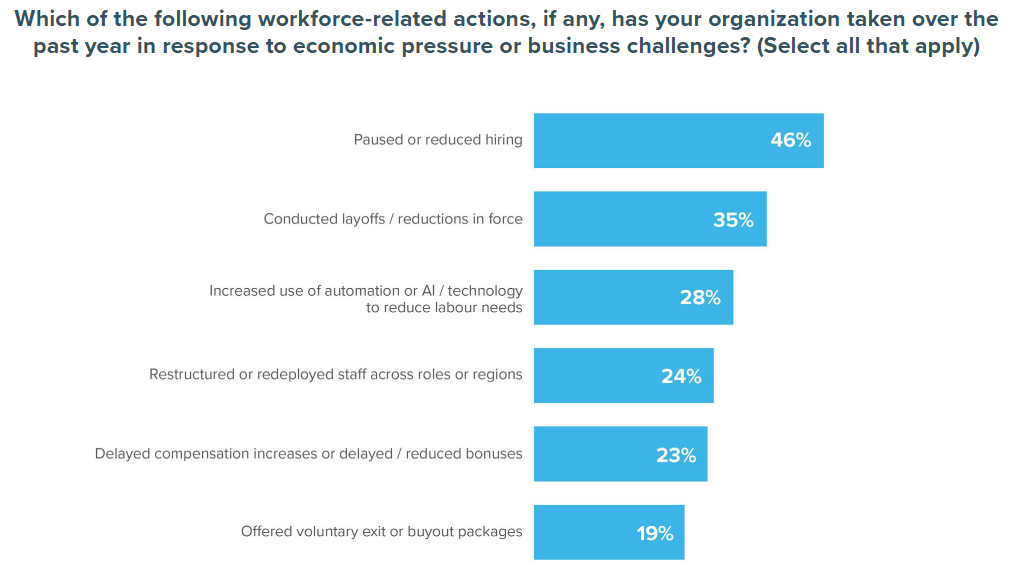
Pausing or reducing hiring was the most common response, cited by 46 per cent, followed by layoffs or reductions in force at 35 per cent and greater use of automation or AI to reduce labour needs at 28 per cent.
Other measures were less common, found the survey by labour and employment law firm Littler. They included restructuring or redeploying staff (24 per cent), delaying raises or bonuses (23 per cent), offering voluntary exits or buyouts (19 per cent) and cutting employee hours (16 per cent). Eleven per cent said they had used the federal Work-Sharing Program.
The survey is based on an online survey of 200 HR professionals, in-house lawyers and C-suite executives conducted in July 2026. Nearly seven in 10 respondents work in HR roles.
Among employers that took workforce actions, 83 per cent said tariff-related disruption played a role: 18 per cent said tariffs contributed to a large extent and 36 per cent to a moderate extent.
“Economic uncertainty and trade disruption are clearly influencing workforce decisions, and those impacts could intensify if U.S.-Canada trade tensions escalate further,” Stephen Shore, office managing partner for Littler’s Canadian offices, said in the release.
Transparency, AI, forced labour, psychosocial risks
Employers are also dealing with a patchwork of new and changing federal and provincial requirements, and some are better prepared than others, according to Littler.
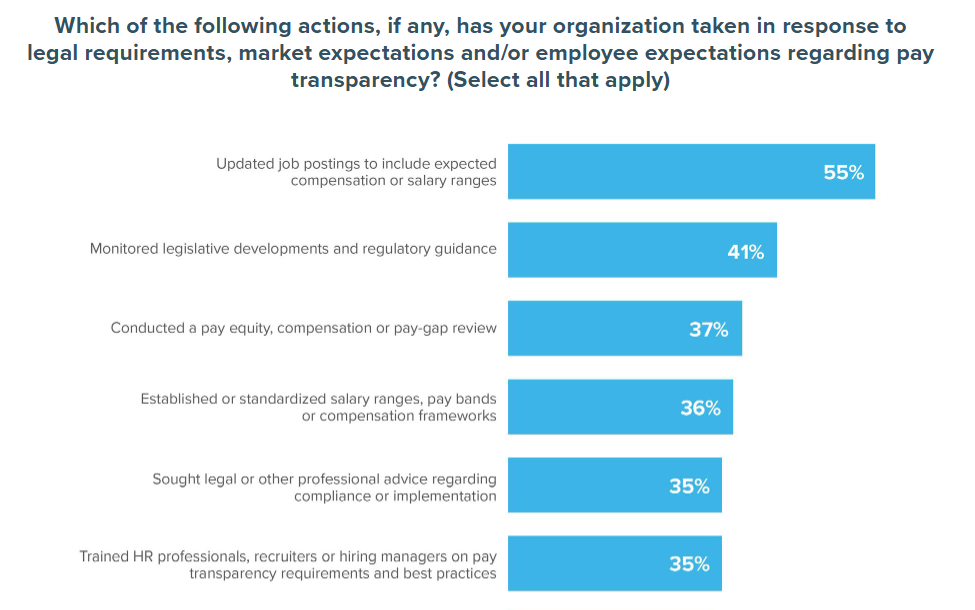
More than half of respondents (55 per cent) have updated job postings to address pay transparency, while 37 per cent have done pay equity, compensation or pay-gap reviews.
With Ontario requiring certain employers to disclose in public job postings when they use AI to screen, assess or select applicants, 30 per cent of respondents have updated job postings to include AI-use disclosures. Smaller shares have trained HR staff or hiring managers (28 per cent), reviewed vendor tools (27 per cent) or updated hiring policies (26 per cent).
Twenty-nine per cent said the requirements don’t apply because they don’t use AI in hiring. Littler cautioned that some of those organizations may be using AI without realizing it, because the technology is often built into existing HR software.
On legislation addressing forced labour, child labour and human rights risks, 48 per cent have developed or updated policies, codes of conduct, contract provisions or governance processes. Only 29 per cent have done risk assessments or mapped their operations or supply chains, the survey found.
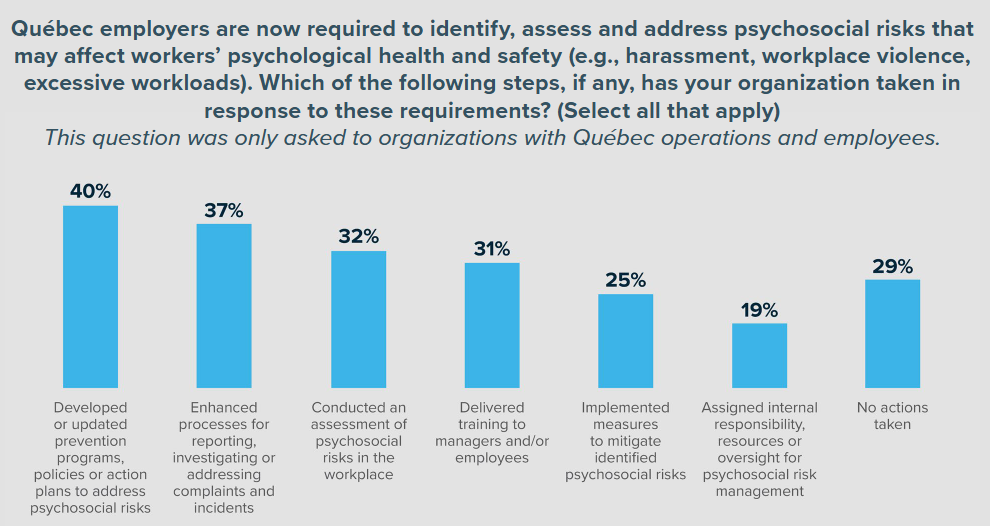
Just 40 per cent of Quebec employers have developed or updated prevention programs, policies or action plans to meet new requirements for managing psychosocial risks such as harassment, workplace violence and excessive workloads. Twenty-nine per cent haven’t taken any steps.
Return-to-office and accommodation
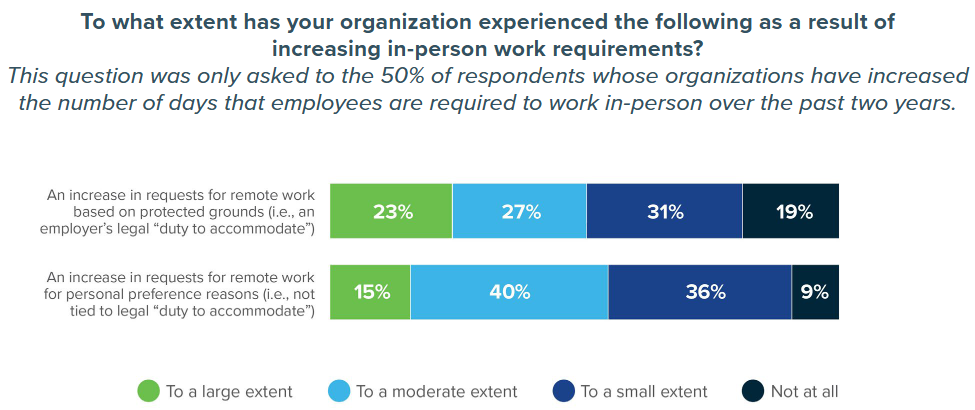
Flexible and hybrid work remains widespread, with 70 per cent of respondents taking a hybrid or variable approach to on-site work, the report found. Still, half have increased required in-office days over the past two years.
Among those employers, 81 per cent reported more remote-work requests based on protected grounds under human rights law, which can trigger a legal duty to accommodate. Ninety-one per cent reported more requests based on personal preference.
Separately, 59 per cent of all respondents reported more requests for leaves or accommodations related to mental health, and 51 per cent saw more requests tied to family or caregiving responsibilities, according to Littler.
AI reshaping jobs as governance lags
The survey suggests AI is changing how Canadian employers handle jobs and hiring. According to the report, 44 per cent of respondents have reassessed job responsibilities (30 per cent) or are doing so (14 per cent) because of actual or expected increases in AI use.
Nearly one-quarter (22 per cent) have reduced hiring or are in the process of doing so (14 per cent) because of AI. One-third have made AI-related workforce reductions (22 per cent) or are in the process of making them (11 per cent).
Formal oversight has not kept pace, Littler found. Fewer than half of respondents reported having a formal workplace AI policy (49 per cent) or a formal review or approval process for AI tools (42 per cent). Fewer still restrict what information employees can enter into AI tools (40 per cent) or provide training on approved AI applications (38 per cent). About three in 10 have a designated person (32 per cent) or committee (31 per cent) responsible for AI oversight.
“There’s still a gap between how much employers are talking about AI and how far many have gone in governing its use,” said Monty Verlint, a Littler partner in Toronto. He said employers need to understand where AI is being used and put policies and oversight in place “rather than waiting for regulation to force the issue.”
Challenges with union activity
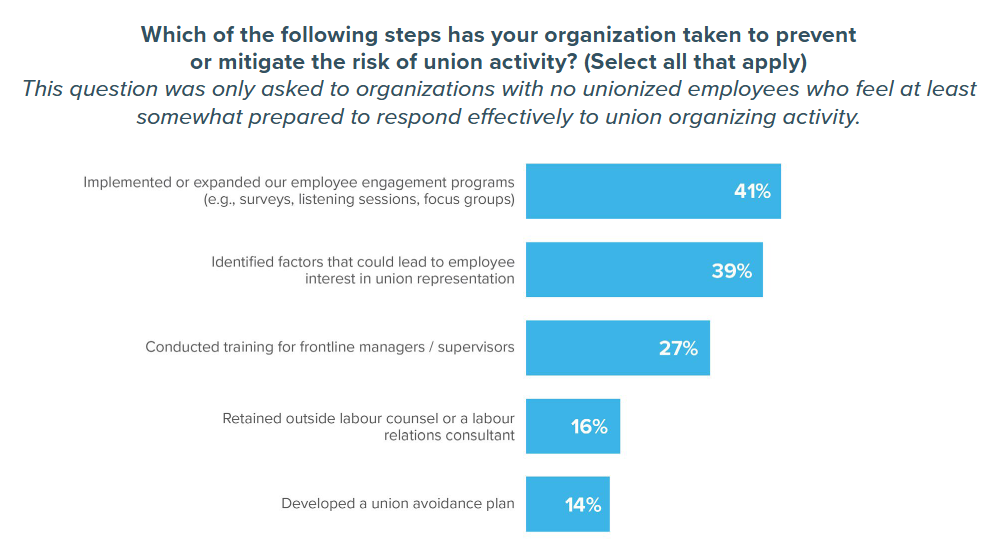
Unionized employers were fairly confident in their ability to handle escalated bargaining tactics such as strikes and walkouts, with 81 per cent saying they are very or moderately prepared, the survey found. Non-unionized employers were far less certain. Just 29 per cent described themselves as very or moderately prepared to respond to union organizing, and 41 per cent said they are not prepared at all.
Asked what might drive employee interest in unionizing, besides pay and benefits, respondents most often cited job security (47 per cent) and work-life balance (45 per cent), followed by economic pressures (41 per cent). Eighteen per cent pointed to AI integration.
A luxury Vancouver hotel that promised to “keep the status quo” and fix worker concerns “by next week” was ordered unionized, after a labour board found the employer’s scramble to offer wage hikes, bonuses and better conditions amounted to unlawful union interference.