Lola Obomighie, VP of people and culture, outlines best practices for trauma-sensitive HR in high-stakes situations
If organizations expect employees to bring their whole selves to work, that sometimes includes their trauma.
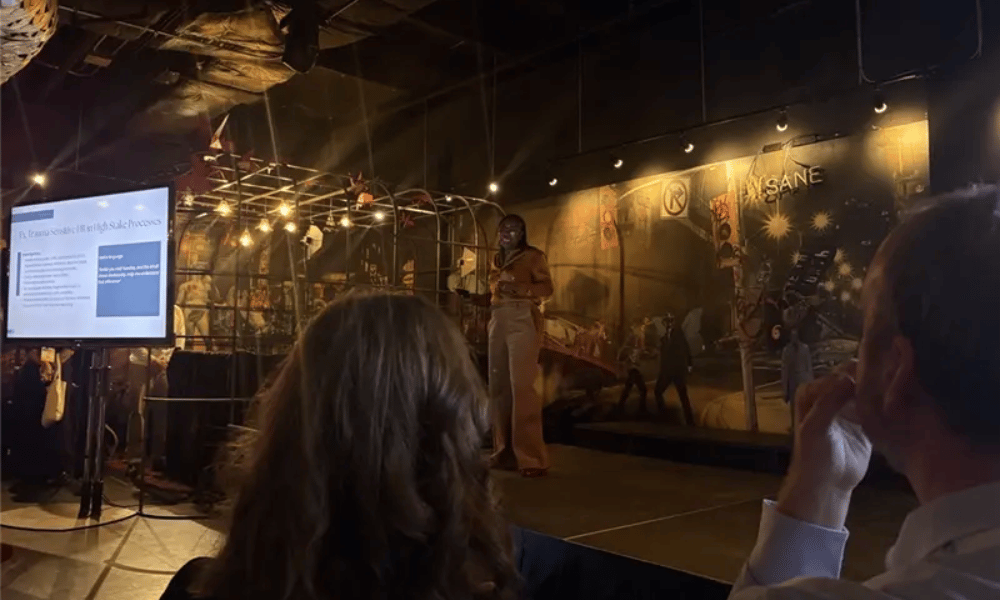
That is what Lola Obomighie, vice-president of people, culture and organizational effectiveness at Northumberland Hills Hospital (NHH) in Cobourg, Ont., highlighted at HRFest Canada
“I hear it all the time. ‘Bring your whole selves to work,’ and then we judge them when they come with their whole selves,” she says. Trauma can show up in many ways in the workplace.
“Sometimes it’s presenteeism — people coming to work, but the productivity is low. People who used to be engaged are no longer engaged,” Obomighie says.
Employees can experience trauma from many different things — from personal life circumstances such as carrying grief and caregiver burden, to workplace experiences such as discrimination, surviving layoffs and restructuring.
That is why, she says, HR professionals who are meant to give advice and support need to take a trauma-sensitive approach.
“It means that as we do our jobs, we’re mindful. We want to reduce avoidable harm. We don’t want to add to people’s stress. We want to make sure that we maintain fairness, uphold accountability. While we are doing that, we want to meet our legal and organizational obligations,” she says.
Obomighie led the session Trauma-Sensitive HR: Leading When People Are Not Okay at Rebel on Nov. 11.
What trauma-sensitive HR is not
However, trauma-sensitive HR should not be mistaken for therapy or for replacing professional medical or psychological support, Obomighie says.
“How many of us have felt as HR professionals — ‘You just need a couch, you need a light, and I will charge you per hour. And for repeats, maybe we’ll knock off a little bit of discount,’” she says. “That’s not what it is.”
It is also not about avoiding those hard conversations in the workplace or promising full confidentiality to employees when it cannot be promised, she says.
“It’s not lowering the standards. I do want to emphasize that very strongly,”.
What it does mean, Obomighie says, is recognizing that HR professionals are not always removed from the very trauma they are helping others through
“There’s sometimes a tension when we ourselves are expected to provide advice when we ourselves are impacted by the decisions or by trauma or by the things that take up space in our hearts,” she says.
The SAFE HR framework
The framework Obomighie recommends — one she says she learned early in her career doing day-to-day HR support — is called SAFE HR.
It focuses on four main aspects:
-
Stabilize — Before the meeting even starts, explain what the meeting is for, who is in the room and why they are there, and what will happen next.
-
Attune — Be fully present and emotionally aware. As a professional you might run this process a hundred times, but this person has not.
-
Frame — Be crystal clear about the process. Tell them what is happening, why it is happening, what the steps are, what is still unknown, and what their input is needed for.
-
Enable voice — Give employees a chance to add their input, have a say in the process and feel supported — whether that is around timing, representation or having someone present with them.
What feels routine to HR professionals, Obomighie says, is anything but routine for the employee going through it.
“We cannot assume that because the process is familiar to us, people are aware of the conversations we’re having,” she says.
That means understanding that employees might get caught off guard when called into a meeting — or feel defensive if an investigation is happening and a another colleague shows up unexpectedly to ask questions. Part of that defensiveness, she says, can simply be the anxiety of the moment.
“A lot of times, we pull them off the floor, pull them off the shift, sit them down in a room and ask them a question, and they don’t even understand why they’re there. We wonder why they’re being defensive,” she says. “If we were to flip the tables around and we sat ourselves on the other side of the desk, we will be defensive.”
Applying the framework in high-stakes situations
In an investigation, Obomighie says HR can sometimes act like “lie detector tests in the workplace”.
“They say, ‘Belinda couldn’t come up with an example and she seemed guilty,’” she says.
Part of applying the framework, she says, starts with attuning — checking one’s own biases.
“We’re jaded. We deal with this all the time. We’ve seen it 100 times. This is the 101st time. But that pausing and saying, ‘Will this stand up to scrutiny?’” she says.
The key, Obomighie says, is to keep questions neutral and reframed.
“‘Earlier you said Tuesday and the email shows Wednesday. Help me understand the difference?’ Which sounds better than ‘You’re lying? Which I know we don’t do,'" she says.
In situations where restructuring is happening and an employee’s role is affected, the framework would start with stabilizing — being clear about what has and has not been decided yet, Obomighie says.
“How do we let them walk away with a clear and crisp understanding of the process and timelines? ‘The decision regarding the role is final. Transition arrangements and redeployment options are still being reviewed,’” she says.
Attuning in that moment also means recognizing the personal circumstances an employee may be carrying into that conversation — such as being a caregiver or from a single-income family, she says.
“‘What kind of trauma is Lola bringing to that conversation? How can I, as an HR professional, not exacerbate the trauma, visible or invisible?’” she says.
Reflective practice
An important aspect Obomighie says every HR leader should take away from the framework is keeping a reflective practice.
“We need to take a step back and say, ‘How did Lola lead and support that meeting?’” she says. “Is there anything I could have done differently or better? How could I have shown up differently? Was I more impatient?”