
‘It’s easy to lose sight of the lived reality for individuals that have to navigate the system,' says academic and co-author of new report

"This is a framework that is underapplied across not only skills training and policy decisions overall, but just in society in general.”
So says Nathaniel Barr, professor of creativity and senior advisor, innovation at Sheridan College, speaking to Canadian HR Reporter about a new report on Canada's apprenticeship crisis.
"We often build systems and ecosystems focusing on the externalities and the realities that we face as business leaders, policymakers, and all the rest. But it's easy to lose sight across that journey on what the lived reality is for the individuals that have to navigate this system."
Are We Ready to Build Canada? A Behavioural Analysis of Canada's Construction Talent Pipeline and Skills Training Policy is an independent report prepared for the Residential Construction Council of Ontario (RESCON) and released June 18. It argues that Canada's persistent apprenticeship crisis is not primarily a funding problem — it is a design problem because the system has been built around economic assumptions about human behaviour that the evidence does not support.
“Only as we see [these systems] operate over time do we start to see where maybe there’s an incongruence with what’s been built and what’s required for your average person to navigate easily,” says Barr.
The report was co-authored by Michael McNamara, professor of creativity and director of the Community Ideas Factory at Sheridan, and James Stewart, economist and senior fellow at the C.D. Howe Institute.
Low completion rates challenge Canada
Canada's apprenticeship completion rate has been stuck at roughly 20 per cent of registrations since 2013, despite strong demand for skilled labour, the report states. Skill shortages are estimated to have caused GDP to be $2.6 billion lower in 2024 alone, and to have contributed about seven per cent of Canada's growing labour productivity gap with the United States since 2014.
The federal government in 2026 projected excess demand of over 1.4 million skilled trades workers versus supply by 2033.
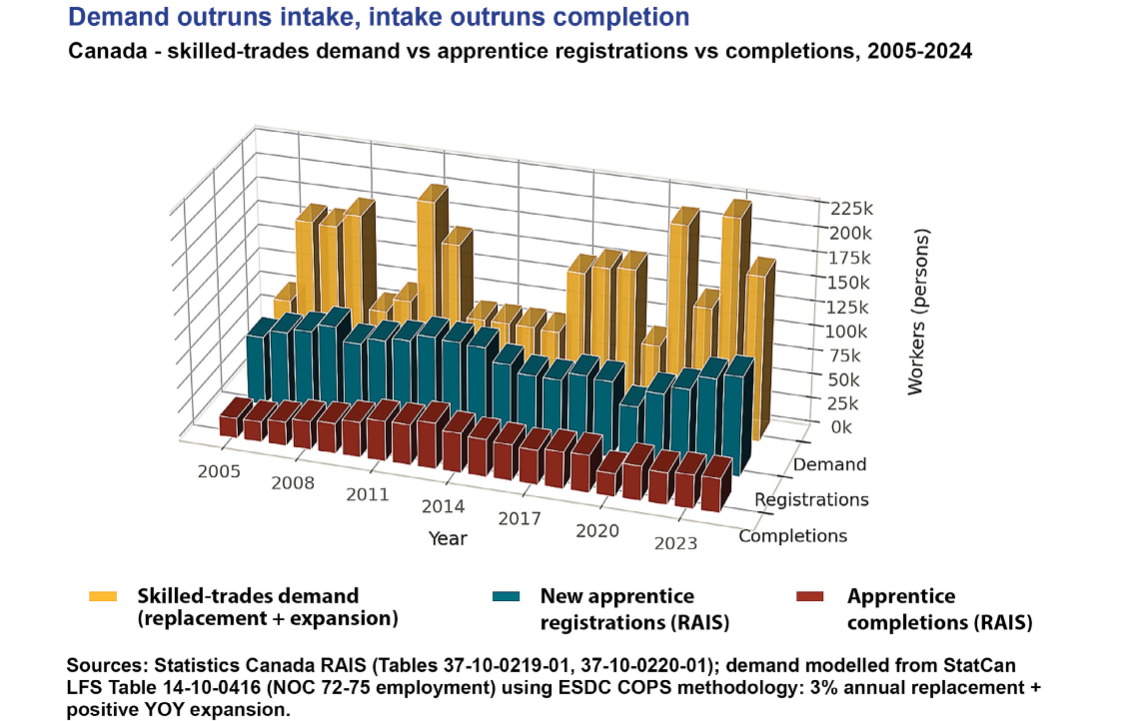
Yet Canadian training policy has long relied on the same tools — subsidies, tax credits, and awareness campaigns — built on the assumption that people, given enough opportunity, information, and incentive, will make sound decisions and follow through on them, the report argues: "The evidence says otherwise.”
Behavioural science — the study of cognitive constraints, social pressures, and structural frictions that shape human decisions — starts from the premise that people are not the rational, information-processing agents that training policy tends to assume, the report states. Rather, people are "boundedly rational": decisions are shaped by limits of time, attention, cognitive energy, and available information.
"Canada needs to overhaul its system from one that merely provides opportunities to one that actively facilitates meaningful usage and completion," the report states. "The missing ingredient is an understanding of why people behave as they do."
Barriers include too much choice, finances
Several specific barriers recur throughout the apprenticeship journey, according to the report.
Choice overload is among the most significant. Ontario alone has 144 designated trades across seven distinct construction sectors, each with different certification requirements, employer structures, union arrangements, and working conditions, the report states.
It’s taxing for people to make these important decisions, according to Barr.
"Right off the hop, when considering a path in the skilled trades, there's immense psychological challenge in winnowing down that choice set to something manageable," he says. "There's not a clear roadmap laid out for people."
Loss aversion — the tendency to weigh potential losses more heavily than equivalent gains — discourages both new and mid-career entrants from committing to multi-year training programs, the report also states. In voluntary trades, apprentices can often reach near-full wages before earning formal certification, making early exit feel financially rational.
"The rational move, from the apprentice's perspective, frequently points toward stopping before completion," the report states.
Present bias — the tendency to overweight immediate costs relative to future rewards — compounds this further. When apprentices attend mandatory in-school training blocks, they lose employment income. For those managing family obligations and fixed financial commitments, that short-term cost is acute, and the distant credential struggles to offset it, the report states.
Social norms add another layer. For decades, the cultural weight in Canada has sat firmly on the side of post-secondary academic credentials, with the trades treated as a fallback rather than a first choice.
"If your family is not familiar with these pathways, not only will they not be able to help you navigate this, not only will they not be able to help you navigate this, perhaps they won't be in a position to give you tactical advice on who you need to talk to and where to go," Barr says.
Financial precarity intensifies all of these barriers, he says.
“Not only is this a large, unwieldy, complex system that requires knowing the right people — a lot of people are under stress and pressure, and all of those things compound to make this a journey that requires a real centering of the individual trying to navigate it if we hope to reach our national goals.”
Mid-career workers and retirees
The report flags two additional challenges the system is poorly designed to handle.
Mid-career workers displaced by AI-driven disruption or US tariff shocks represent a growing potential source of skilled trades entrants, the report states, noting that AI is displacing entry-level work in many sectors while construction demand is rising. But the psychological and financial cost of trading an established professional identity for a new one is high — and the system was not designed to receive this group.
"Their loss aversion is higher as the stakes of getting it wrong are greater when one has dependants, a mortgage, and an established professional identity to surrender," the report states.
On the other end of the career spectrum, roughly 700,000 skilled trades workers across Canada are expected to retire by 2028, removing decades of accumulated knowledge that cannot easily be taught in a classroom, according to the report. That knowledge transfer challenge was not built into the training pipeline's design.
Three ways to redesign apprenticeships
Barr outlined three broad categories of change the report recommends.
The first is systems-level redesign. "We have to imagine from the beginning the blueprint again," he says. Federal investment creates a timely opportunity for governments, unions, colleges, and employers to coordinate on what structural changes are needed — potentially reaching as far back as elementary school.
"That's that big systems redesign level stuff that takes time, concerted political energy, and money," he says.
The second is embedding behavioural insights throughout programs to reduce friction at each stage — what the report calls rethinking "choice architecture."
"How do we build choice environments for people where they can benefit from the way it's designed rather than have to fight against it?" says Barr.
The third, and perhaps the most neglected, he says, is a genuine commitment to testing what actually works.
"Absent a broad commitment to testing, iterating, and continually innovating across the entirety of the system, we won't know until it's often years down the line whether these investments are mapping to the outcomes we hoped," he said.
The history of skills training policy is "littered with programs that were designed with good intentions, implemented at scale, and never rigorously evaluated," the report states.
Barr is careful to frame the behavioural lens as complementary to, not a replacement for, other approaches.
"We see it as a good system that can be further optimized rather than a completely failed system," he says. “[Behavioural science is] perhaps best used as a lens through which to view the problems and which you can use as a foothold to think about solutions.”
Looking abroad — but not copying blindly
Other countries offer useful models. The report points to Germany as one example worth studying, where apprentices are more fully incorporated into the broader work environment and many more remain with their training employer for the duration of their careers than in Canada.
But simply transplanting these models to Canada would miss the point, Barr says.
"This raises the importance of this behavioural or psychological lens, because we want to take the best ideas from these other jurisdictions and think about how we meet that moment within the Canadian context. We have unique demographics and psychological and all sorts of unique elements of what it means to work within these trades in the Canadian context.
“So, we need to think about those, and we can take the best from other countries and try and adapt them and build them to reflect the people and systems within Canada."
The broader international trend points toward growing confidence in the behavioural approach, he says.
"When you look globally across all sorts of skills training and other sorts of public policy areas, we see this continual growth in the sphere of influence that behavioural science has come to have, because it has been so successful in driving the sort of outcomes that governments and businesses want to see.”
HR's role: beyond hiring to belonging
For HR and employers, there is an important role to play, according to Barr.
"How can employers and HR professionals work with skills training providers to ensure a tight fit, such that the on-the-job training, the classroom training — be it from colleges or unions — all of that adds up to what employers really need?" he says. "Are we training people on the right things, and then in turn, are we selecting them in a way that's conducive to getting the best product and best people in the right places?"
But selection is only part of the equation, Barr notes, in emphasizing retention, belonging and identity.
"Finding ways to make the work sites more welcoming and to ensure that diverse voices and groups are welcomed and given a chance to learn on the job and through their apprenticeship — all that is crucially important."



