Find out how job architecture helps organizations define roles, align compensation, and build scalable career frameworks

- HR's role in job architecture
- What’s the difference between job design and job architecture?
- Key components of an effective job architecture framework
- How job architecture supports career pathing and development
- Common challenges in job architecture and how HR can solve them
- Tools and technologies that support job architecture
- Why job architecture matters
Every organization, regardless of size, could benefit from a job architecture exercise. It could uncover some surprises. Case in point: banking giant BNY Mellon. During a job architecture exercise, it discovered that there were seven to 15 job titles for what was essentially the same role.
Job architecture can help streamline and define roles, providing clarity and focus for your people. In this article, we’ll discuss what job architecture is, what its key components are, and how it can benefit your workforce.
HR’s role in job architecture
As an HR professional, you’re at the heart of job architecture. Your role goes beyond implementation – you're the steward of a system that shapes your organization’s culture.
This means that you will be leading on these areas:
Governance and ownership
HR typically leads the design and governance of job architecture, often in partnership with Compensation/Total Rewards and business leaders. Clear ownership ensures accountability and keeps the framework aligned with business strategy.
Change management
Introducing or updating job architecture requires careful change management. You’ll need to communicate the benefits, address concerns, and provide training to managers and employees.
Ongoing reviews and updates
Job architecture isn’t a one-time project. HR takes the lead on reviewing and updating the framework to reflect new roles, skills, and business priorities.
Equity and transparency
With increasing focus on pay equity and diversity in Canada, HR’s role in maintaining a fair, transparent job architecture is more important than ever. Your efforts directly impact employee trust, engagement, and retention.
What’s the difference between job design and job architecture?
These terms sound similar, and some HR professionals tend to use one to mean the other. But job design and job architecture are different.
Job design focuses on the content and structure of individual roles:
- what tasks are performed
- how they’re done
- what skills are required
Job architecture operates at a higher level. It’s the framework that groups jobs into families, levels, and career paths.
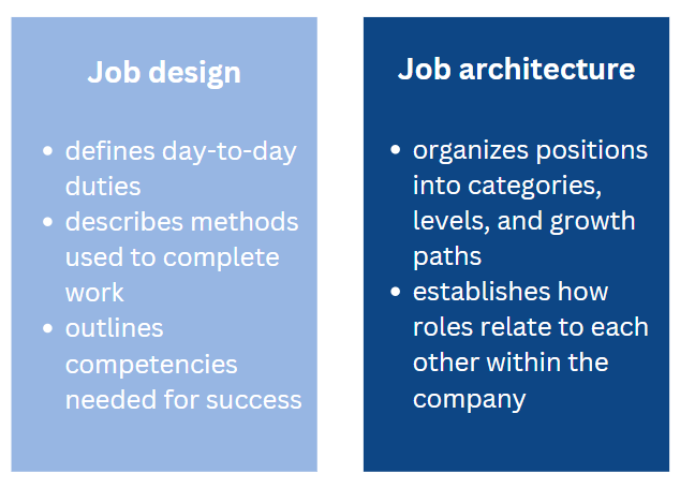
You can think of job design as the details that go into a specific role, while job architecture is all about the bigger picture. It shows how all roles across the organization work together to deliver common business goals.
Why is job architecture important? Here’s why it matters:
-
Job architecture standardizes titles, responsibilities, and compensation, reducing confusion and preventing pay discrepancies
-
Employees understand where they fit, what’s expected, and how they can progress
-
Having job architecture ensures that your talent strategy supports business goals, making it easier to adapt to change
-
With pay equity legislation and transparency expectations rising in Canada, a clear framework helps you stay compliant and competitive
For Canadian HR teams, job architecture isn’t a luxury. It’s a requirement to stay compliant and attract top talent in a competitive market.
Key components of an effective job architecture framework
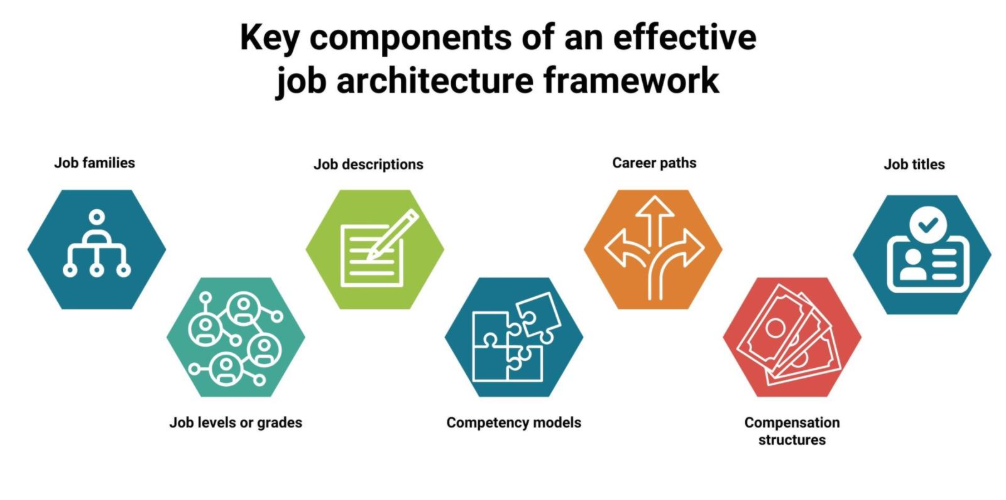
A robust job architecture framework isn’t a static document; it’s a living system that brings structure to your organization. Here are the essential components:
1. Job families
Job families group similar roles based on function or expertise. Think marketing, finance, engineering, or customer service. This grouping makes it easier to manage talent, benchmark compensation, and design career paths.
2. Job levels or grades
Within each family, job levels define the scope, responsibility, and complexity of roles. There's entry level, intermediate, senior, and lead, for example. Clear levels help you differentiate roles, set pay bands, and outline progression criteria.
3. Job descriptions
A well-crafted job description summarizes the purpose, key responsibilities, required qualifications, and core competencies for each role. In a strong job architecture, these are standardized and regularly updated.
Job descriptions are an important element in recruitment. Writing unclear job descriptions is one of the biggest hiring mistakes, according to Robert Half.
4. Competency models
Competencies are the skills, expertise, and behaviours that employers expect from their employees. Competency models link roles to performance expectations, supporting development and succession planning.
But it’s no longer about competency alone. New research shows that character beats competence, especially when it comes to leadership.
5. Career paths
Career paths map out how employees can move vertically (promotion) or horizontally (lateral moves) within or across job families. This leads to better engagement and creates more internal opportunities for your people.
6. Compensation structures
Pay bands or salary ranges are aligned with job levels and market benchmarks. This ensures fair, competitive compensation and supports pay equity initiatives.
7. Job codes and titles
Standardized naming and classification systems bring order to your job catalog. For example, giving the same job function different titles - marketing assistant in one location, marketing associate in another – can lead to confusion.
Having consistent job descriptions and titles makes it easier to manage roles across locations and business units.
How job architecture supports career pathing and development
One of the most powerful benefits of job architecture is its impact on career pathing and employee development. When your structure is clear and transparent, you create a roadmap for growth that benefits both your people and your organization.
Here are some ways job architecture helps in this area:
Clarity for employees
Employees want to know how they can advance. Job architecture shows them the steps: what skills they need, what roles are available, and how to get there.
Studies show that employees are more engaged and motivated if their employers invest in their career development. If there are clear ways for them to progress within the organization, they are more likely to stay.
Support for managers
Managers can use job architecture to have meaningful development conversations. With clear competencies and career paths, they can help employees set goals, identify skill gaps, and pursue targeted learning opportunities.
Internal promotion and lateral moves
A well-designed framework makes it easy to move talent across functions or locations. This is especially valuable in Canada’s competitive talent market. Internal mobility can reduce overall turnover, minimizing disruptions in operations.
Succession planning
Job architecture and succession planning go hand in hand. Job architecture lays the foundation for developing high-potential employees, getting them ready for future leadership roles. By mapping competencies and career paths, you can build succession plans and create opportunities for your rising stars.
This is even more important in light of reports of poor succession planning among Canadian employers.
Common challenges in job architecture and how HR can solve them
Implementing and maintaining job architecture isn’t without its issues. Here are some common challenges and how you can address them:
-
Inconsistent job titles and descriptions: When different departments create their own titles or descriptions, confusion and inequity follow
Solution: Centralize the process. Use standardized templates and involve HR, managers, and compensation experts in regular reviews
-
Pay equity and transparency: With new pay equity laws in Canada, inconsistencies can lead to compliance risks and employee distrust
Solution: Centralize the process. Use standardized templates and involve HR, managers, and compensation experts in regular reviews
-
Resistance to change: Managers and employees may be attached to legacy titles or unclear about the benefits of job architecture
Solution: Communicate the reasons behind the changes. Provide training and resources to help everyone understand the new framework
-
Keeping the framework current: Business needs change, and static frameworks quickly become outdated
Solution: Treat job architecture as a living system. Schedule regular reviews, gather feedback, and update roles as your organization grows
-
Governance and ownership: Who maintains the job catalog? Who approves changes? This was a common question we saw on Reddit discussion boards about job architecture
Solution: Assign clear ownership. Often, it’s Compensation/Total Rewards for the framework, with HR teams or managers responsible for job descriptions. Document processes and roles to avoid confusion
Tools and technologies that support job architecture
Modern HR teams have a wealth of tools to help design, implement, and maintain job architecture. Here’s what you should consider:
-
Human Resource Information Systems (HRIS): Most Canadian organizations use an HRIS to manage job data, titles, and compensation structures. Look for systems that support job families, levels, and competency mapping
-
compensation management tools: These tools help align pay bands with job levels and market data, supporting pay equity and transparency initiatives
-
analytics and reporting: Data-driven insights are essential for monitoring the effectiveness of your job architecture. Use analytics to track internal mobility, pay equity, and workforce planning metrics
If your organization is doing job architecture for the first time, it doesn’t hurt to bring in the experts. Consultancies like TalentGuard, Korn Ferry, and Mercer can guide you with their expertise.
Meanwhile, for a listing of the top HR tools in Canada, read our report on the best HR software providers.
Why job architecture matters
Job architecture is a structured framework that helps organize and define roles within your company. It maps out how each role functions in relation to other teams and the wider organization. This leads to an efficient workforce where everyone knows their functions and goals, with a clear pathway to career progression.
This is a living system, not a one-off activity. As the workplace evolves – with AI, remote working, and other innovations – roles change, too. An employee’s place in the organization changes. And that’s why job architecture is an important aspect of every organization’s evolution.
Visit and bookmark our staffing and recruitment page for expert insights on building and maintaining a strong workforce.