At HRFest Canada, UKG, Queen’s and OPG leaders say headcount is out and business strategy is in
For many organizations, workforce planning has traditionally meant deciding how many people are needed and when. But in a constantly changing environment, that may no longer be enough.
Matthew Bragstad, head of AI strategy and commercialization at UKG, says organizations have been doing workforce planning for decades — better models, better training, better data — yet here they are, still having the same conversation.
“I’m reminded of Mike Tyson — everyone has a plan until they’re punched in the face. And most organizations I talk to feel like they’re getting punched in the face, like, every day right now,” he says.
The problem is not always the planning — it is that organizations are planning for a world that no longer exists by the time the plan is finished.
“We build up this 18-month cycle of planning, and we get six months into it and realize we might as well start again because the world has changed dramatically,” Bragstad says. We have to stop planning for the future workforce of what they are and instead start thinking about what a resilient, adaptable workforce looks like.”
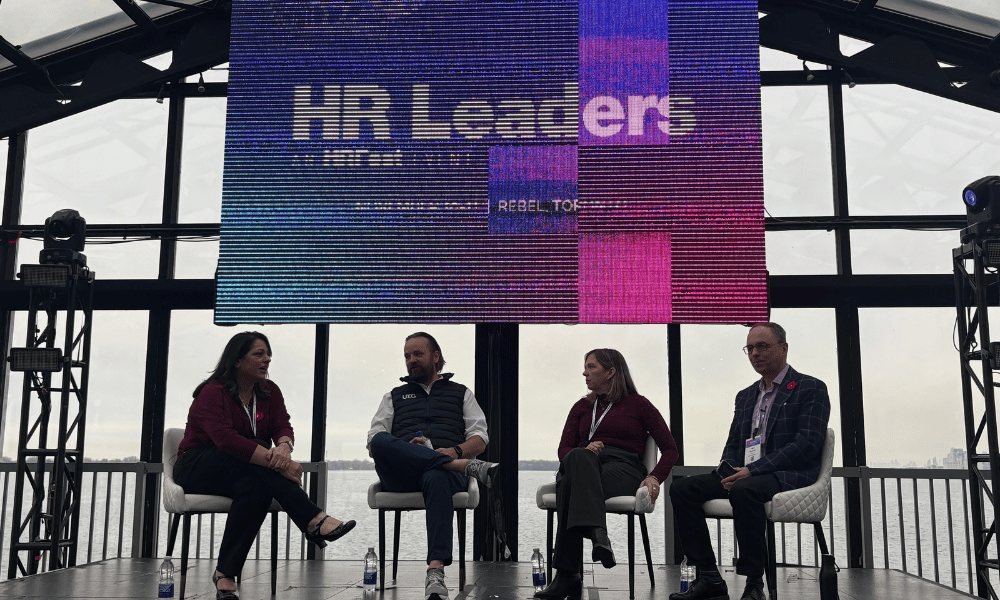
It is a sentiment that resonated across a panel at HRFest Canada, where Bragstad joined Wylie Burke, adjunct professor at Queen’s University and Queen’s IRC, and Cynthia Domjancic, senior vice-president of human resources at Ontario Power Generation (OPG), to discuss what strategic workforce planning needs to look like now.
The session, “Workforce Planning and Leadership Pipelines that Don’t Break Under Pressure,” was moderated by Vince Molinaro, founder and chief executive officer of Leadership Contract Inc., and held Nov. 11 at Rebel in Toronto.
Workforce planning as business strategy
At Ontario Power Generation, with a workforce of 11,000 people and operations across 66 hydroelectric stations and two nuclear stations, workforce planning is treated as a business strategy, Domjancic says.
Rather than leaving it to the CHRO to solve alone, the focus has been on how the organization fits within a broader ecosystem, she says.
“We have very deep partnerships with our building construction trade unions, with a lot of colleges and universities that we have strategic partnerships with. We inform their programs and guide enrollment volumes so that we can get the right graduates,” Domjancic says. “We look very forward to that supply being able to match demand because it’s not going to help us to have an oversupply and then a gap in the areas where we actually need people.”
She says OPG looks at the next five, 10 and 15 years — tracking how technology will shift the skills required — to plan for capabilities rather than just headcount. That means identifying which roles are most critical to the business and ensuring enough people are ready to step into them.
Business leaders own those pipelines and are held accountable through quarterly reviews and key performance indicators (KPIs) tracked all the way up to the executive level.
“It’s on our KPIs, on our scorecards. So, it is a very real thing,” she says.
Start with strategy, not headcount
Getting leaders to think that way, however, is not always straightforward, Burke says. Drawing on her research background and consulting work across multiple workplaces, she says one of the most common gaps is leaders not understanding what workforce planning means in today’s context.
For her, modern workforce planning must be far more strategic — starting with what the organization needs to do well over a period of time, then building a skills map from there. That also means using workforce planning as a lens into what talent already exists inside the organization.
“We need to really understand the depth and breadth of talent that we have in our organizations,” Burke says. “So, really changing the language around why are we doing this — what is the outcome that we’re actually trying to drive when we’re doing really good strategic workforce planning?”
Knowledge no longer competitive advantage
Even when organizations get the strategy right, there is a deeper shift needed in what they value in their people, Bragstad says.
Traditional workforce planning has focused heavily on knowledge and specialization — qualities organizations have rewarded for years. But with AI and large language models (LLMs) giving people the ability to learn things faster than ever, the question is whether knowledge alone is still a valuable skill, he says.
“You are going to put a lot of people — not necessarily out of work but they are going to be really struggling to find their worth,” Bragstad says.
In the workforce of the future, curiosity, optimism and critical thinking are becoming more valuable — even though they have never been specifically measured in performance reviews.
“The ability to almost be like a dog with a bone where you want to find an answer, so you’re going to keep digging, keep digging, keep digging — those types of skills are becoming really important,” he says. “The people that ask more and more critical questions and use the model to get deeper and deeper and then decide they’ve solved them, that’s what you should be rewarding.”
Those skills also determine who can move fluidly across different parts of an organization, Bragstad says.
“We have to start looking for qualitative things on what are making our employees successful,” he says. “If I’m looking at creating a workforce that doesn’t break, I want a workforce that flexes when things go wrong.”