‘Salary transparency is shaping how organizations attract and retain talent’

Salary disclosures, it seems, have become a competitive baseline rather than a legal formality for Canadian employers, based on the findings of a recent survey.
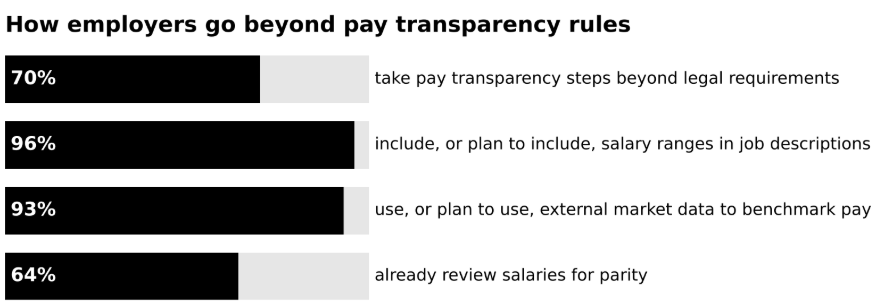
Seven in 10 Canadian employers are now taking pay transparency steps that go further than the law requires, according to Robert Half.
The finding comes as provincial pay transparency laws – rules requiring employers to disclose expected pay in public job postings or report on internal pay gaps – keep expanding. Robert Half surveyed more than 2,850 hiring managers and workers nationwide.
“Salary transparency is shaping how organizations attract and retain talent,” said Koula Vasilopoulos, senior managing director at Toronto-based Robert Half Canada.
What are employers doing beyond compliance?
That shift starts with the job posting. Nearly all hiring managers surveyed – 96 per cent – include salary ranges in job descriptions or plan to.
Robert Half also found 93 per cent of employers use, or plan to use, external market data to benchmark compensation, while 64 per cent review salaries for parity.
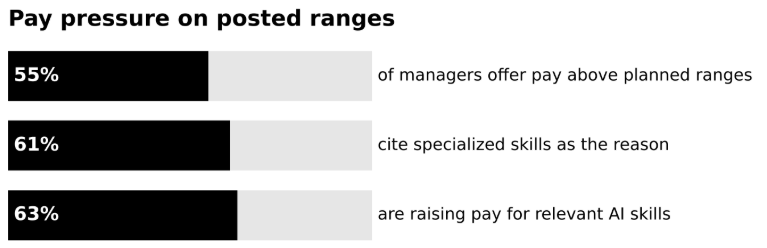
According to the survey, 55 per cent of managers are offering pay above planned ranges to land top talent, with 61 per cent citing specialized skills. Another 63 per cent are raising pay for relevant artificial intelligence (AI) skills.
“When organizations combine reliable market data with transparent compensation practices, they can make salary decisions with confidence, set clear expectations with candidates, streamline hiring decisions, and support stronger retention outcomes,” Vasilopoulos said.
Pay transparency legislation: where the rules stand
Those voluntary moves sit atop legal requirements that vary by province.
In Ontario, employers with 25 or more employees have had to include expected compensation or a range in publicly advertised job postings since Jan. 1, 2026, under the Employment Standards Act, 2000 (ESA). Under Ontario Regulation 476/24, a posted range cannot exceed $50,000 a year, and roles paying more than $200,000 are exempt.
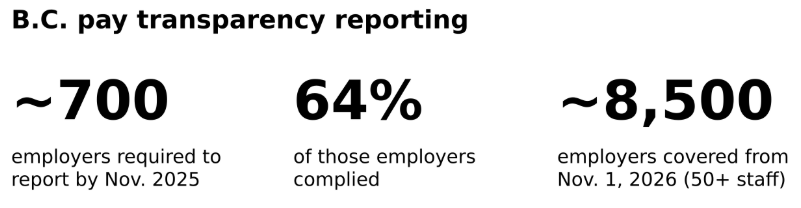
British Columbia has required pay information in public job postings since Nov. 1, 2023. As of Nov. 1, 2026, B.C. employers with 50 or more employees must also publish annual pay transparency reports – roughly 8,500 employers, the province estimates. Compliance has lagged: about 64 per cent of roughly 700 employers due to report by November 2025 complied, according to a June 2026 bulletin from B.C.’s Ministry of Finance.
Prince Edward Island and New Brunswick also require pay information in public job postings, as Canadian HR Reporter has reported in its look at whether pay transparency is closing the gender gap.