Statistics Canada's latest job vacancy data shows labour market tilting away from degree requirements toward easier-to-fill credentials

Job vacancies have hardly moved in the second quarter, holding at 510,200 nationally, according to Statistics Canada's Job Vacancy and Wage Survey, released this week. That headline number is the least interesting thing in the report.
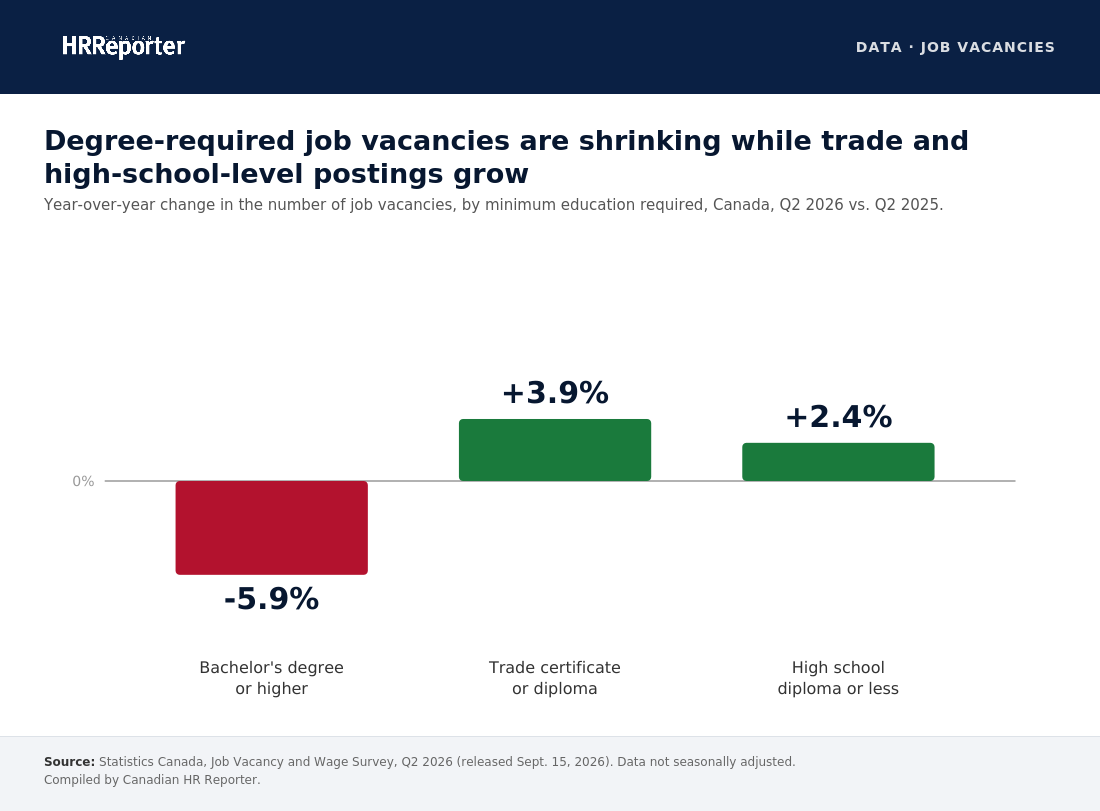
The reversal worth flagging sits in the education-level breakdown. Year over year, vacancies requiring a bachelor's degree or higher fell by 5,100, or 5.9%. Over the same period, vacancies requiring only a high school diploma or less rose by 7,000, or 2.4%, the first year-over-year increase for that category since the third quarter of 2022.
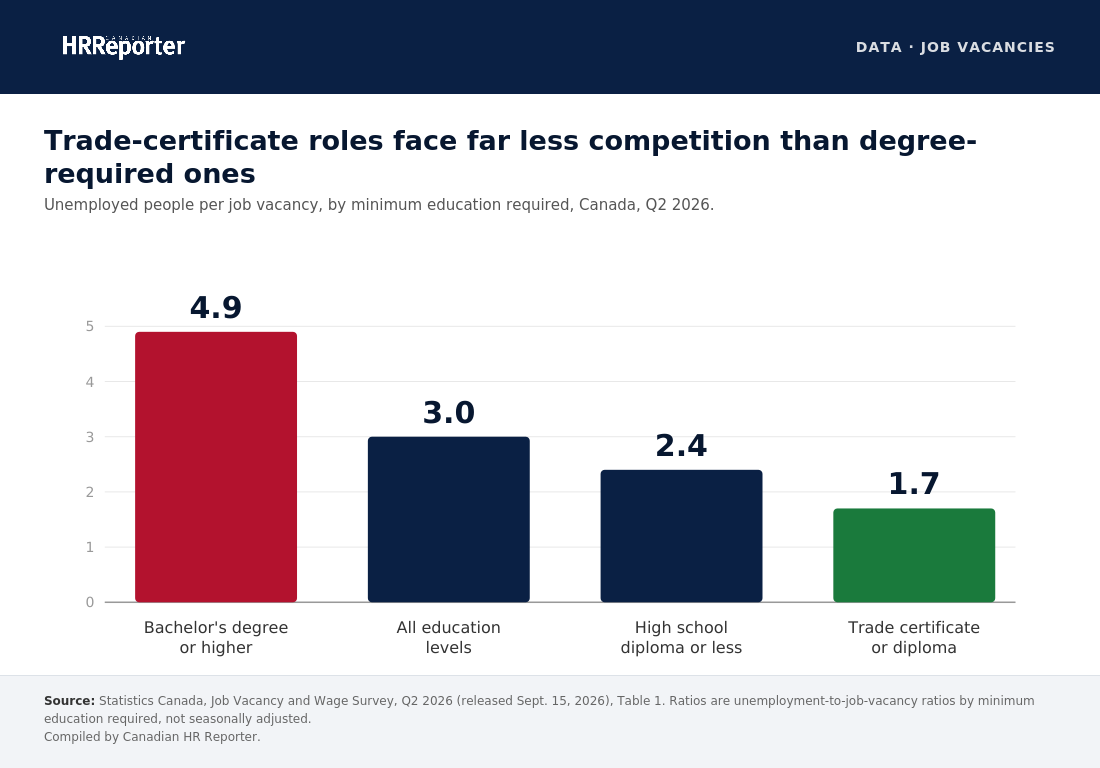
The competition numbers make the gap starker still. There were 4.9 unemployed people for every vacancy requiring a bachelor's degree or higher in the second quarter, unchanged from a year earlier. For vacancies requiring only a trade certificate or diploma, that ratio was 1.7, down from 1.8 a year ago and the lowest of any education level Statistics Canada tracks.
Vacancies requiring a high school diploma or less sat in between, at 2.4 unemployed people per opening, an improvement from 2.5 the year before.
A job seeker with a trade certificate is now competing against roughly a third as many rivals per opening as one with a bachelor's degree.
This is a reversal, not a continuation
For the past few years, the credential story in Canadian job postings has run the other way. When Statistics Canada's fourth-quarter 2025 data came out, Canadian HR Reporter noted that vacancies were holding steady even as employers continued to demand higher qualifications for open roles.
That quarter's data showed why: the share of vacancies requiring five or more years of experience hit a record 12.9%, and 16.9% of postings asked for a bachelor's degree or higher, just below the 17.7% recorded a year earlier.
The second-quarter numbers don't erase that trend, but they complicate it. Vacancies requiring a trade certificate or diploma were up 3.9% year over year, alongside the 2.4% increase for high-school-level roles.
Degree-required vacancies, meanwhile, are now shrinking rather than merely growing more slowly. Two consecutive quarters of this pattern would make it a genuine shift; one quarter is at least a reason to check your own postings against what the role actually requires.
Recruiting overall got easier
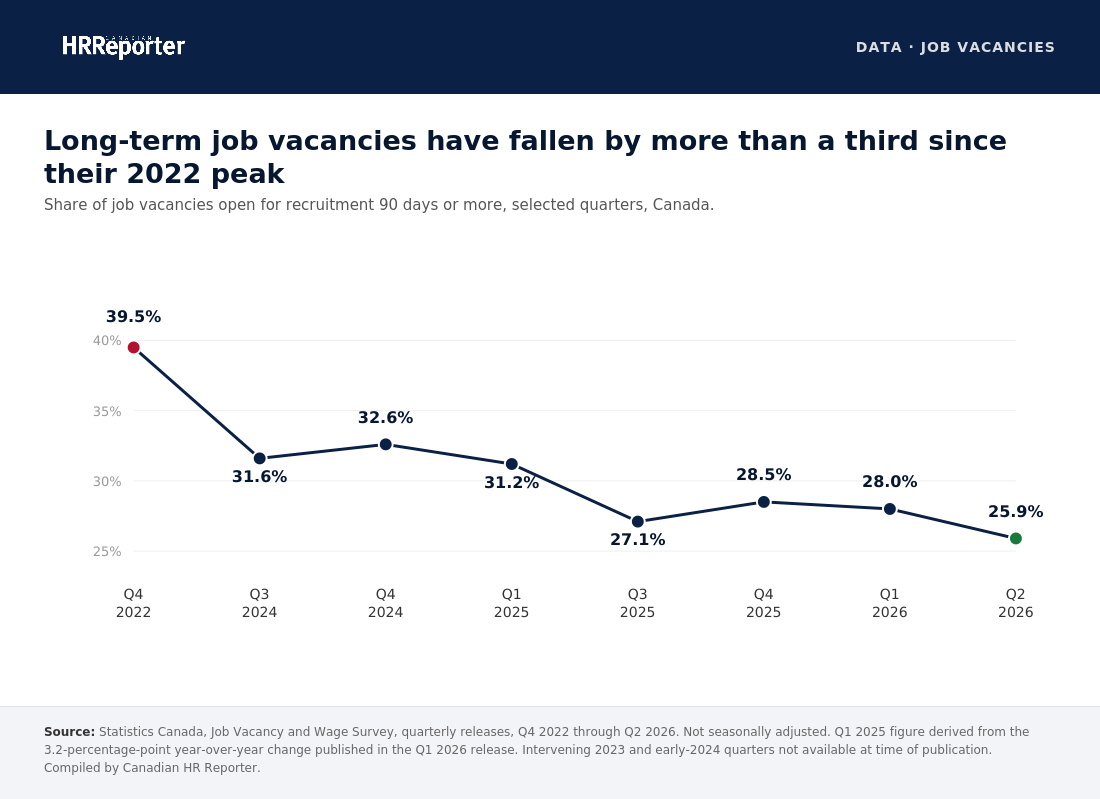
This reversal is happening against an easing labour market, not a tightening one. The share of vacancies that had gone unfilled for 90 days or more, Statistics Canada's marker for genuinely hard-to-fill roles, dropped to 25.9% in the second quarter, down from 28.0% in the first quarter and well off the 39.5% peak recorded in the fourth quarter of 2022.
Total labour demand rose 1.0% year over year over the same period.
So, employers aren't lowering the bar out of desperation. They're filling roles more easily than they have in years, and the mix of what they're posting is still shifting away from degree requirements. That looks more like a deliberate change in hiring criteria than a symptom of a market forcing employers' hands.
The wage side hasn't caught up yet
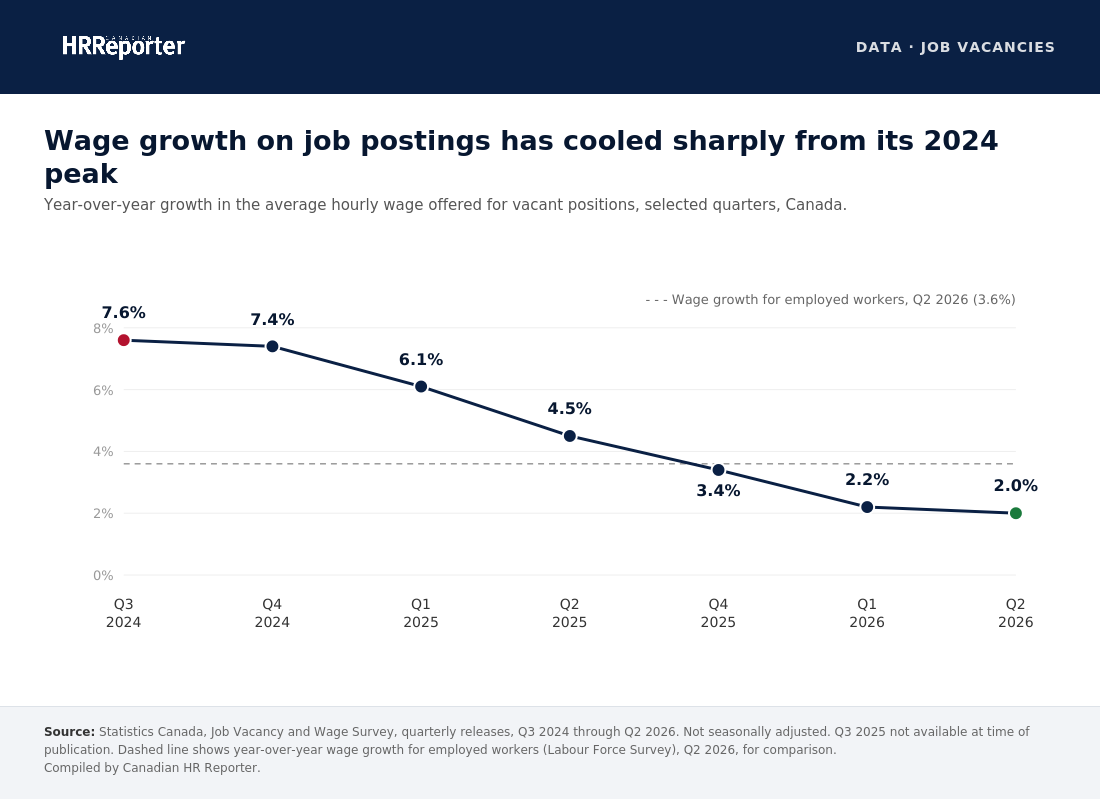
One caution before anyone rewrites a total-rewards strategy around this: the pay premium for trade and high-school-level roles hasn't shown up in the aggregate wage data yet. The average hourly wage offered on vacant positions nationally rose 2.0% year over year to $28.55 in the second quarter, decelerating from 2.2% growth in the first quarter and well down from the 7.6% peak reached in the third quarter of 2024.
That's slower than wage growth for people already employed, which the Labour Force Survey put at 3.6% over the same period.
Statistics Canada's release doesn't break out offered wage growth by education level, so there's no way yet to say whether trade and high-school-level postings are seeing better wage momentum than degree-required ones specifically. That's a gap to watch in the next release before drawing any conclusions about pay.
What this means for job postings
Three things for talent acquisition and workforce planning teams to take from this release.
Start by auditing degree requirements against what roles actually need rather than habit. If national demand for degree-required roles is shrinking while demand for trade and high-school-level roles grows, a posting that defaults to "bachelor's degree preferred" for a job that doesn't strictly need one is competing in a shrinking, more crowded pool for no operational reason.
Don't mistake easier-to-fill for lower priority. The tightest unemployment-to-vacancy ratio in the country right now is for trade-certificate-level roles, at 1.7, tighter than for degree-required roles. If your organization competes for tradespeople, that competition is real and getting tighter, not looser.
And treat one quarter as a lead, not a conclusion. The education-level breakdown isn't seasonally adjusted, so a single quarter's reversal is worth reviewing your own postings over, but not yet worth rewriting compensation bands over.
The next release, covering the third quarter, is due Dec. 15.